
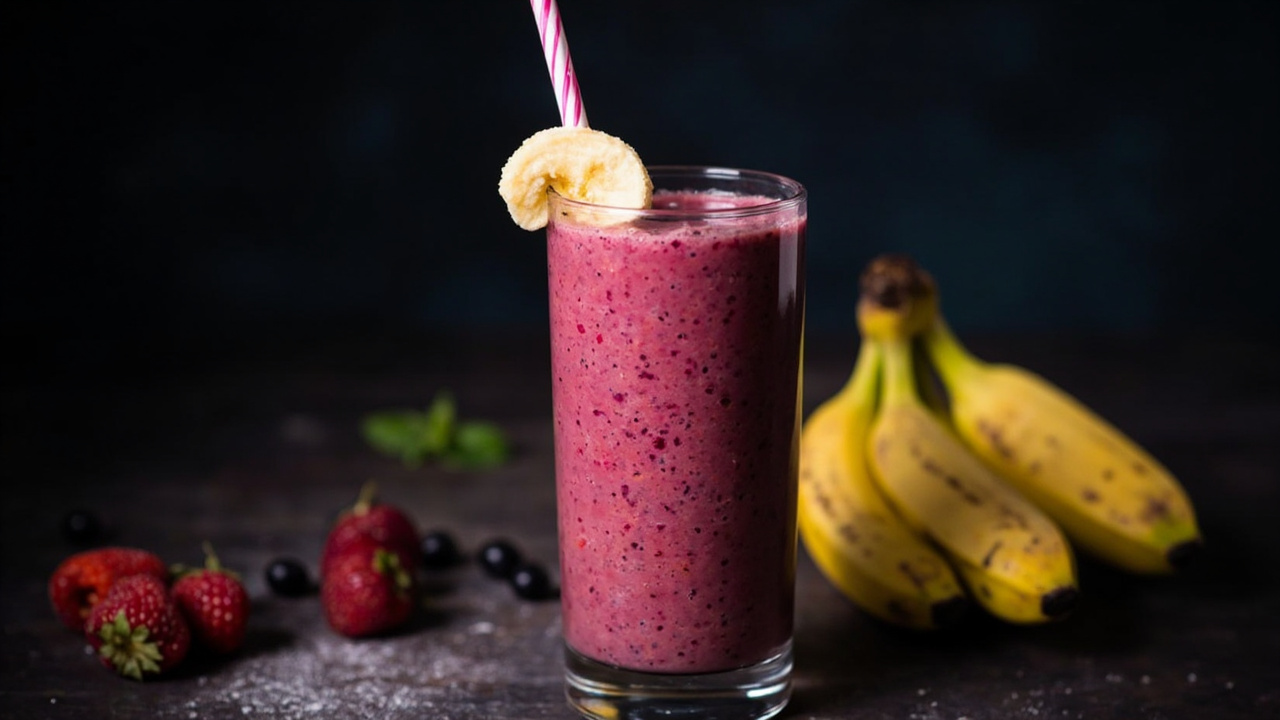
The Banana Smoothie You Think Is Healthy Might Be Doing Less Than You'd Hope
Here's a scenario you've probably lived a hundred times: You grab a banana, throw in some blueberries, maybe a handful of spinach, hit blend, and congratulate yourself on being an adulting champion. The smoothie looks amazing, tastes great, and feels incredibly nutritious. But what if I told you that one of those innocent ingredients was actually working against the others?
This isn't some dramatic exaggeration. Researchers at UC Davis actually discovered something pretty wild about the humble banana when it's mixed with other popular smoothie staples.
What's Really Happening in Your Blender
Let's talk about an enzyme you've probably seen in action without even knowing it had a name. You know that brown spot that appears when you slice an apple or peel a banana? That's caused by something called polyphenol oxidase, or PPO for short. It's the fruit's natural browning mechanism, triggered when the fruit is cut, bruised, or exposed to air.
The UC Davis team wondered: what if this same browning enzyme was doing something to the nutrients in your smoothie, not just the appearance?
The Experiment That Changed Everything
The researchers decided to test this in a pretty straightforward way. They had people drink three different drinks:
- A banana-based smoothie
- A mixed berry smoothie
- A flavanol capsule (to use as a comparison)
They then measured how many flavanols—these are plant compounds that are basically nutritional superheroes for your heart and brain—actually made it into people's bloodstreams.
The results were shocking.
Here's Where It Gets Weird
People who drank the banana smoothie had 84% lower flavanol levels compared to the control group. That's not a small difference. That's absolutely wild.
Meanwhile, the mixed berry smoothie (which has very low PPO activity) produced flavanol levels that matched the control capsule perfectly. Same healthy berries, but without the banana? Totally different result.
The lead researcher, Javier Ottaviani, was honestly as surprised as we are. He said the team was amazed at "how quickly adding a single banana decreased the level of flavanols in the smoothie and the levels of flavanol absorbed in the body."
But Wait, There's More (And It's Even Weirder)
The researchers did a second test where they kept the banana and berries from touching each other until people actually drank them. You'd think that would solve the problem, right?
Nope. The flavanol levels were still reduced. This suggests that the enzyme might continue doing its thing even after you drink the smoothie—possibly right there in your stomach. Your digestive system becomes the blender, essentially, and the same reaction happens inside your body.
So... Should You Abandon Your Banana Smoothies?
Not exactly. This is the important part, so read carefully: bananas are not bad for you. They're full of fiber, potassium, and tons of other good stuff. The issue is much more specific than that.
If your goal is to maximize the specific benefits of flavanols—which are linked to heart health and cognitive function—then yeah, bananas might actually be working against you when combined with berry-based smoothies or anything else high in flavanols.
But if you're just trying to make a tasty, nutritious smoothie without specifically targeting flavanol absorption? A banana is still a great choice.
The Simple Fix
If flavanol maximization is your goal, nutrition expert Ottaviani suggests pairing your flavanol-rich foods (berries, grapes, cocoa, apples) with ingredients that have low PPO activity instead. Think:
- Pineapple
- Oranges
- Mango
- Yogurt
Or just... eat your banana separately. Have it as a snack on its own, or make a banana smoothie without all the berries. Simple as that.
A Reality Check on the Science
Here's the honest part: this study was small. The main test involved eight people, and the second test had eleven. That's not exactly a huge sample size. The findings are genuinely interesting and worth paying attention to, but they're not the absolute final word on how every single person's body processes smoothies.
Also, nutrition is complicated. Your personal digestion, your overall diet, which foods you eat regularly—all of that stuff matters too. One banana isn't going to destroy your health or cancel out the benefits of your smoothie.
The Real Lesson Here
The coolest takeaway from all this is understanding that a smoothie isn't just a random pile of nutrients dumped into a glass. The ingredients actually talk to each other in ways that change how your body processes them.
Food combination matters. Preparation matters. The way you mix things matters.
That's actually kind of beautiful when you think about it. It means nutrition isn't just about checking boxes of "did I eat this?" It's about being thoughtful about how you combine things to get the most out of your food.
So next time you're standing in front of your blender deciding what to throw in, maybe think for two seconds about whether you want a banana in there. Probably fine either way, but now you know the science behind the choice.
Pretty cool, right?
Source: https://www.sciencedaily.com/releases/2026/05/260524020950.htm