
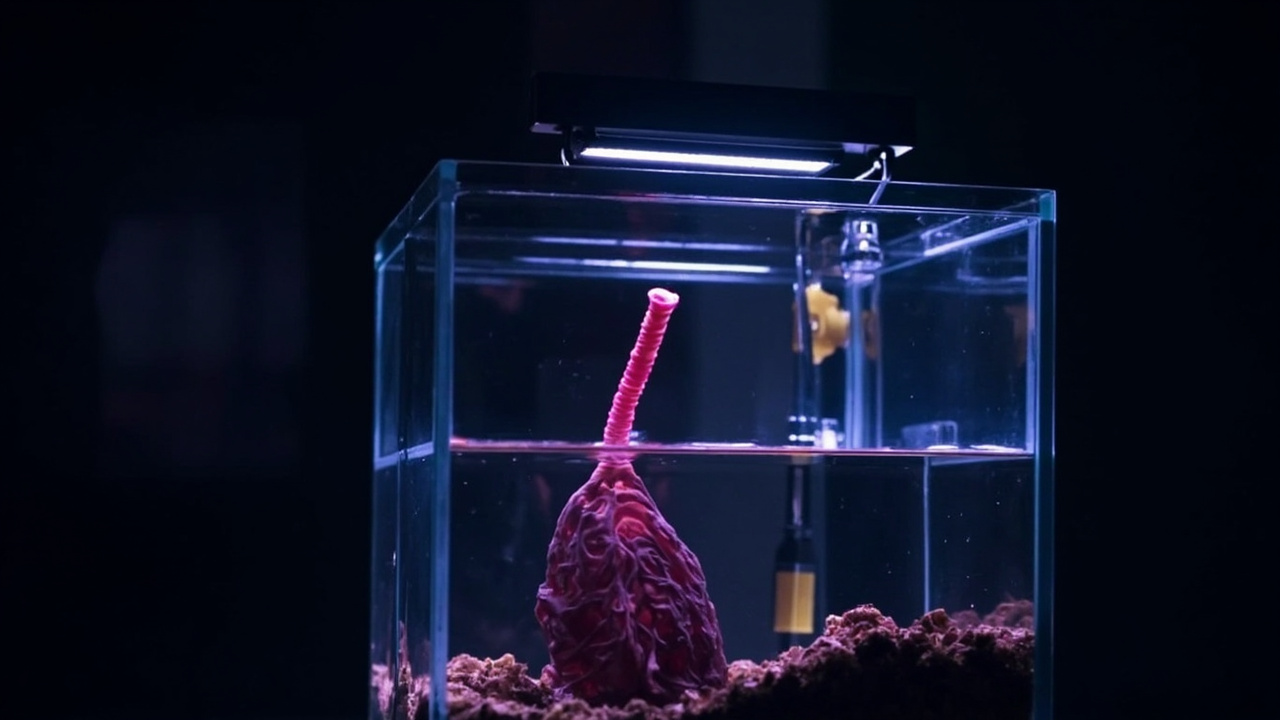
Let me tell you about one of the most wildly creative scientific breakthroughs I've heard about in a while—and it started with a three-and-a-half-gallon fish tank at a pet store in Galveston, Texas.
Around 2010, Michael Riddle was a medical student in his late thirties, juggling classes at the University of Texas Medical Branch while supporting a wife and four kids. Not exactly the stereotypical image of a scientist on the verge of a major breakthrough, right? But sometimes the best innovations come from people who can't afford to play by the rules.
One day, Riddle wandered into a local pet shop and spotted something remarkable: a cheap fish tank that looked, to his trained eyes, uncannily like a human chest cavity. Most of us would see a tank. Riddle saw a prototype.
He bought that $20 tank and built what he calls the world's first large lung bioreactor—a fancy term for a chamber where you can grow living lungs outside the human body. And here's where it gets really interesting. The device he cobbled together eventually helped researchers grow engineered pig lungs that were successfully transplanted into actual pigs. Oh, and did I mention his team also grew what they describe as the very first human lung in a laboratory setting?
Not bad for something that started in the aquarium section of a pet store.
Now, let me break down the actual science because it's genuinely fascinating—and honestly, a little like science fiction.
The idea is elegantly simple once you understand what's happening. First, scientists take a donor lung that's too damaged for normal transplant use. They've got a huge shortage of good lungs, by the way—more than 100,000 Americans are waiting for organ transplants at any given time, and most donated lungs never make it into patients. Many just... get thrown away.
What Riddle and his team figured out was how to "wash" these discarded lungs. They use special detergents to strip away all the original cells, leaving behind what looks like a ghostly white scaffold made of proteins and microscopic structures. Think of it like removing all the furniture from a house but keeping the walls, rooms, and architectural framework intact.
Then comes the really cool part: they repopulate that scaffold with cells from the person who needs the transplant. Same person, same cells, personalized organ. No need for lifetime immunosuppression drugs that come with traditional transplants. Your body wouldn't even recognize it as foreign because, technically, it IS you.
The big challenge was scaling this up. It worked great in mice—scientists could decellularize and recellularize tiny mouse lungs all day long in the lab. But when Riddle asked why nobody was doing this with larger animals or humans, he got two blunt answers: it took five months to decellularize a big pig lung, and nobody had a bioreactor big enough to handle human-sized organs.
That's where his fish tank came in.
But here's the thing about lungs: they float. In any liquid. And at first, Riddle saw that as a problem. He tried squeezing the air out, pushing down against the buoyancy, and hitting wall after wall. Then he had a moment of genius that I absolutely love.
"Okay," he thought, "if it floats no matter what I do, maybe I should work with that instead of against it."
So he flipped the pig lung upside down, attached the windpipe to a pipe at the bottom of his improvised tank, and let the organ float while pumping detergent through both its blood vessels and airways simultaneously. The lung stayed suspended without crushing its delicate structures.
The result? What used to take five months now took three days. That's not a small improvement—that's the difference between a proof-of-concept and something actually usable.
The team transplanted these engineered lungs into pigs, and here's the remarkable part: the rebuilt organs integrated with the animals' bodies and continued developing for up to two months. No rejection, no major complications. They weren't functioning as the pigs' sole lungs yet—the pigs still needed their originals—but the concept was proven. It worked.
Later, they did the same with a human lung, growing the first lab-grown human lung from a scaffold and stem cells.
Look, I know this sounds like something out of a Frankenstein novel—and honestly, the researchers themselves acknowledge those echoes. But here's the beautiful difference: Frankenstein stitched together parts from different bodies. What Riddle and his colleagues are doing is rebuilding using your own cells. Same person, same DNA, new organ.
This isn't the monster story. It's the regeneration story.
And Riddle's journey from broke med student to CEO of a biotech company called Mesogen is the kind of underdog tale that makes you wonder what other breakthroughs are hiding in plain sight, just waiting for someone creative enough to see them differently.
The implications are staggering. If we can rescue discarded organs and turn them into personalized replacements, we're not just helping transplant patients—we might be fundamentally changing how we think about organ failure.
One $20 fish tank at a time.