
When the Universe Throws a Curveball
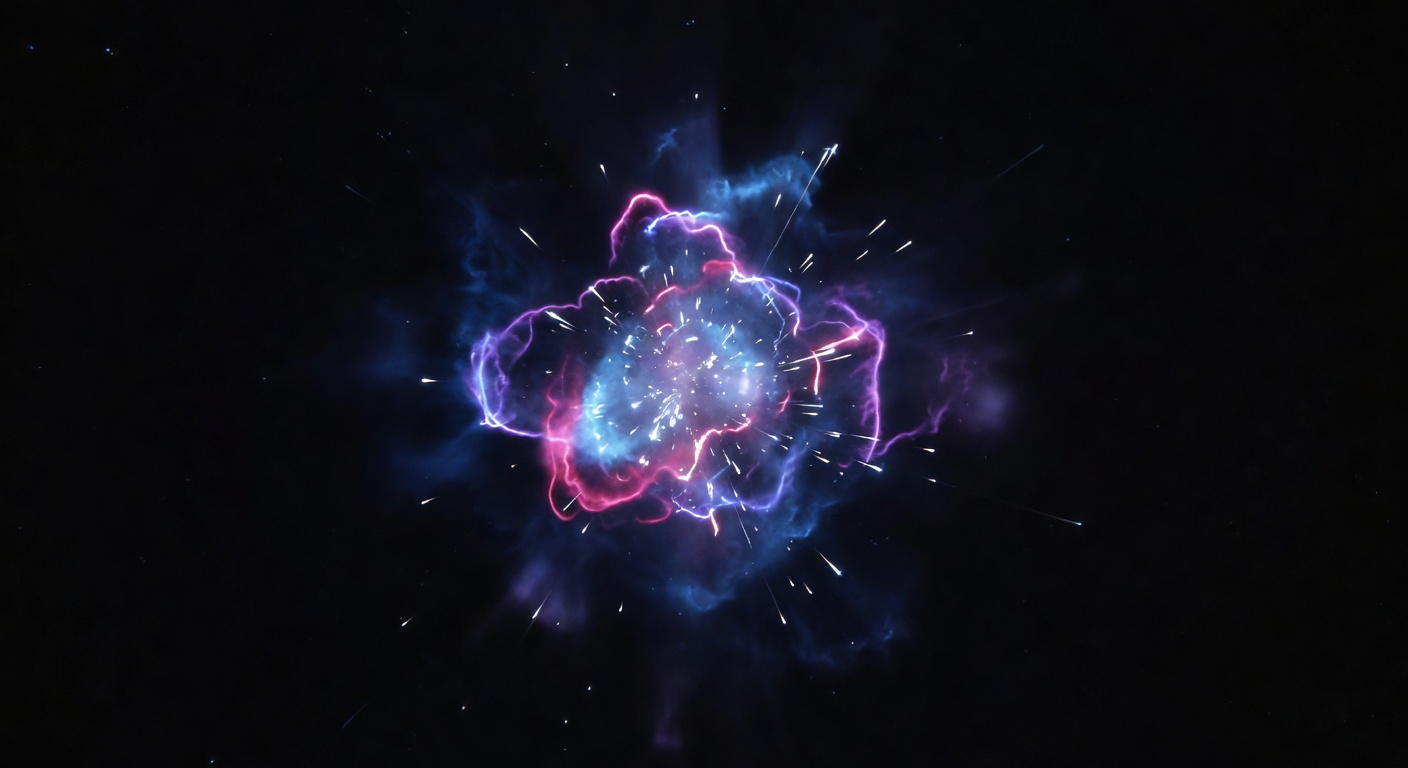
You know that feeling when something happens that's so weird you have to do a double-take? That's basically what astronomers experienced recently when they detected an explosion in space that absolutely refused to follow the rules.
For decades, scientists have observed gamma-ray bursts—these incredibly energetic cosmic explosions that happen when massive stars collapse into black holes. They're spectacular, but they're also predictable. You know what to expect: a quick, intense flash of high-energy radiation that's over almost as fast as it started. Blink and you'd miss it.
But then came GRB 250702B, which decided to do its own thing entirely.
When Hours Feel Like Seconds (But Aren't)
Here's where it gets wild. This explosion? It lasted for hours. Not minutes—we're talking about a cosmic event that just kept going and going, like the Energizer Bunny of space.
To put this in perspective, the previous record-holder for the longest gamma-ray burst maxed out at around three and a half hours. GRB 250702B shattered that record by nearly doubling the duration. Scientists had also detected X-ray activity from the same event a full day before the main explosion kicked into gear.
"This object shows extreme properties that are difficult to explain," said Huei Sears, a researcher at Rutgers who's been investigating this cosmic mystery. And honestly? That's the understatement of the century.
The Global Detective Work
This wasn't a job for just one telescope. When something this unusual happens, the entire astronomical community essentially puts down what they're doing and focuses like a laser on the problem.
Teams around the world—using China's Einstein Probe, NASA's Fermi telescope, the Very Large Array (yes, the one from the movie Contact—how cool is that?), and of course the James Webb Space Telescope—all pooled their observations. They collected gamma rays, X-rays, infrared light, and radio signals to build a complete picture of what went down.
Think of it like having witnesses from different angles describing the same accident. Each one sees something slightly different, and together they give you the whole story.
The Head-Scratching Theories
So what actually happened out there in the cosmos? That's the million-dollar question, and honestly, nobody's quite sure yet.
Scientists are wrestling with a few different explanations. Maybe it was just an unusually extreme version of a regular gamma-ray burst—like getting dealt an incredible poker hand. Another theory involves a tidal disruption event, where a supermassive black hole (thousands of times heavier than our Sun) gets too close to a star and basically tears it apart like cosmic taffy.
Then there's the really intriguing idea: what if a smaller black hole merged with a stripped helium star and consumed it from the inside out? That would explain the extended duration and the unusual behavior.
"A lot of the studies on this explosion provide different, and sometimes contradictory, explanations," Sears admits. "It's still early in our understanding of what really happened."
A Galaxy 8 Billion Years in the Past
Here's another twist that makes this even more interesting. When researchers used the Hubble Space Telescope to look at where the explosion came from, they found something unexpected: an unusual galaxy that, at first glance, looked like it might be two galaxies merging or one galaxy being bisected by dust.
Further observations from Webb revealed the truth. The explosion happened in a galaxy that's about 8 billion light-years away. That means we're looking back in time to when the universe was only about 5.5 billion years old—billions of years before Earth even existed.
And get this: when Sears led follow-up observations using Webb's infrared imaging tools, the picture became even clearer. It's actually just one really massive galaxy with a complex structure and a prominent dust lane running through it. The galaxy is so intricate that scientists still can't definitively say whether any remnants of the explosion are even visible anymore—it might just be too faint to detect.
The Bottom Line: We Don't Know, And That's Exciting
Here's what makes science genuinely cool: sometimes we run into something that completely stumps us. And instead of that being a bad thing, it's actually amazing because it means we get to learn something brand new.
Whether GRB 250702B was an extreme gamma-ray burst, a tidal disruption event, or something we haven't even classified yet, it's clear that it's rare, significant, and unlike anything observed in the past 50 years.
"This gives us a unique chance to study the extremes of how stars and black holes evolve," Sears said. "GRB 250702B could even be the discovery of something unexpected and new."
The universe just handed astronomers a genuine mystery, and they're determined to solve it. And honestly? I can't wait to see what they discover.