
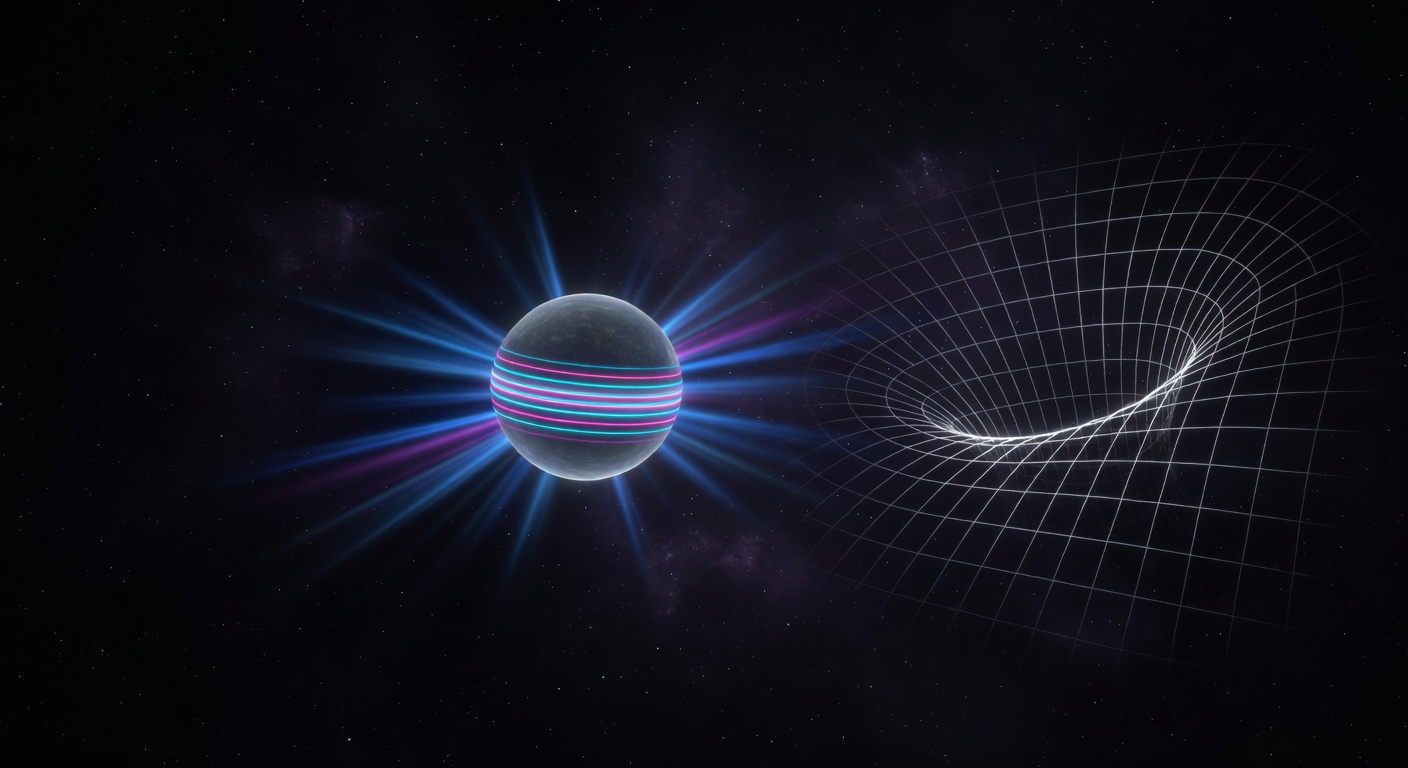
When a Dead Star Started Acting Weird
Imagine pointing a telescope at a distant neutron star and seeing something that shouldn't be there. That's what happened with the Crab Pulsar, the spinning remains of a supernova that exploded way back in 1054 (yes, people noticed and wrote it down).
For over 20 years, radio astronomers noticed something peculiar: the Crab Pulsar was beaming out radio waves in evenly spaced stripes. Not like a smooth rainbow. More like someone had taken a rainbow, deleted half the colors, and left only sharp, distinct bands separated by complete darkness. Weird, right?
Why This One Pulsar Was So Special
Here's the thing—most pulsars are kind of boring from a radio perspective. They emit a noisy, messy signal spread across lots of frequencies, like static on an old TV. The Crab Pulsar? Total showoff. It has these razor-sharp, well-defined stripes that no other pulsar displays.
Scientists love mysteries like this because they usually point to something interesting happening. And boy, were they right.
The "Aha!" Moment Involves Einstein
Enter Mikhail Medvedev, a theoretical astrophysicist at the University of Kansas who decided to tackle this cosmic puzzle. Here's where it gets cool: he figured out that the answer involves gravity literally bending the shape of space.
You know how a glass lens bends light to focus it? Einstein showed us that gravity does something similar. In the presence of massive objects, space itself curves, and light has to follow that curvature—it can't travel in a straight line because "straight" itself changes.
"Light doesn't travel in a straight line in a gravitational field," Medvedev explains. "Space itself is curved."
A Tag Team: Gravity and Plasma
But here's what makes this discovery truly unique: gravity isn't working alone. Around the Crab Pulsar, there's also plasma—that soup of charged particles that fill space around the star.
Think of it like this: plasma acts like a defocusing lens, scattering light rays in different directions. Gravity acts like a focusing lens, pulling light rays together. These two forces are playing cosmic tug-of-war.
When scientists tried to explain the stripes using just the plasma effect, they could reproduce the pattern... but it wasn't sharp enough. The contrast didn't match reality. Adding gravity into the mix? That was the missing ingredient.
The Interference Party
Here's where waves get involved. When radio waves from the pulsar travel through this warped spacetime and curved plasma, they can take slightly different paths to reach us. And when two nearly identical paths arrive at our telescopes at the same time, they interfere with each other.
Sometimes those waves reinforce each other—their peaks and valleys line up perfectly—creating bright bands. Other times, they cancel out, creating darkness. This interference pattern is exactly what we see as the zebra stripes.
"At some frequencies, the signals reinforce each other (in phase), producing bright bands," Medvedev explains. "At others, they cancel (out of phase), producing darkness."
Why You Should Care
Okay, so a pulsar has weird stripes. Cool. But what's the big deal?
First, this is the first time scientists have actually observed gravity and plasma working together to shape an astronomical signal. With black holes, gravity does all the heavy lifting alone. But here, both are essential. That's genuinely new.
Second, this gives us a powerful new tool for studying neutron stars and the extreme physics happening around them. The Crab Pulsar is only about 6,500 light-years away and clearly visible, making it the perfect laboratory for testing our theories about the most violent, densest objects in the universe.
The Takeaway
Sometimes, the biggest breakthroughs come from asking "why?" when something looks weird. For 20 years, scientists stared at these stripes and refused to accept "we don't know" as an answer. Now we do—and the answer is elegant, involving some of the deepest concepts in physics.
The universe, it turns out, likes to show off in ways we don't always expect. And thankfully, we've got curious people willing to spend decades figuring out the trick.