
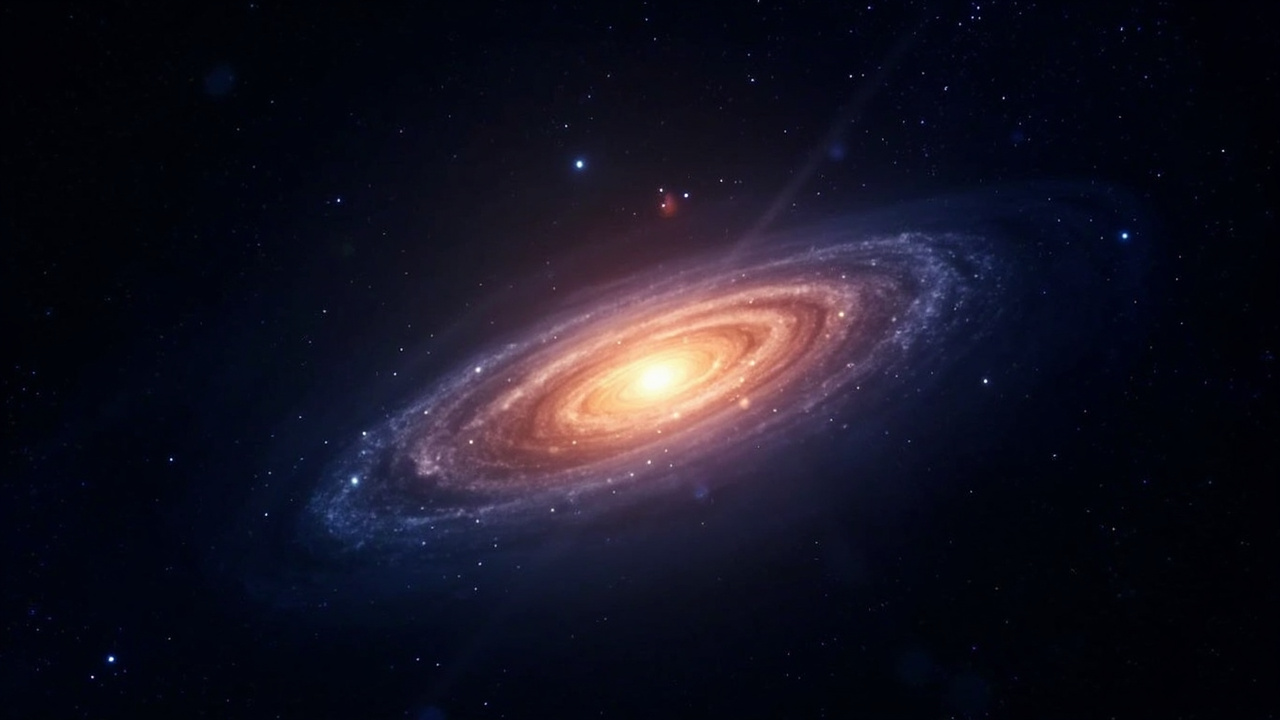
The Galaxy That Refused to Spin
Imagine building a top and expecting it to spin the moment you set it down. That's basically what astronomers thought would happen with galaxies. But the James Webb Space Telescope just found one that's sitting there, perfectly still, defying all expectations.
The galaxy in question—with the catchy name XMM-VID1-2075—dates back to when the universe was less than 2 billion years old. For context, the universe is now about 13.8 billion years old, so this galaxy was a cosmic toddler. And yet, it's already massive, already stopped making new stars, and apparently already gave up on the whole spinning thing.
Why Galaxies Should Be Spinning in the First Place
Here's the thing about forming galaxies: they should naturally start rotating. When gas clouds collapse under gravity, they develop something called angular momentum—basically the same physics that makes figure skaters spin faster when they pull their arms in. It's inevitable, or so we thought.
As galaxies age and go through billions of years of cosmic interactions, their spins can change. Sometimes they collide with other galaxies (which sounds dramatic but happens relatively often in the densely packed universe). These cosmic fender-benders can either add more spin or, in some cases, cancel it out entirely. But here's the key: this process takes a really long time. Like, an absurdly long time.
So finding a young galaxy that's already a non-spinner is like discovering a toddler who's already mastered calculus. It shouldn't be possible, yet there it is.
What Makes This Galaxy So Weird (And Massive)
Before the Webb telescope jumped on the case, researchers were already studying XMM-VID1-2075 using ground-based observations from the Keck Observatory in Hawaii. They'd confirmed it was an absolute beast—we're talking multiple times heavier than our entire Milky Way, which is already one of the largest galaxies we know about. And it had already stopped producing new stars, which made scientists really curious about what was going on inside.
The Webb telescope took things to the next level. By analyzing how the stars and gas move within this galaxy, researchers could actually map its internal dynamics. Spoiler alert: the stars weren't moving in any organized, spinning pattern. Instead, they were just kind of bouncing around randomly in all directions.
The Collision Theory
So how does a galaxy become a cosmic couch potato so fast? The leading hypothesis involves a pretty dramatic event: a massive collision.
Picture two galaxies heading toward each other, each spinning in nearly opposite directions. When they collide and merge, their opposite spins could mathematically cancel each other out, leaving the resulting galaxy essentially stationary. It's like two spinners on a table rotating in opposite directions and then crashing together—the result isn't spinning, it's just... messy.
The researchers actually spotted evidence supporting this idea. There's an unusual burst of light off to one side of the galaxy that suggests something else has recently crashed into it and is actively messing with its dynamics. So it's not just theory—they're seeing the aftermath of what might be happening right now.
The Bigger Picture
Here's why this matters beyond just "cool space fact": our models of how the universe evolves are based on certain assumptions. If these assumptions are wrong, then everything we think we know about galaxy evolution might need adjusting.
The research team is now hunting for more of these non-spinning galaxies in the early universe. By comparing how common they actually are with what computer simulations predict, scientists can test whether current theories are holding up or if we need to go back to the drawing board.
"Are there tons of these spinless galaxies out there, or are they genuinely rare?" is basically the question they're asking. The answer will tell us a lot about whether we really understand how galaxies form and evolve.
Why This Matters to You (Yes, Really)
I know what you're thinking: "Cool space discovery, but why should I care?" Here's the thing—understanding how galaxies form and interact is one of the fundamental questions in science. It's part of the bigger puzzle of how our universe works and how we got here. Plus, every time we think we understand something and then the universe surprises us, it reminds us how much we still have to learn.
The James Webb Space Telescope is basically letting us look back in time to see galaxies as they were in their infancy. That's incredible. And discoveries like this one—finding something that shouldn't exist—that's how science advances. We come up with theories, we test them, and when reality doesn't match our predictions, we learn something new.
So here's to cosmic mysteries that refuse to behave. They're the best kind.