
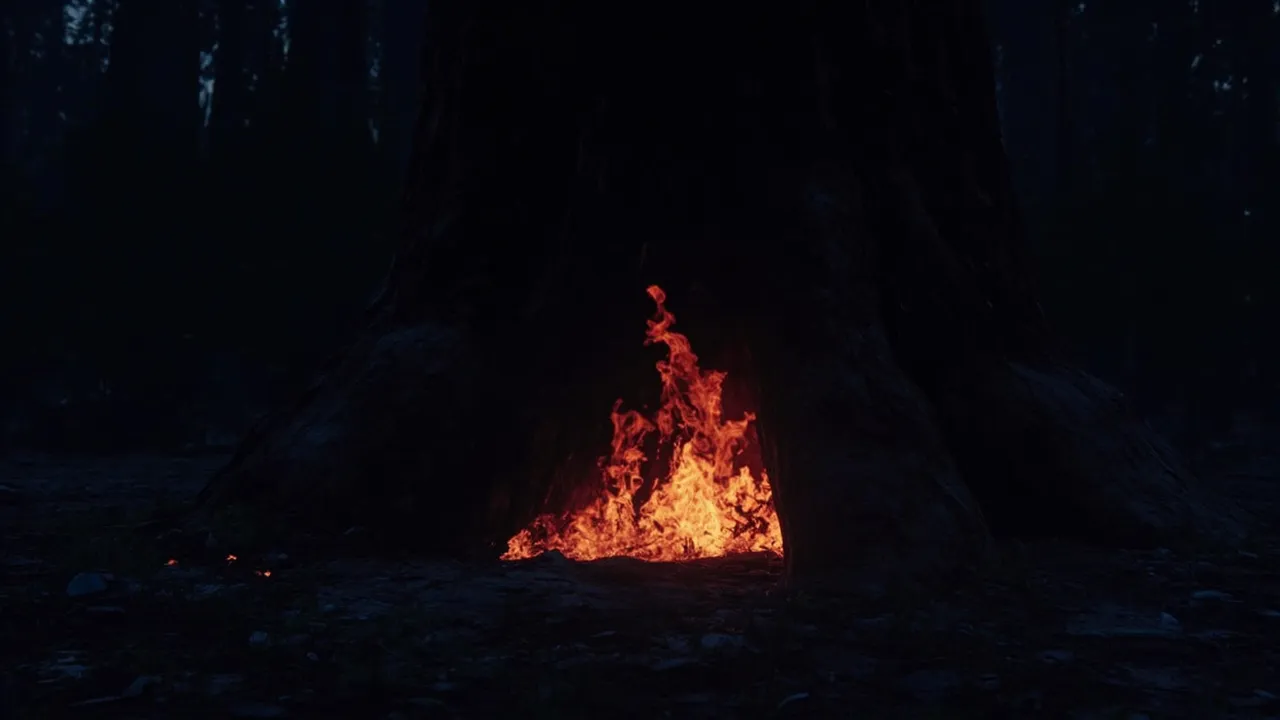
Wait, We're Fighting Fire With... Fire?
Okay, I know what you're thinking. "Burning trees to save trees? That can't be right."
But stick with me here, because this is one of those stories that completely flips your assumptions upside down.
Giant sequoias are basically the superheroes of the plant world. These magnificent trees can live for over 3,000 years and weigh as much as fifteen blue whales combined. We're talking about organisms so old they were already ancient when the Roman Empire was at its peak. They only grow naturally in a tiny strip of California's Sierra Nevada mountains, making them one of the rarest living things on our entire planet.
For decades, the conventional wisdom was that these trees were practically fireproof. Their bark can grow up to three feet thick, and their massive canopies sit high above the flames licking at the forest floor below. These trees evolved alongside fire for millions of years, after all.
Then came 2020 and 2021.
When Ancient Giants Fell
Something absolutely heartbreaking happened during those fire seasons. Massive wildfires swept through sequoia groves and killed thousands of these ancient giants. Images emerged showing entire groves reduced to charred skeletons—trees that had weathered centuries of droughts, storms, and fires suddenly falling victim to flames.
"It was unprecedented," researchers noted. "These trees have seen so much variability in climate and wildfire over their long lives, but having so many die in just two years was shocking."
The culprit? Not the fires themselves, exactly, but rather what we've done to the forests over the past century.
The Problem With Being Too Good at Stopping Fires
Here's where humans accidentally made things worse.
For decades, we aggressively suppressed wildfires across the American West. Sounds reasonable, right? Fewer fires mean fewer destroyed homes and less smoke in the air.
But giant sequoias actually need fire to thrive. Low-intensity burns clear out the underbrush, recycle nutrients into the soil, and create the open conditions where young sequoias can sprout and grow. Fire is as much a part of their ecosystem as rain.
When we stopped natural fires, we inadvertently created a tinderbox. Dead wood piled up. Shrubs and smaller trees crowded the forest floor. All that accumulated fuel sat waiting for a spark.
So when wildfires finally did arrive—especially the intense, fast-moving blazes we're seeing more of due to climate change—they had way more material to consume. The flames climbed higher and burned hotter than anything these trees had faced in millennia.
The Silver Lining in a Controlled Burn
Now for the genuinely hopeful part.
Researchers from UC Davis recently published a study in Nature Communications that offers a ray of hope. They've been studying what happened to sequoia groves in Sequoia and Kings Canyon National Parks during the devastating 2020 Castle Fire and 2021 KNP Complex Fire.
Here's what they found: Trees that had been treated with prescribed burns in the previous decade were nearly four times more likely to survive than untreated trees in the same groves.
Let that sink in for a moment.
Controlled burning reduced a giant sequoia's odds of dying by about 77%. The researchers estimate that earlier prescribed burns prevented roughly 1,900 sequoia deaths. And here's an even more striking number: another 3,900 trees might have survived if every sequoia in those groves had received similar treatment.
The parks have maintained one of the country's most extensive prescribed fire programs since the 1960s, which created a patchwork of areas with different fire histories. Some sections had been burned recently. Others hadn't seen fire in over a century. That natural experiment let scientists directly compare outcomes.
Why Does This Work?
Think of it like clearing brush from around your house before wildfire season. Prescribed burns remove the fuel that would otherwise allow flames to climb into the canopy and engulf even the most fire-resistant trees. The trees get "lightly burned" when conditions are controlled, then have a much better chance of surviving when the really intense wildfires come through.
"We found that prescribed burns are effective at reducing giant sequoia mortality, even for today's extreme wildfires," said Dan Dixon, the study's lead author. "If the goal is protecting giant sequoias, prescribed fire is an essential tool available to managers."
It's a powerful reminder that sometimes the most unnatural-seeming approach is actually the most natural one. These forests evolved with fire. Our job isn't necessarily to keep all fire away—it's to manage fire intelligently.
What This Means Going Forward
California has been ramping up its prescribed burning efforts in recent years, and this study provides strong scientific backing for continuing that work. The researchers combined airborne lidar (which maps forest structure using laser pulses) with high-resolution satellite imagery to analyze nearly 26,400 giant sequoias across 19 different groves.
This kind of detailed, data-driven approach helps land managers make smarter decisions about where and when to conduct burns.
Climate change is making wildfires more frequent and more intense across the West. We can't stop that entirely. But we can prepare our forests to be more resilient. And for these irreplaceable ancient giants—trees that have witnessed the rise and fall of civilizations—we owe them every advantage we can give.
The next time you hear about firefighters setting a controlled burn near sequoia country, don't worry. They might just be saving the oldest living things on Earth.
Source: University of California, Davis via ScienceDaily https://www.sciencedaily.com/releases/2026/07/260726015243.htm