
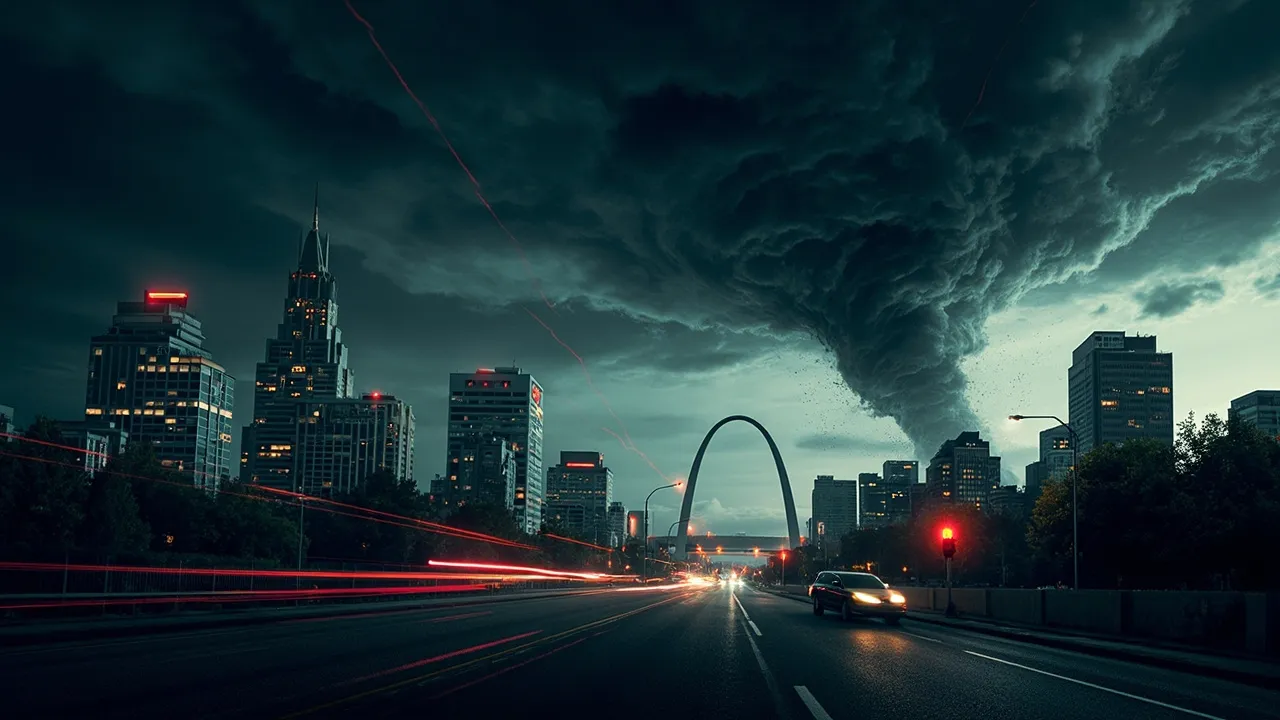
- Start with the St. Louis tornado (the most famous part)
- Explain what happened during those two weeks
- How tornadoes form (simplified)
- The scale of destruction
- The modern context and climate change connection
- Reflection on whether it could happen again
The Night St. Louis Disappeared
Imagine you're living in St. Louis in 1896. You're going about your evening on May 27th, probably excited that spring is finally warming up. Then the sky turns green—and everything goes wrong.
What happened next would become one of the most devastating natural disasters in American history.
The Great Cyclone of 1896—which is honestly a terrifying name—ripped through St. Louis and East St. Louis that evening. We're talking about an F4 tornado (on the old Fujita scale, which maxes out at F5) that was half a mile wide and carved a 10-mile-long path of destruction through what was then America's fifth-largest city.
311 buildings completely demolished. 7,200 more damaged. 255 people dead.
The St. Louis Post-Dispatch reported that "all over the city, bells were tolling for the dead."
I don't know about you, but that line gives me chills.
A Two-Week Tornado Nightmare
Here's what's really mind-blowing: the St. Louis tragedy wasn't even the only major tornado that week. It was just the worst.
From May 15 to May 28, 1896, something like 40 tornadoes ripped through the Midwest and into the eastern United States. Twelve states got hit. At least three of those twisters would have rated F5 on the scale—the most violent classification, with winds up to 300 miles per hour.
Scientists call what happened a "tornado outbreak sequence"—basically when one storm system after another keeps spinning up tornadoes in rapid succession. In modern terms, it's like your weather system got stuck in "easy mode" for destruction.
Nearly 500 people died in total across that two-week period. Millions in damage (which in 1896 dollars was an astronomical sum). This wasn't just a bad week—it was one of the most violent tornado sequences in U.S. history.
So... How Do Tornadoes Even Form?
Quick science lesson, I promise it's interesting.
Tornadoes happen when cold, dry air from Canada or the Arctic collides with warm, moist air from the Gulf of Mexico. This temperature mismatch makes warm air shoot upward and cool air sink, creating spinning currents. When that spinning column gets strong enough and reaches the ground, boom—tornado.
The U.S. is basically the tornado capital of the world because our geography makes this collision happen constantly. We get more than 1,000 tornadoes every single year. More than any other country on Earth.
The "Tornado Alley" area across the Great Plains—especially Oklahoma—sees the most action, but twisters can pop up from Canada to Florida to Maine.
The Unsettling Part
Here's where this story gets relevant to us today.
Since 2000, scientists have observed that the number of tornado outbreaks—those concentrated periods of multiple twisters from the same storm system—has doubled. That's according to NOAA.
Now, here's the thing: overall tornado days have actually decreased. We're seeing fewer days with tornadoes overall. But when tornadoes do happen, more of them tend to cluster together in big outbreaks.
And here's why climate change is the villain in this story: as the planet warms, that temperature difference between northern and southern air masses is likely to become even more dramatic in certain seasons. The conditions that created that nightmare in 1896 could become more frequent.
The most recent comparable event was in 2019, when 374 tornadoes tore through the country in just 13 days. That's similar scale, similar intensity.
Could It Happen Again?
Honestly? It probably will.
The ingredients that created that devastating May in 1896 haven't gone away. If anything, our warming climate might make them more common. We've gotten better at warning people—modern radar and alert systems would definitely save lives that were lost in 1896. But the raw power of these storms isn't going anywhere.
It's one of those reminders that nature doesn't really care about our cities, our infrastructure, our sense of safety. Sometimes the atmosphere just decides to remind us who's boss.
The Great Cyclone of 1896 was so dramatic that two weeks later, it made the cover of Harper's Weekly. A German-language newspaper back then called it "Der Große Tornado"—the Great Tornado.
Maybe the most haunting part is that if something similar happened today, we'd have smartphones to document it. Social media would explode with footage. And yet, somehow, I think the terror would feel exactly the same as it did for those St. Louis residents hearing bells toll for the dead.