
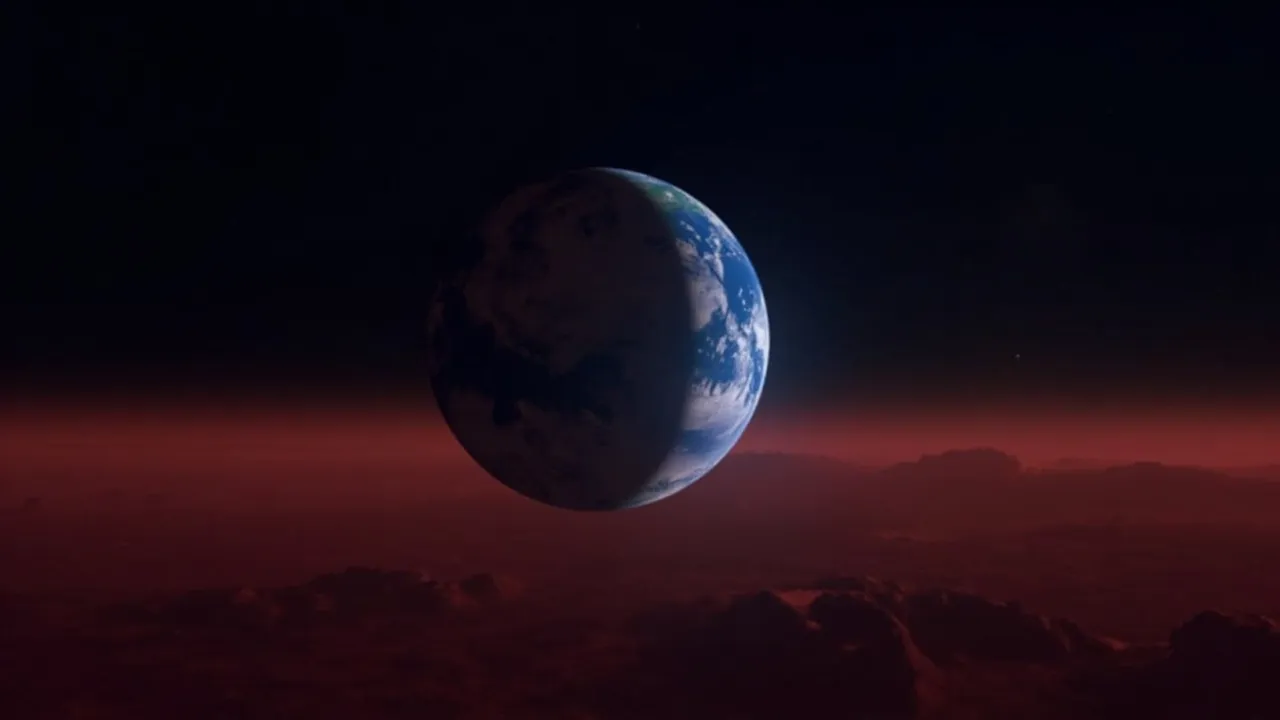
A Cosmic Magic Trick
Picture this: You're standing on Mars, watching the evening sky, when suddenly Earth just... disappears.
Not slowly fading into the Martian dusk like we do every night from our own backyard. I mean gone. Completely blocked by a tiny, lumpy moon called Phobos that's only about 17 miles wide.
This isn't science fiction. NASA's Perseverance rover actually captured this moment on July 2nd, and honestly, it's one of those images that makes you want to just sit quietly for a while afterward.
What Exactly Did We See?
Here's the beautiful part: from Perseverance's location at the edge of Jezero Crater, Earth appeared as literally one single pixel of light. That's our entire planet—every ocean, every continent, every human who's ever lived—reduced to the size of a pinprick.
Meanwhile, Phobos was zooming across the Martian sky in the opposite direction, and when these two cosmic objects lined up, Earth vanished behind Phobos's shadowed edge for a brief moment. Poof. Gone.
Scientists call this an "occultation," which is just a fancy word for when something big (in apparent size, not actual size) blocks something smaller that's farther away. In this case, Phobos is tiny compared to Earth, but because it's so much closer to Perseverance, it completely blocked our view of home.
The Most Humbling Selfie Ever
One of the scientists described this image as "a unique Earth self-portrait, taken from the surface of another planet, with a Phobos photobomb." And I love that framing.
Think about it—we've taken countless selfies from Earth. Selfies at the beach, selfies with friends, selfies with our pets. But this might be the most perspective-changing "selfie" humanity has ever captured. Our home planet, photographed by one of our robotic ambassadors, with another planet's moon photobombing us.
Justin Maki, one of the imaging scientists, put it beautifully. But honestly? I think the real magic here is in what it makes us feel.
Perspective Check
From Earth, we see the Moon dominate our night sky. It feels big, it feels close, it's the thing that catches our eye when we're stargazing. But from Mars, Phobos appears about one-third the size of our Moon does from Earth—yet it still had no problem swallowing up our entire planet.
And Earth? We were 195 million miles away. That's roughly 314 million kilometers of empty space between us and our robotic representative on another world. From that distance, we're just... a dot.
This is the kind of image that should make us both incredibly small and impossibly connected at the same time. We're the species that built a machine, launched it across the solar system, landed it on another planet, and programmed it to watch the sky and send the data back home. That's extraordinary.
Why Do Scientists Even Care About This?
Here's where it gets practical (and still fascinating). Understanding Phobos's orbit matters more than you might think. The little moon is slowly spiraling closer to Mars, and in about 50 million years, it'll either crash into the Red Planet or break apart into a ring.
Scientists also love watching these occultations because they help us precisely measure Phobos's position and orbit. It's like doing cosmic geometry with stakes that are, admittedly, pretty far from our daily lives—but still pretty cool.
The Bigger Picture
What really got me about this image wasn't the technical achievement (though that is genuinely impressive). It was the emotional punch.
We've all seen images of Earth from space—the famous "Blue Marble," the "Pale Blue Dot" taken by Voyager. Those pictures changed how we see ourselves. They made Earth feel precious and fragile, suspended in the vastness of space.
This new image does something similar, but in a completely different way. Instead of seeing Earth from space, we're seeing Earth in space—seen from another world, getting briefly blocked by a passing moon. It reminds us that we're not just observers of the cosmos. We're participants in it, spinning around on a small rock in a corner of the universe, occasionally being photographed by our own creations from millions of miles away.
So the next time you look up at the night sky and see the Moon, take a moment to appreciate that perspective. Our Moon is the size it is, orbiting where it does, because of where we are. And somewhere on Mars, one of our robot explorers is looking back, watching our tiny light in the Martian evening, and occasionally losing sight of us entirely when Phobos comes shuffling by.
That's pretty magical if you ask me.