
When the Planet Became a Musical Instrument
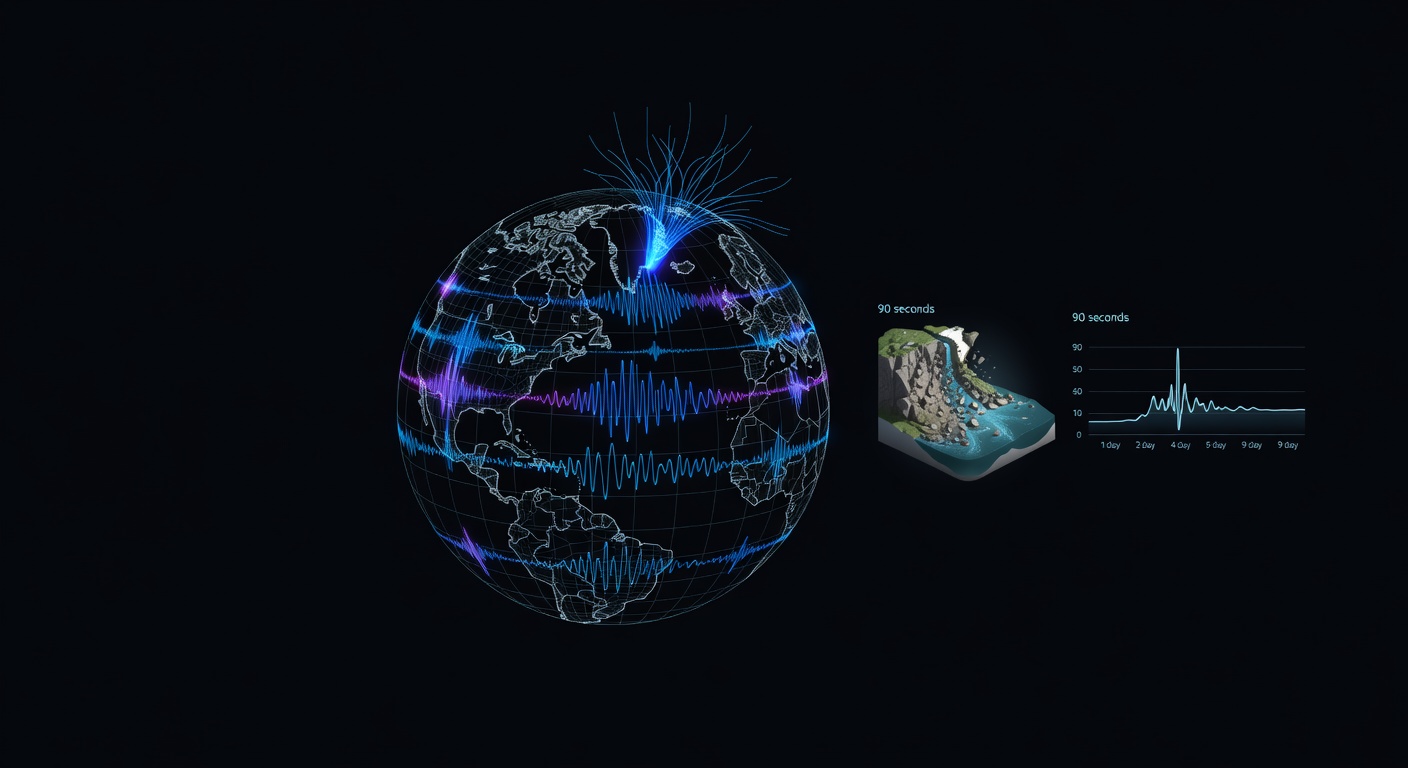
Picture this: You're sitting at your desk in September 2023, and somewhere deep beneath your feet, the Earth is humming. Not metaphorically — literally vibrating with a steady rhythm every minute and a half. For nine straight days.
That's exactly what happened, and it drove seismologists around the world absolutely crazy trying to figure out what was going on.
The Mystery Signal from the Arctic
The strange vibrations first showed up in September, then vanished like a ghost, only to return in October. Scientists initially suspected something called a "seiche" — basically water trapped in an enclosed space that sloshes back and forth like water in a bathtub after you get out.
But here's the thing about scientific hunches: you need proof. And proving this particular theory turned out to be way harder than anyone expected.
The suspected culprit was hiding in Dickson Fjord, Greenland, where a massive landslide had triggered what researchers call a "megatsunami." Think of it like dropping a boulder into a narrow swimming pool — the resulting waves have nowhere to go, so they just keep bouncing back and forth.
Why Old Tech Couldn't Crack the Case
For months, this remained one of those frustrating scientific mysteries where you're pretty sure you know what's happening, but you can't quite prove it. The problem? Our existing satellite technology was like trying to watch a movie through a keyhole.
Traditional satellite altimeters could only take snapshots when they happened to pass overhead, missing huge chunks of the action. It's like trying to understand a conversation by hearing only every tenth word — you might get the gist, but you're definitely missing the full story.
Enter SWOT: The Game Changer
This is where the story gets really cool. NASA's Surface Water Ocean Topography (SWOT) satellite — a collaboration between NASA and international partners — happened to be transitioning into its main science mission right when this whole thing was happening.
SWOT is basically the superhero version of ocean-monitoring satellites. While older satellites could only measure water height directly below them, SWOT can map entire areas with incredible detail. It's like upgrading from a flashlight to stadium lighting.
Thomas Monahan from Oxford University and his team decided to dig deep into SWOT's data, and boy, did they hit the jackpot.
The Smoking Gun
What they found was beautiful in its simplicity. The satellite data showed exactly what they'd suspected all along: waves up to 6.5 feet tall trapped in the fjord, slowly losing energy as they sloshed back and forth. These waves were creating vibrations that traveled through the Earth's crust, making our entire planet ring like a bell.
The researchers even recreated the weather conditions during those weeks and ruled out every other possible explanation. Wind patterns, atmospheric pressure, ice movement — nothing else could account for the signal.
Why This Matters Beyond Cool Science
This discovery is way more significant than just solving a puzzle. Climate change is making extreme weather events like landslides and tsunamis more common, especially in places like Greenland where ice is rapidly melting.
Understanding how these events create cascading effects — like trapped waves that can shake the entire planet — helps us better prepare for and predict similar phenomena in the future.
Plus, it shows us how powerful our new generation of satellites really is. SWOT can peer into remote fjords and enclosed water bodies that were essentially invisible to previous technology.
The Bigger Picture
I find it amazing that in 2023, our planet could still surprise us with something this dramatic. A mountain collapses in one of the most remote places on Earth, creates a trapped wave, and suddenly seismologists in Japan, California, and everywhere else are scratching their heads over mysterious signals.
It's a reminder that Earth is still an active, dynamic planet full of interconnected systems we're only beginning to understand. And sometimes, when something big happens in one corner of the world, the whole planet literally feels it.
The next time you hear about strange seismic signals or unexplained environmental phenomena, remember this story. The answer might be something as elegant as the Earth itself humming a tune, waiting for the right technology to help us finally hear the music.