
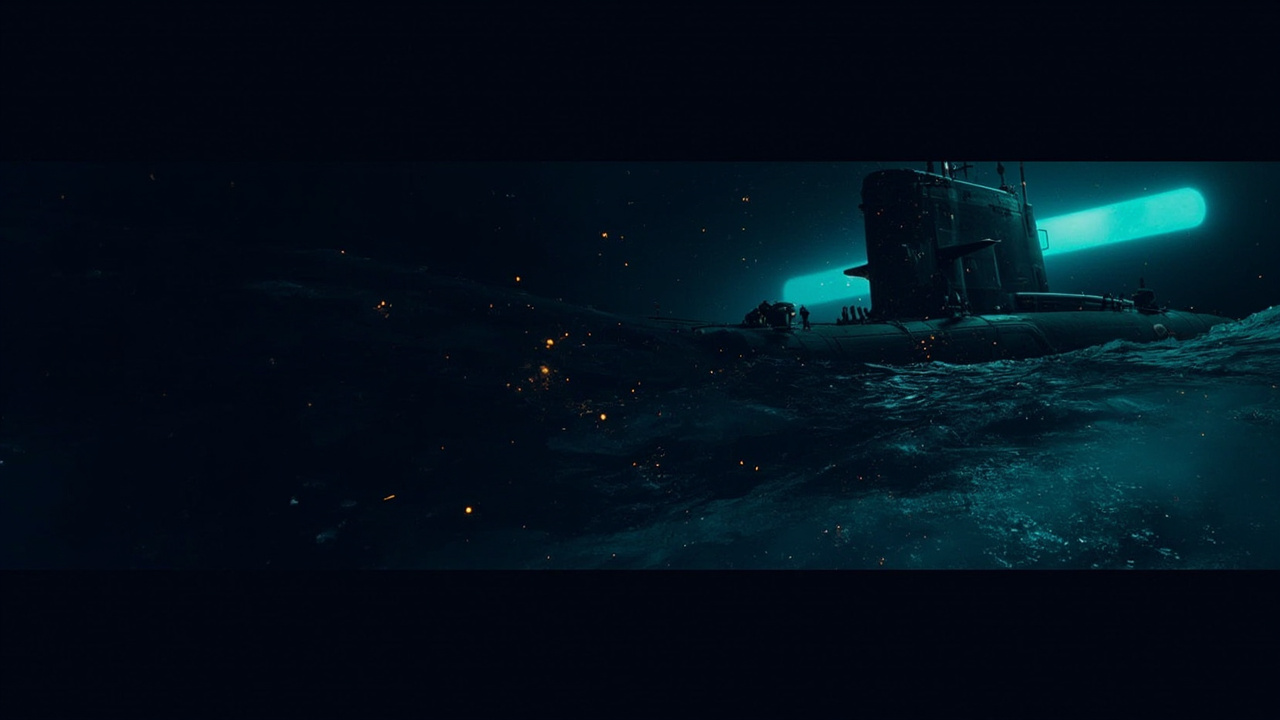
**The Day a Submarine Disappeared
Picture this: It's late May 1968. The Cold War is in full swing, and tensions between the US and Soviet Union are simmering just below the surface—pun intended. The USS Scorpion, a sleek Skipjack-class nuclear attack submarine, is out on patrol. This isn't just any sub, either. We're talking about one of the fastest, most advanced submarines America had built to that point. It could cruise along underwater at 33 knots, practically invisible, thanks to its teardrop-shaped hull designed for stealth rather than surfacing.
The crew was about 99 men—young sailors, experienced officers, all volunteers for one of the most demanding and dangerous jobs in the military. Nobody joins the submarine service thinking it's going to be easy.
The Last Transmission
Here's what we know for sure: On May 21, 1968, the Scorpion radioed in its position—about 250 miles southwest of the Azores, a cluster of Portuguese islands sitting in the middle of the Atlantic. The sub was running a secret mission, tracking a Soviet naval task force that the Navy suspected was measuring NATO acoustic signatures. (Think of it as the underwater equivalent of someone trying to photograph your military radar equipment.)
The sub checked in and said it expected to return by May 27. Simple enough, right?
Except the Scorpion was never heard from again.
The Hunt Begins (Too Late)
By May 24, Navy brass knew something was seriously wrong. The submarine wasn't responding to coded messages—messages that subs are trained to acknowledge, no matter what. By the 27th, they officially declared her missing. You can imagine the sick feeling in the gut of every admiral in the Atlantic fleet that day.
Here's where it gets eerie: the Navy's underwater listening system, called SOSUS, had actually picked up the sound of the Scorpion's hull imploding as it dropped beyond crush depth. But nobody caught it in time. The data wasn't processed quickly enough to matter. By the time anyone understood what they'd heard, the Scorpion and all 99 souls aboard were already at the bottom of the ocean.
The wreckage was finally found in October 1968, resting in about 11,000 feet of water roughly 400 miles southwest of the Azores. Two nuclear weapons were aboard. So was the nuclear reactor. None of it has ever been recovered.
So What Happened? The Theories
This is where things get frustrating—and fascinating. The Navy held a court of inquiry, but it never reached a definitive conclusion. Officially, the loss of the Scorpion remains "unsolved." But that hasn't stopped people from theorizing.
The Torpedo Theory
The most commonly cited explanation is a torpedo accident. Specifically, some experts believe a "hot run" occurred—one of those nightmare scenarios where a torpedo becomes active while still inside its tube. The weapon's motor fires up, and suddenly you have a live torpedo pointing at your own hull.
If that happened, the crew would have had seconds to react. One documented response was to turn the submarine away, trying to trigger the torpedo's safety mechanism. And here's an interesting detail: the Scorpion was reported to have turned away from its expected course before it vanished. That's the kind of clue that keeps investigators up at night.
The Trash Disposal Unit Theory
Another popular theory focuses on the submarine's trash disposal unit—the TDU. I know, "trash disposal" sounds mundane, but on a submarine, even mundane systems can become critical. The TDU allowed crews to eject waste overboard while submerged. The problem? Some submarines, including the Scorpion, had experienced flooding issues with this system.
Here's where it gets scary: if enough seawater flooded in through a failed TDU, that water could reach the submarine's massive lead-acid battery bank. Batteries and seawater don't mix well. A short circuit, a spark, maybe a hydrogen explosion from the batteries releasing gas... suddenly you're dealing with a catastrophic internal event. And remember, hydrogen is colorless and odorless—a ticking time bomb in a sealed pressure hull.
The Battery Well Theory
Speaking of hydrogen, there's another battery-related explanation. Submarine batteries generate hydrogen gas during charging. In an enclosed space like a submarine, this gas can accumulate to dangerous levels. One spark—one tiny, insignificant-looking spark—and boom. An internal explosion would be absolutely devastating in that confined space.
The Missing Pieces
Now here's what really bothers naval historians and investigators: there may be information the public still doesn't have. In recent years, authors like Ed Offley have argued that the official narrative leaves out significant details. The Cold War was in full swing, and both the US and Soviet Union had reasons to keep certain information classified.
Could the Soviets have been involved? Did something happen during that intelligence-gathering mission that we don't know about? These questions linger like shadows at the bottom of the ocean.
Why This Mystery Still Haunts Us
I've always found the USS Scorpion story particularly haunting because it represents so many layers of loss and mystery. There are the 99 men who never came home, leaving behind families who never got closure. There's the technological mystery—the loss of one of America's most advanced naval assets, with its nuclear payload, never fully explained. And there's the broader context of the Cold War, when secrecy was valued above almost everything else.
We live in an age where we put rovers on Mars and map the human genome, but there are still places in our own oceans we can't explain. The Scorpion sits in perpetual darkness, a steel tomb holding secrets we may never fully uncover.
Maybe that's the most unsettling part. Not that we lost a submarine, but that we still don't know why. And for the families of those 99 crew members, that uncertainty never heals.