
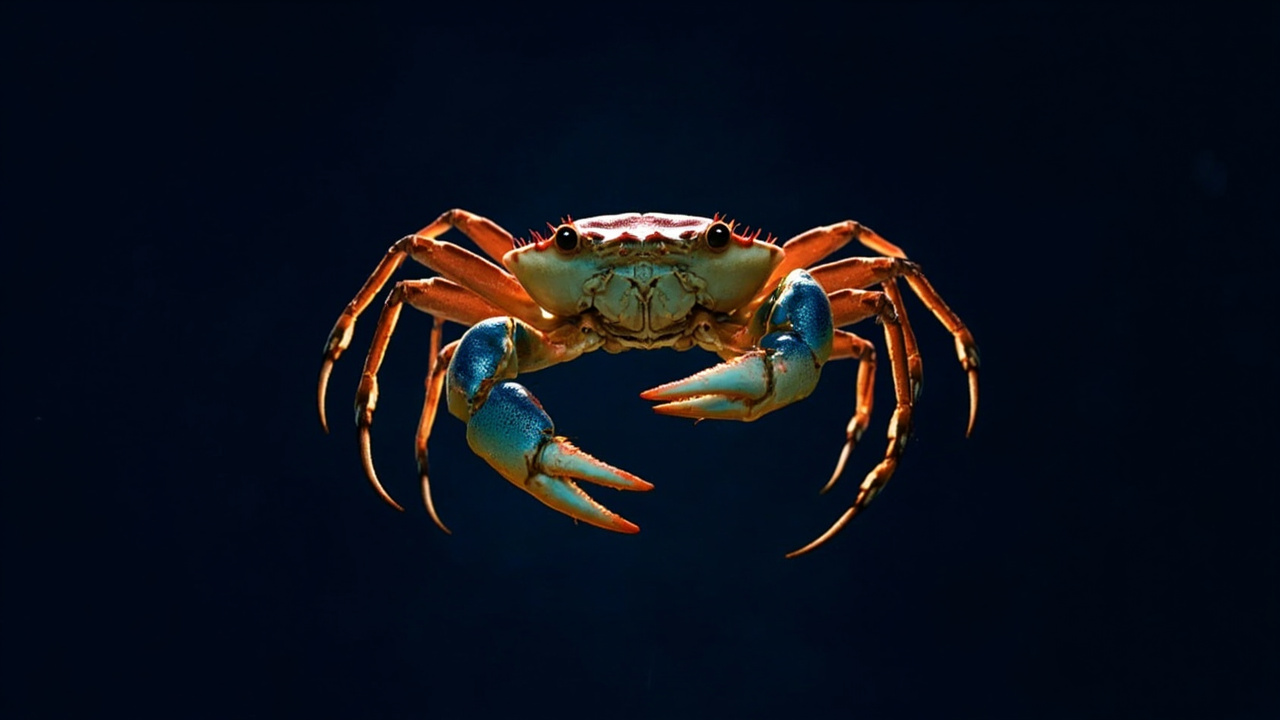
Why Do Crabs Walk Like They're Constantly Leaving a Party?
Let's be honest—crabs are weird. They don't walk toward things or away from things like most animals. Instead, they shuffle sideways like they're perpetually trying to avoid eye contact. You've probably noticed this if you've ever been to a beach or an aquarium. But here's the thing: nobody really knew why they did this or how far back this behavior went in their evolutionary history.
Until now.
Scientists Finally Cracked the Case
A team of researchers led by Yuuki Kawabata from Nagasaki University decided to solve this mystery once and for all. They watched 50 different species of crabs for 10 minutes each (which honestly sounds like the most relaxing research job ever) and recorded exactly how each one moved.
Then came the detective work. The scientists compared their observations against the evolutionary family tree of crabs—mapping out which species were related to which, going back millions of years. What they discovered was genuinely surprising: sideways walking didn't evolve slowly over time or pop up multiple times in different crab lineages.
It evolved exactly once.
One Moment That Changed Everything
Picture this: About 200 million years ago, during the early Jurassic period, a crab ancestor made the switch from walking forward to walking sideways. And that's it. That single behavioral shift spread throughout the entire crab family and has stuck around ever since.
Out of the 50 species they studied, 35 mostly walk sideways while 15 still walk forward. But when you trace this behavior backward through time, it all comes back to that one moment—one ancestor, one direction change, one evolutionary decision that somehow became the defining trait of true crabs.
Pretty wild, right?
But Wait... Why Would They Do That?
You might be thinking: "That's cool, but why would a crab evolve to walk sideways in the first place? Doesn't that seem inefficient?"
Actually, no. Sideways walking is surprisingly brilliant from a survival perspective. When a crab moves laterally, it's harder for predators to predict where it's going. It's like how a basketball player who can move in any direction is harder to guard than one who can only run forward. Crabs can scramble left or right equally fast, which makes them escape artists extraordinaire.
Plus, sideways movement is actually rare in the animal kingdom. Most animals don't do it because it interferes with other important activities like burrowing, mating, and eating. But somehow, crabs managed to make it work. And boy, did it work.
The Secret Sauce: Timing Is Everything
Here's where it gets really interesting. The researchers didn't just discover that sideways walking evolved once—they figured out when.
Around 200 million years ago wasn't just a random time in Earth's history. The planet was undergoing massive changes. Pangaea, the supercontinent, was breaking apart. New shallow ocean habitats were expanding. There was a huge burst of marine evolution happening (scientists call it the "Mesozoic Marine Revolution").
In other words, the ocean was basically wide open with new real estate and new opportunities. A crab with a new, unique way of moving could take advantage of all that empty space. It's like being the first person to invent a skateboard when everyone else is still walking—you've got a huge advantage.
The researchers suspect that the combination of this innovative behavior plus this perfect environmental moment created an explosion of crab diversity. There are now roughly 7,900 species of true crabs living everywhere—in the ocean, in freshwater, on land, even in the deep sea. Not bad for a group that started with one sideways shuffle.
What Makes This Discovery So Cool
The real takeaway here isn't just "crabs walk sideways, and now we know why." It's that this study shows us something profound about how evolution works.
Unlike body shape, which crabs have evolved multiple times in different ways (a phenomenon called "carcinization" if you want to sound smart at parties), behavioral innovations like sideways walking are genuinely rare. Most animals stick with the same basic movement style that their ancestors used. When something as fundamental as how you walk changes, it's a big deal—and usually it only happens once.
This study reveals that sometimes a single innovation, at exactly the right moment in Earth's history, is enough to unlock tremendous success. One ancestor did something different. That difference stuck around. And millions of years later, the entire ocean is crawling with sideways-walking crabs.
The Bottom Line
Next time you see a crab scuttling along the beach in that unmistakable sideways shuffle, you're watching an evolutionary masterpiece. That little guy (or girl) is performing a behavioral trick that evolved once, 200 million years ago, and has been so successful that it's basically the crab's signature move.
Science is wild. Crabs are weirder than we thought. And sometimes the answer to "why?" is just: "Because it worked, and it worked really, really well."