
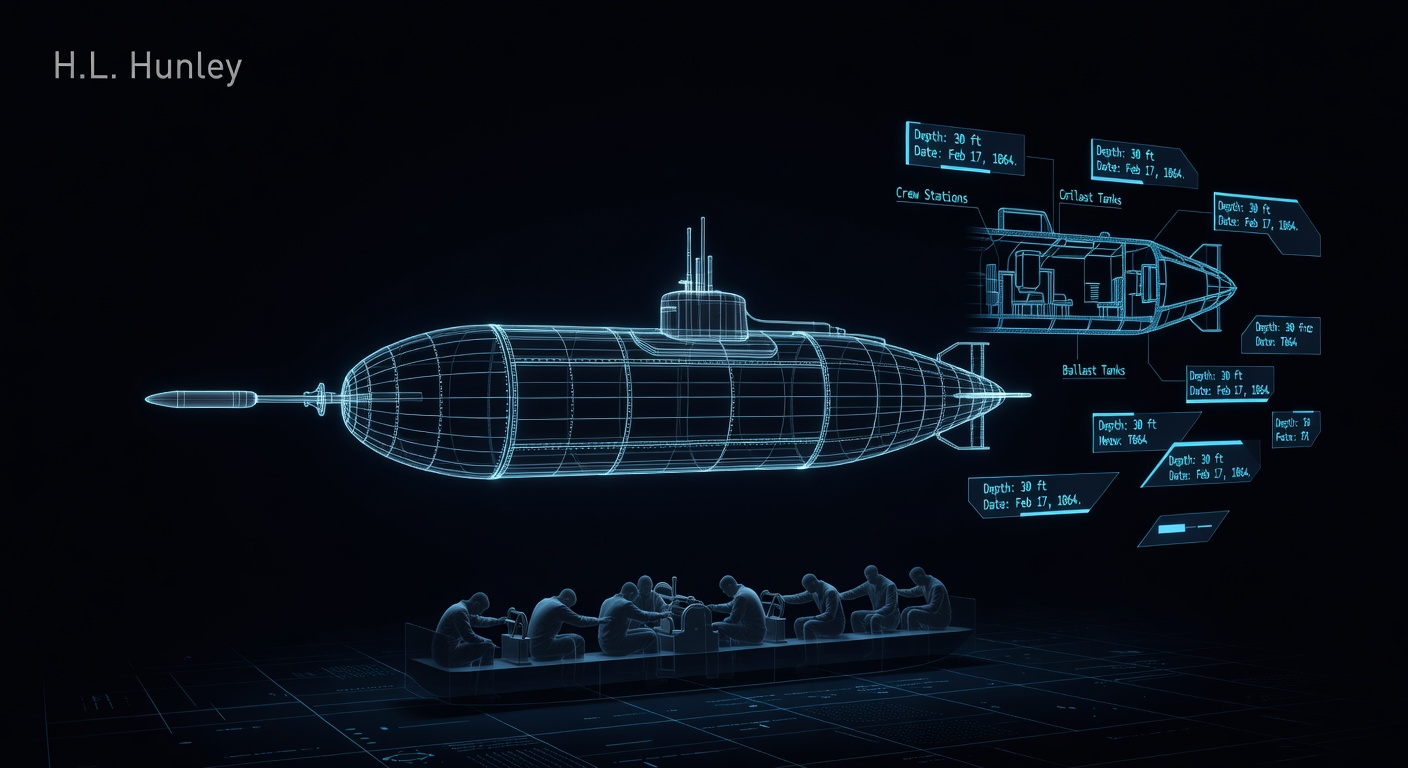
A Ghost Ship Frozen in Time
Imagine being an archaeologist who opens up a 150-year-old submarine and finds eight perfectly preserved bodies, each one still sitting calmly at their workstation—like they're about to clock back in from a break. That's exactly what happened when the H.L. Hunley was pulled from Charleston Harbor in the 1990s, and it absolutely baffled everyone involved.
The Hunley wasn't just any old shipwreck. This thing was legendary in naval history. Back in 1864, as the Civil War was winding down, it did something that had never been done before: it became the first submarine ever to actually sink an enemy warship in combat. The USS Housatonic went down, along with some of its crew. That alone would've made the Hunley famous.
But here's the creepy part—on the very same night the Hunley pulled off this historic first, it also sank. All eight crew members went down with it, and nobody found them for over 130 years.
The Mystery That Didn't Make Sense
When divers finally recovered the Hunley and brought it to the surface, they expected to find what they always find in sunken submarines: a nightmare scene. You know what I mean—bodies piled up near exit hatches, evidence of desperate scrambling, maybe signs of men trying to claw their way out of a metal tomb. That's the historical pattern with submarine disasters.
But the Hunley was different. The eight men aboard were just... there. Sitting. At their stations. Completely composed.
One historian described it perfectly: instead of finding panicked sailors clustered near the exits in a last-ditch escape attempt, researchers found them "seemingly serene," each one positioned peacefully at their post. No scratches on the hatches. No evidence of frantic struggling. Nothing.
What was going on? How could eight intelligent men, facing certain death in a sinking metal tube, just sit there and accept it?
Enter the Graduate Student Detective
This mystery hung around for nearly two decades, frustrating historians and marine researchers alike. Then in 2017, a Duke University graduate student named Rachel M. Lance decided to crack the case using modern science.
Here's where it gets clever: Lance built a scale model of the Hunley—1/6th the actual size—and studied how explosions behave underwater. She looked at old experimental data, ran calculations, and basically recreated what would've happened when that 135-pound black powder torpedo did its thing.
Here's what she discovered: the Hunley's torpedo wasn't launched in the fancy way we imagine modern submarine warfare. It was literally strapped to a 16-foot pole sticking out from the front of the sub. When it hit the USS Housatonic and exploded, something unexpected happened.
The Killer You Never Saw Coming
The explosion that sank the Housatonic also sent a massive blast wave backward through the water—right at the Hunley itself. This wasn't just a gentle push either. The shock wave was powerful enough to make the submarine's entire hull flex and contort.
Lance's calculations showed that this blast wave was so intense that each crew member had less than a 16% chance of surviving the impact. In other words, they never stood a chance.
The most likely scenario? Those eight sailors died instantly from the shock wave of their own weapon. They never even realized their submarine was sinking because they were already gone. They literally never got the opportunity to panic or try to escape—they just... stopped.
Why This Story Matters
There's something oddly noble about how this tragedy played out. Those men made history in their final moments, becoming the crew of the first combat submarine to sink an enemy vessel. And they died the way sailors throughout history probably dream of—doing their jobs, at their posts, in the middle of something that mattered.
The Hunley's crew didn't go out in chaos or desperation. They went out instantly, still performing their duties, unknowingly having changed naval warfare forever.
It's a grim reminder that sometimes history's most important moments come with the heaviest price tags.