
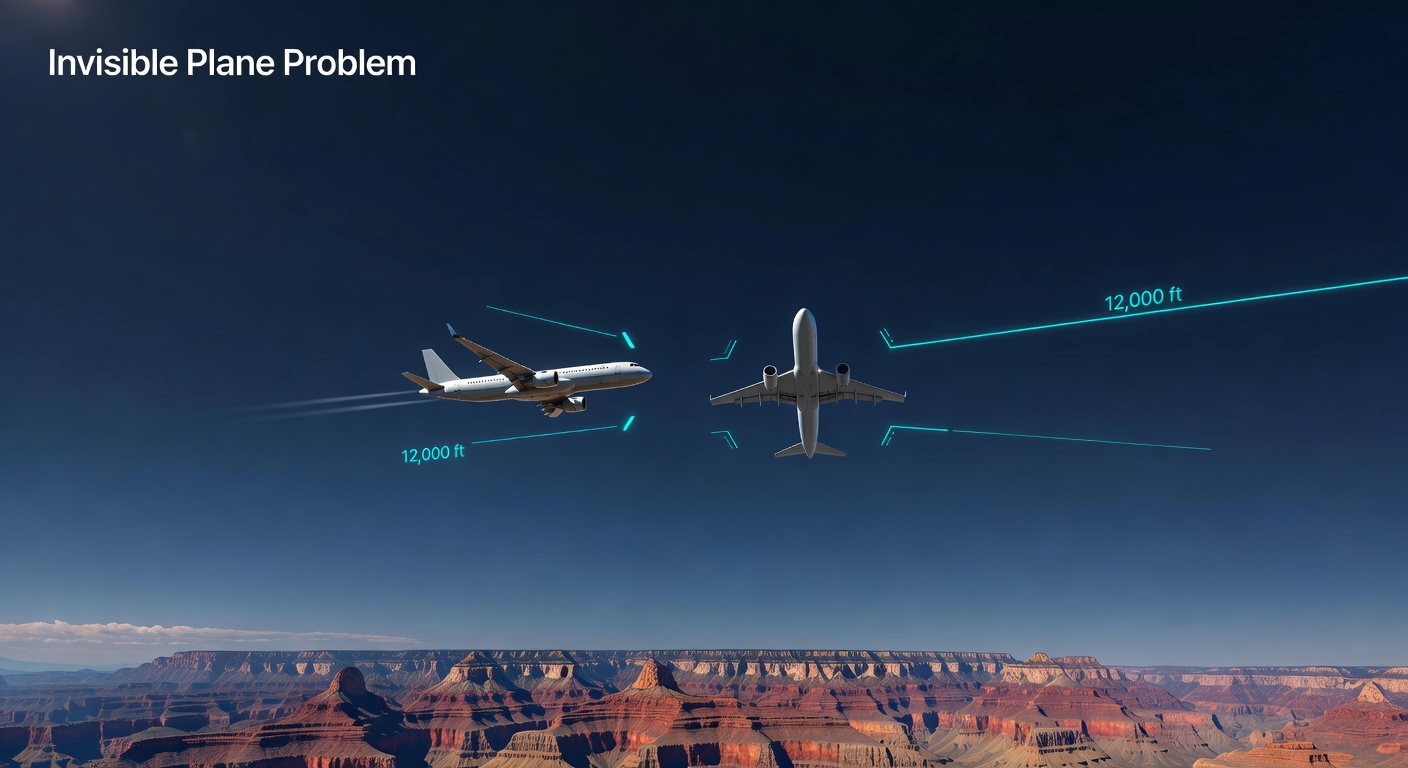
Why You Can't See the Plane Coming Straight at You
Here's a wild fact that keeps aviation safety experts up at night: the hardest plane to spot in the sky is the one heading directly toward you.
It sounds ridiculous, right? An airplane is a massive machine. Shouldn't it be easy to see? But our brains and eyes evolved to detect movement—things crossing left to right, up and down, that kind of thing. When something is coming straight at you without changing position in your field of view, your brain basically goes "nothing to see here."
The Physics of the Invisible Collision
This phenomenon has a fancy name in aviation: constant bearing, decreasing range. The bearing (the direction) stays the same, the distance keeps shrinking, and if both planes keep their current course, they're headed for the same exact spot.
Here's what this looks like from a pilot's perspective: Instead of seeing a plane move across the windshield, they see something that appears to get gradually bigger while staying in roughly the same spot. It's like watching a picture slowly zoom in—your eyes aren't great at recognizing that as a threat, especially when the object is still far away.
By the time your brain finally registers "wait, that's actually a plane and it's getting dangerously close," you might have only seconds to react. The FAA estimates pilots need 12.5 seconds to spot something, realize it's an aircraft, understand it's a threat, make a decision, and actually move the controls. In a fast-moving jet, those seconds evaporate impossibly fast.
The Cockpit Doesn't Help
Things get worse when you add the actual reality of flying a modern aircraft. The windframe has posts and supports that block portions of the sky. Clouds suddenly appear and cover approaching aircraft. And here's the thing people don't always think about: pilots are busy. While they're supposedly scanning the horizon for other planes, they're also managing instruments, radio communications, navigation systems, weather data, and passenger comfort.
It's like asking someone to watch for traffic while they're reading a map, listening to directions, and adjusting the radio. Our attention isn't infinite.
When the System Failed: The Grand Canyon Disaster
On June 30, 1956, all these factors came together in tragedy. TWA Flight 2 and United Airlines Flight 718 collided above the Grand Canyon in broad daylight, killing all 128 people aboard both aircraft.
What made this disaster particularly frustrating is that the danger signs were visible to air traffic control. Both planes reported their positions to the Salt Lake City controller, and the numbers showed they were both expecting to reach the same waypoint (the Painted Desert line) at the same altitude (21,000 feet) at virtually the same time.
But here's where the system completely fell apart: the controller wasn't allowed to warn them.
The Fatal Gap in the Rules
At the time, these aircraft were flying in uncontrolled airspace following what's called "see and avoid" rules. Basically, the pilots were entirely responsible for spotting each other. The air traffic controller knew about the potential conflict but had no authority—and no requirement—to intervene.
Both flight crews had also chosen to fly "off-airways," taking more direct routes instead of following the established airline corridors. This was legal, but it put them in an area with no electronic tracking and no safety net. The assumption was that pilots could visually separate themselves from other aircraft.
They couldn't. And 128 people died because of that assumption.
Why This Still Matters Today
The Grand Canyon collision exposed something that aviation experts had been warning about for years: human eyes and brains simply cannot be relied upon as the sole method for preventing midair collisions. The "see and avoid" principle sounds good in theory, but it conflicts with how human vision actually works.
This disaster triggered massive changes in aviation—better radar systems, controlled airspace requirements, and collision avoidance technology. But the underlying lesson remains relevant: we can't depend on human perception alone when the stakes are this high.
It's a humbling reminder that sometimes the most dangerous things are the ones we can't see, even when they're right in front of us.
Source: https://www.popularmechanics.com/flight/airlines/a71271196/airliner-collision-grand-canyon-disaster