
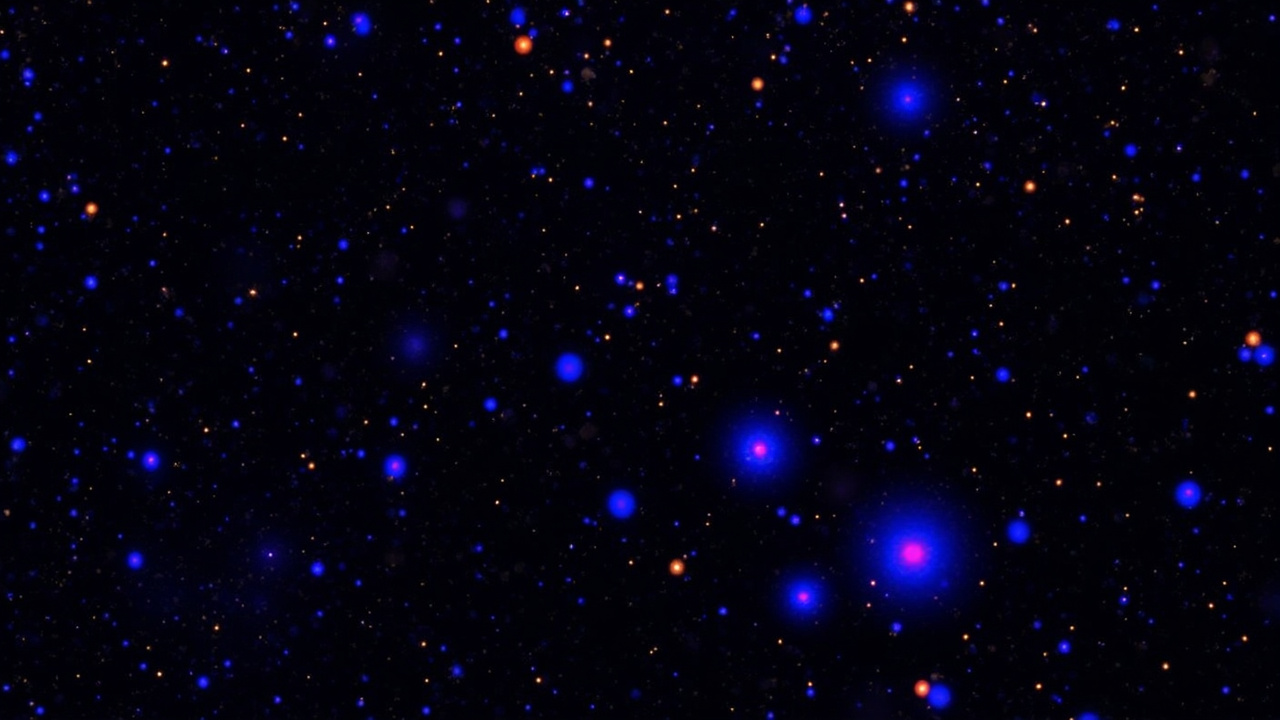
Picture the Universe Like a Cosmic Spider Web
Imagine if you could see the entire universe laid out in front of you—not just the pretty galaxies we usually photograph, but the entire structure holding everything together. That's basically what astronomers just accomplished, and honestly? It's kind of like discovering that reality has a hidden blueprint we couldn't see before.
The "cosmic web" isn't something you can touch or hold. It's the vast network of dark matter and gas that weaves throughout space, connecting galaxies and galaxy clusters across mind-bending distances. Think of it like the wooden frame of a house—you don't notice it because the walls cover it up, but it's what gives the whole structure its shape and strength.
Why James Webb Changed the Game
When NASA's James Webb Space Telescope launched in 2021, it was like upgrading from old glasses to a brand-new pair with perfect prescription lenses. This telescope can see infrared light, which means it can detect galaxies that are so faint and so far away that earlier telescopes like Hubble basically gave up on them.
Here's the really cool part: because light takes time to travel to us, looking at distant galaxies is like looking back in time. When JWST peers at galaxies billions of light-years away, it's literally seeing what the universe looked like billions of years ago. It's time travel, but with photons instead of a DeLorean.
The COSMOS-Web Project: Mapping the Unmappable
A team led by researchers at UC Riverside decided to use JWST for its biggest survey project yet: COSMOS-Web. They pointed the telescope at a patch of sky roughly the size of three full moons and said, "Let's map everything."
What they found was spectacular. They identified 164,000 galaxies and traced their positions back through cosmic time—all the way back to when the universe was only about a billion years old. For perspective, the universe is about 13.7 billion years old now, so they were basically looking at the universe when it was a toddler.
From Blurry to Crystal Clear
Hossein Hatamnia, the lead researcher on the project, explained something that really drives home how revolutionary this is: when Hubble had looked at the same patch of sky before, the image was so blurry that separate structures looked like one giant blob. JWST's sharper images revealed that what Hubble saw as one fuzzy thing was actually many distinct structures.
"What used to look like a single structure now resolves into many," said Bahram Mobasher, one of the project leaders. It's like someone took off a foggy lens and suddenly you could see clearly.
The improvement comes from two things working together: JWST detects way more faint, distant galaxies than older telescopes could, and it measures their distances much more accurately. When you know exactly how far away each galaxy is, you can place it precisely on your cosmic map, filling in details that were basically invisible before.
What Does This Actually Tell Us?
So what can we learn from a clearer map of the cosmic web? Everything, basically. It helps us understand how galaxies form and evolve over billions of years. It shows us how gravity sculpts the universe on the largest scales. And it lets us see the universe at different ages—like comparing baby pictures, childhood photos, and adult pictures to understand how something grows and changes.
The bright yellow regions on the map show dense clusters and filaments where galaxies hang out together like cosmic cities. The dark regions? Those are the voids—enormous empty expanses of space with barely anything in them. Together, they create the web's distinctive pattern.
Science That Everyone Can See
Here's my favorite part about this whole project: the researchers made all their data publicly available. They released the maps, the catalog of 164,000 galaxies, a video showing the cosmic web evolving over billions of years, and even the tools they used to build it.
This is what open science looks like. Instead of hoarding their data, they're saying, "Hey, other scientists, artists, students, and curious people everywhere—here's what we found. What can you do with it?" That's pretty awesome.
The Universe Just Got Clearer
I think what gets me most excited about this discovery is what it represents: we're living in an era where we can actually see the deep structure of the universe in unprecedented detail. Our parents' generation could only imagine what this might look like. We get to actually see it.
And honestly? It's even cooler than we imagined. The cosmic web isn't just some abstract concept—it's a real, observable structure that connects every galaxy in existence, stretching back nearly to the beginning of time itself.
The universe just became a little less mysterious. And a lot more beautiful.