
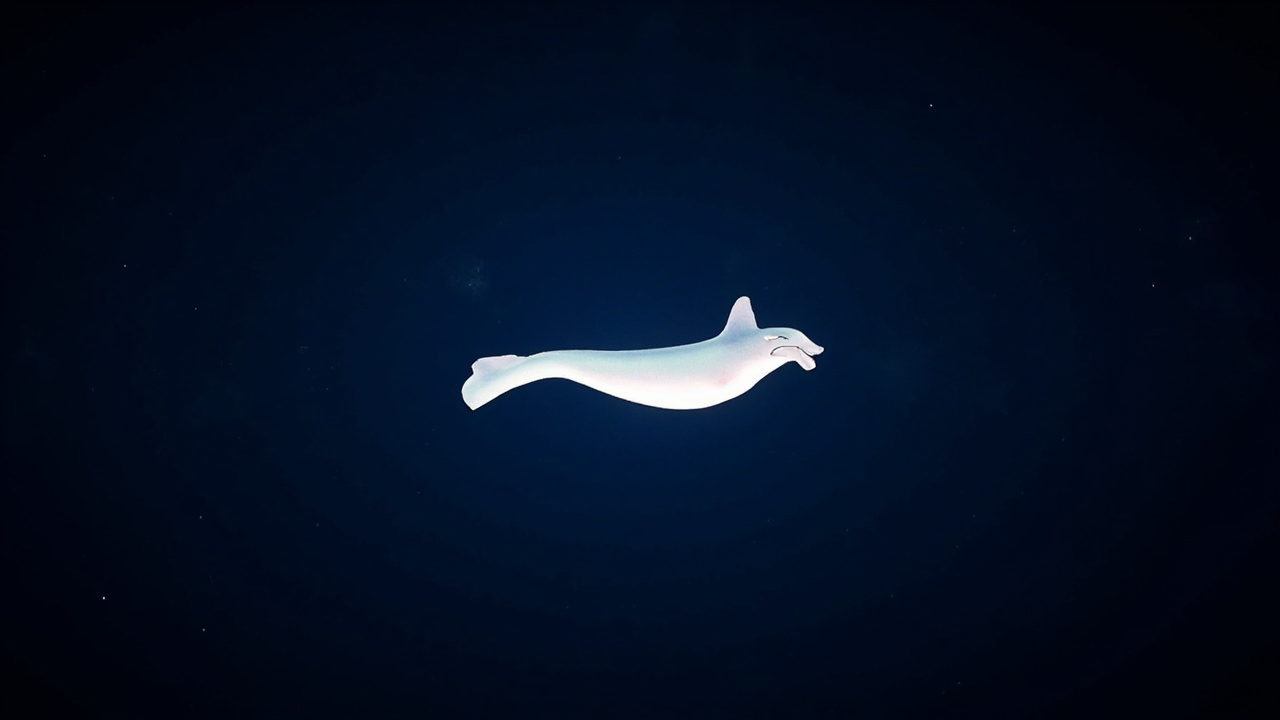
The Little Porpoise Running Out of Time
Have you ever heard of the vaquita? If not, you're definitely not alone. This tiny porpoise—measuring just about 5 feet long—has spent most of its existence hiding in the shallow, murky waters of Mexico's Gulf of California, completely unknown to science until the 1950s. And now, heartbreakingly, it might vanish before most people ever get the chance to learn its name.
A Species Teetering on the Edge
Let me paint you a picture: imagine the ocean's smallest member of the whale, dolphin, and porpoise family (yes, they're all cousins!). The vaquita has these distinctive dark circles around its eyes and mouth, like it's been secretly wearing mascara. It's shy, it's elusive, and it lives only in one tiny corner of the world.
That uniqueness is exactly what's making this story so tragic.
Today, scientists estimate fewer than 10 vaquitas remain swimming in those waters. Let that number sink in for a moment. We're not talking about "endangered" in the abstract way we sometimes use the word. We're talking about a species that could be gone within my lifetime—or yours.
The Accidental Victim of an Illegal Trade
So what went wrong? The vaquita didn't become endangered because people were hunting it directly. Instead, it became trapped in someone else's problem.
You see, there's another creature in those same waters: the totoaba, a large fish whose swim bladder is considered a delicacy and commands astronomical prices on black markets in Asia. Gillnets—those long walls of netting that hang vertically in the water—were set illegally to catch totoaba. And the poor, innocent vaquita would swim right into them, unable to escape.
Despite fishing bans that have existed for decades, the illegal totoaba trade continues. And every gillnet in the water is a potential death trap for the vaquita.
When the Real Thing Is Gone, What Then?
Here's where things get really interesting—and honestly, a bit emotional for me to write about.
A team of researchers, in a collaboration that reads like a scientific dream team (Florida Atlantic University, San Diego Natural History Museum, SeaWorld, and NOAA Fisheries), decided to do something remarkable. They took a vaquita skeleton that had been sitting in museum storage since 1966 and gave it a whole new life.
Using medical CT scans, ultra-powerful micro-CT imaging (capable of seeing details smaller than a human hair), and high-resolution photography, they created what might be the most complete digital anatomical record of a vaquita ever made.
Think about that: thousands of cross-sectional images stitched together into interactive 3D models that can be rotated, zoomed, and studied from every angle without ever touching the original skeleton. They've essentially created a digital twin of this incredibly rare animal.
Why Does This Even Matter?
You might be wondering—if the vaquita is almost gone, what's the point of scanning its bones?
But that's exactly why this matters so much. These digital models are being shared freely with researchers, museums, and educators around the world. Schools can print 3D replicas for classrooms. Scientists can study anatomy without requesting fragile specimens. Conservationists can show people exactly what we're fighting to save.
"It's not just a model, but a layered dataset," explained Marianne Porter, one of the researchers on the project. And honestly? That feels like an act of hope disguised as technology.
More Than Just Data
I keep thinking about this. These researchers know the odds aren't great for wild vaquitas. They've seen the population charts going in the wrong direction for years. But instead of giving up, they decided to preserve knowledge itself—to make sure that even if the worst happens, the world won't forget what the vaquita looked like, how it was built, what made it unique.
There's something deeply human about that. We document. We remember. We refuse to let things disappear without a trace.
Can We Still Save the Vaquita?
The digital archive is inspiring, but let's be real—it's not a substitute for actually keeping the species alive. The fight to save the vaquita still comes down to the same challenges: stopping illegal fishing, removing gillnets from their habitat, and dismantling the black market demand for totoaba.
Some brave conservationists are even experimenting with catching vaquitas temporarily to protect them in secure enclosures—a controversial but desperate idea born from desperation. Others are working to make fishing in the region safer and more sustainable for everyone.
What Can You Do?
Awareness matters. Every person who learns about the vaquita is a potential voice for change. Share this story. Talk about it. Ask questions about sustainable seafood and the illegal wildlife trade.
And maybe, just maybe, by the time this digital archive becomes the world's primary record of the vaquita, there will still be a few left swimming in those warm Mexican waters—proving that sometimes, hope is the most stubborn creature of all.