
Wait, Wrinkles Can Make Electricity?
Okay, I need to tell you about something that just blew my mind, and I've been covering science for years.
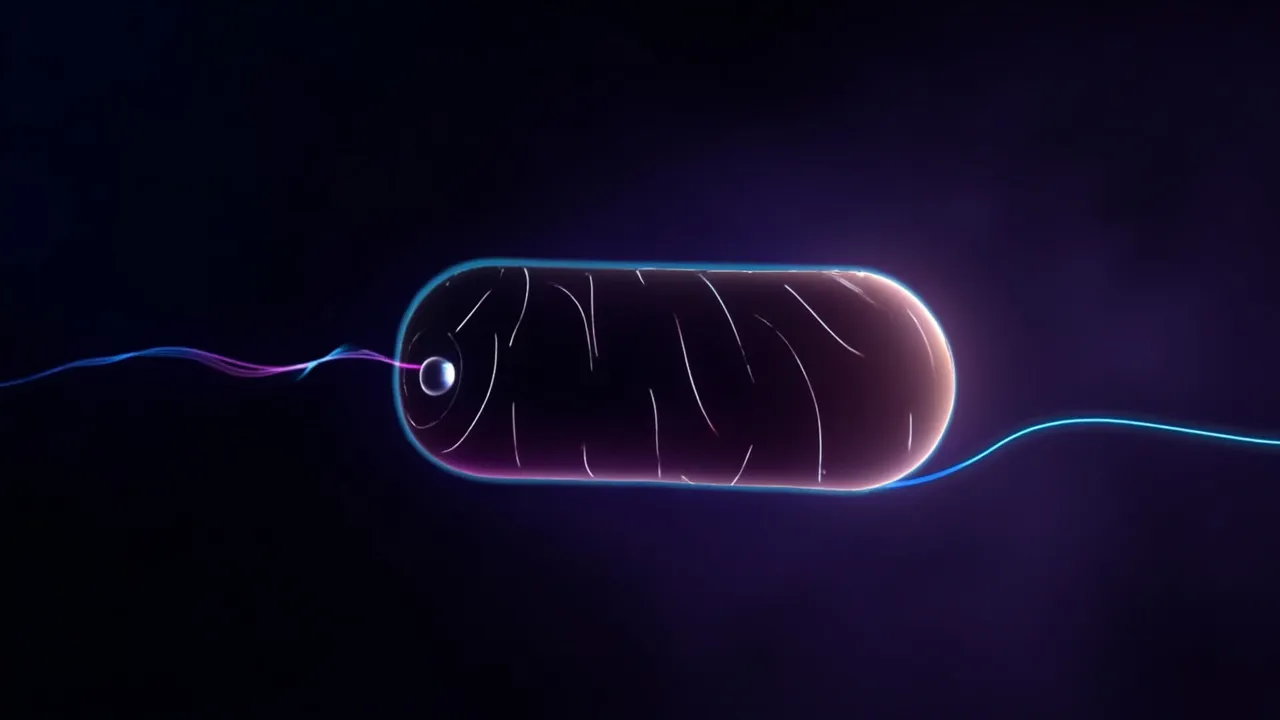
Researchers at Rice University were playing around with graphene — you know, that "wonder material" made of a single layer of carbon atoms — when they noticed something weird. The tiny wrinkles that naturally form in this ultrathin material were doing something remarkable: they were generating electrical effects.
Not through chemicals. Not through added materials. Just through their shape.
Think about that for a second. We're not talking about some complex manufacturing process or exotic additions. We're talking about wrinkles. The kind of thing you'd normally try to smooth out.
The "Ruler" Analogy That Made It Click for Me
One of the researchers, Sathvik Ajay Iyengar, compared the effect to bending a flexible ruler — except the bend is squeezed into a space smaller than a billionth of a meter. At that scale, something wild happens: the electrons in the graphene shift slightly toward one side, creating two opposite electrical "sides" like the ends of a tiny battery.
This is called flexoelectricity, and honestly, the name doesn't do it justice. It sounds boring, but what it means is that when you bend certain materials the right way, electricity just... appears.
Why This Is a Really Big Deal
Here's where things get exciting for the future of technology.
Traditionally, if scientists wanted to change how a material behaves electrically, they'd have to:
- Add chemicals to it
- Combine it with other materials
- Dope it with different elements
All of that is complicated, expensive, and sometimes environmentally questionable. But this new research suggests we might be able to tune electrical properties just by changing a material's shape.
That's a completely different approach. And honestly? It feels like we've only just started exploring what's possible.
The researchers found something particularly interesting: sharpness matters way more than size. A super sharp, tiny wrinkle actually produced stronger electrical effects than a larger, gentler one. The team measured polarization (that's the separation of positive and negative charges) that was between 100,000 and 10 million times stronger than what we see in larger flexoelectric systems.
Let me put that in perspective: if we could somehow scale this up — and that's a big "if" — we're talking about an almost unbelievably powerful effect from something so small you can't even see it.
The Cool Backstory
There's something I love about this story: the theoretical prediction for this effect was made way back in 2008 by physicist Vincent Meunier.
At the time, actually measuring such a tiny effect was basically impossible. The wrinkles in question are only a few atoms wide. Try measuring the electrical properties of something that small. I'll wait.
But years later, Iyengar was going through old data he'd collected with colleague Manoj Tripathi when he noticed something unusual: those strange electrical signals were showing up exactly where the sharpest wrinkles were located.
He shared the data with Meunier — who had co-advised his doctoral work — and suddenly the pieces clicked. Here was experimental proof for an idea that had been floating around for nearly two decades.
"When Sathvik showed me the measurements, we realized that the unusual signals could provide an experimental connection to an idea we had predicted many years earlier," Meunier said.
How cool is that? An old prediction finally getting its moment in the spotlight.
What Could This Lead To?
The researchers are careful not to overhype — and I appreciate that about them — but the potential applications are genuinely intriguing:
- More sensitive sensors: If you can generate electrical signals from physical changes at the nanoscale, you could detect incredibly subtle movements or forces.
- Extremely thin electronic devices: Imagine electronics that don't need bulky batteries or complicated circuitry — maybe the structure itself does some of the work.
- New ways to control electricity in materials: Instead of chemical modifications, shape-based tuning could offer more precise control.
The quote from Pulickel Ajayan really captures the spirit of this discovery: "Our work shows that even an ordinary wrinkle can become an extraordinary electronic feature when viewed at the atomic scale."
My Take
I love stories like this because they remind us that we're still discovering fundamental things about materials we thought we understood.
Graphene has been hailed as a wonder material for over a decade now, and we've found tons of amazing things about it. But here's the thing — most of that research has focused on its flat, pristine form. This new work suggests that the imperfections — the wrinkles, the folds, the natural variations — might be just as important, maybe even more so.
There's something poetically satisfying about that, isn't there? The idea that in a world obsessed with perfection and smoothness, the wrinkles might be where the real magic happens.
We'll have to wait and see what practical applications emerge from this research. But personally? I'm excited to see where this goes. The idea that we might one day "design" materials not through chemistry but through geometry feels like we're only scratching the surface of what's possible.
Source: https://www.sciencedaily.com/releases/2026/08/260815064801.htm