
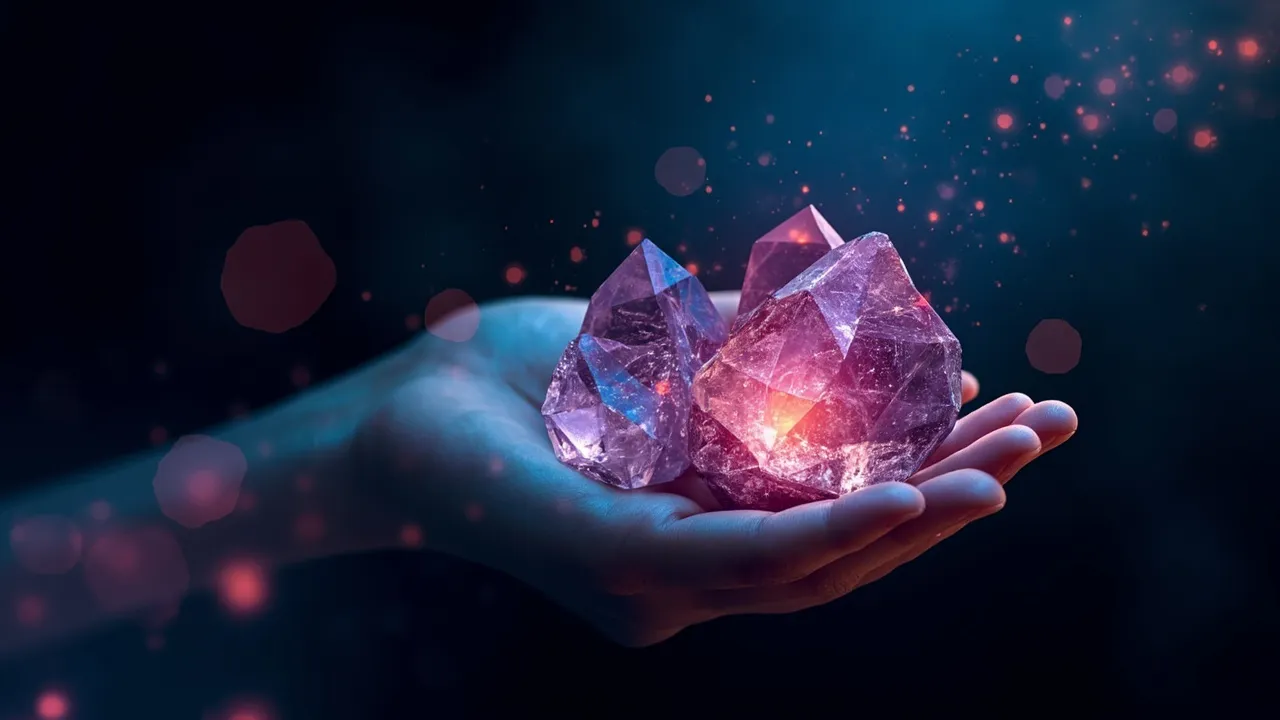
I've always been that person who picks up an interesting rock, holds it to the light, and pops it in my pocket "just because." Apparently, I'm not alone — and I mean that in the most ancient, evolutionary sense of the word.
Archaeologists have found crystals at numerous sites containing Homo remains dating back 780,000 years. These weren't tools, weapons, or jewelry. They were just... pretty. And nobody could really explain why our early relatives were hoarding shiny rocks for nearly a million years.
That is, until researchers decided to study our cousins: chimpanzees.
What's So Special About Crystals, Anyway?
The researchers — led by Prof Juan Manuel García-Ruiz from the Donostia International Physics Center in Spain — wanted to understand what makes crystals so appealing to us. Their approach? Test chimpanzees, our closest living relatives who shared a common ancestor with us 6-7 million years ago.
Here's what they did: They gave two groups of chimpanzees access to large crystals alongside regular rocks of similar size. The results? The crystals won — hands down. (Or should I say, hands-on?)
One chimp named Yvan actually picked up the crystal and carried it back to his sleeping quarters. When researchers tried to get it back, they had to trade bananas and yogurt. (I'd have done the same thing, honestly.)
They Could Spot Crystals in Seconds
But here's where it gets really interesting. The researchers mixed small quartz crystals into piles of 20 regular pebbles. The chimpanzees found the crystals within seconds. Even when they added different types of crystals with varying shapes, the chimps still picked them out.
The chimps started examining the crystals' transparency by holding them up to eye level and looking through them. One chimp, Sandy, carried both pebbles and crystals in her mouth to a wooden platform and sorted them into separate groups.
Now, here's the thing — chimpanzees don't normally transport objects in their mouths. So Sandy hiding these crystals away? That suggests she might have regarded them as valuable. Which is pretty much exactly what our early human ancestors were doing 780,000 years ago.
The Science Behind the Sparkle
So what makes crystals so irresistible? The researchers concluded that two features stand out: transparency and geometric shape.
Think about it. Most things in nature — trees, rivers, clouds, animals — are all curvy and organic. But crystals? They're the only naturally occurring objects with flat surfaces and perfectly straight edges. They're literally geometric anomalies in a world of messiness.
There's something almost mathematical about their beauty. The way light passes through them, the sharp angles, the symmetry... it all creates a sensory experience that our brains (and apparently, chimp brains) find genuinely fascinating.
What This Means for Understanding Human Evolution
Here's my take: I think this study reveals something beautiful about human nature. We often think of early humans as purely practical creatures — focused on survival, hunting, and reproduction. But the fact that our ancestors were collecting "useless" pretty objects for nearly a million years tells us something profound.
We were always more than just survival machines. We were always curious. We always found meaning in beauty for beauty's sake.
The researchers noted that some chimps showed more interest in crystals than others, suggesting personality differences in this attraction. There are "Don Quixotes and Sanchos," as García-Ruiz put it — idealists and pragmatists. Some of us just notice these things more.
What Now?
The study used chimpanzees that live around humans, so researchers acknowledge we should test wild populations too. But honestly? I think we've already learned something remarkable.
Our attraction to crystals isn't some arbitrary cultural quirk. It seems to run deep — deep enough that it's written into the behavioral toolkit we share with our closest relatives. Somewhere in our shared evolutionary history, noticing beautiful, unusual objects became advantageous enough that it stuck around for millions of years.
So the next time someone teases you for collecting crystals or pretty rocks, just tell them: you're engaging in behavior that's nearly a million years old. That's not weird. That's ancestral.
And personally? I think that's pretty cool.
Source: ScienceDaily