
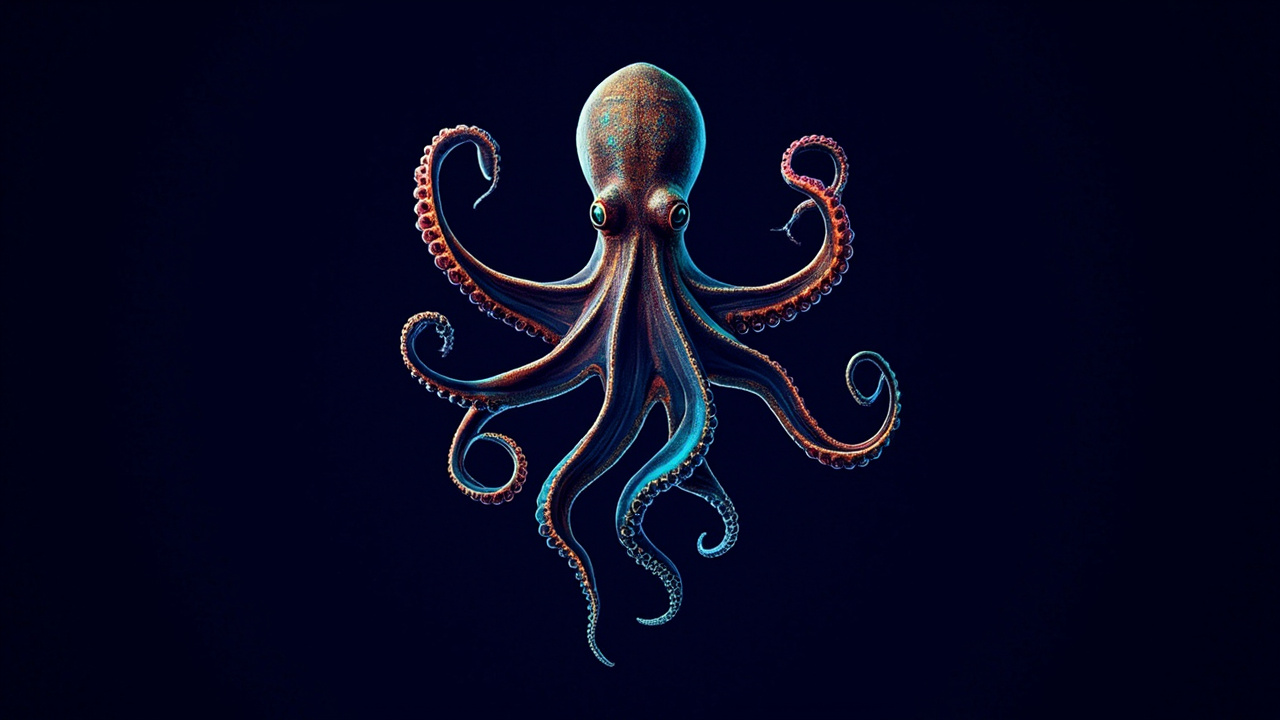
When Octopuses Ruled the Deep: A Prehistoric Plot Twist
You know that feeling when you learn something completely upends what you thought was true? That's exactly what happened to me when I read about this recent discovery. For years, the story went: octopuses are these modern, clever creatures that evolved to be soft-bodied sneaks, slipping through cracks and hiding in dark corners. But it turns out their ancient ancestors were basically the ocean's version of apex predators—the T-Rex of the sea, if you will.
The Mystery of Soft Bodies and Hard Evidence
Here's the problem scientists have always faced: octopuses don't have bones or shells. That means when they die, they basically disappear from the fossil record. It's like trying to solve a murder mystery when the victim leaves no trace. Pretty frustrating for paleontologists trying to understand how these creatures evolved.
But researchers at Hokkaido University got clever. Instead of looking for entire fossils, they focused on something that actually survives millions of years—the jaw. And boy, did those jaws tell a story.
Finding Monsters in the Rocks
Using some seriously advanced technology (we're talking high-resolution grinding tomography—basically a fancy digital way to slice through rocks without destroying them), scientists discovered fossilized octopus jaws from the Late Cretaceous period. We're talking 100 to 72 million years ago, when dinosaurs still roamed the Earth. They found these specimens in Japan and Vancouver Island, places where ancient seafloors were calm enough to preserve these delicate structures.
Here's where it gets wild: these weren't your average cephalopod jaws. They were huge.
Giants With Crushing Power
Based on the size and shape of these fossils, researchers concluded that these ancient octopuses could grow up to 20 meters—that's about 65 feet. For perspective, that's longer than a school bus. And these weren't gentle giants. The jaw fossils showed extensive damage: chips, cracks, scratches, and polish marks everywhere.
What does all that wear and tear mean? Repeated, violent encounters with prey. We're talking about animals that regularly crushed hard shells with their powerful bites. The damage was even worse than what you see in modern cephalopods that eat hard-shelled creatures, which tells you these prehistoric octopuses were absolutely relentless hunters.
In fact, some specimens had worn away up to 10% of their jaw tip. That's the kind of damage you only get from a lifetime of aggressive feeding.
The Intelligence Factor
Here's something that surprised even the researchers: the wear patterns on the jaws weren't even. One side showed significantly more damage than the other, suggesting these octopuses had a preferred side for biting.
Why does that matter? In modern animals, this kind of lateralization—favoring one side—is linked to advanced brain function. So not only were these creatures massive and powerful, they were probably smart too. Your ancient octopus nightmare just got a little scarier.
Rewriting the Ocean's History
For a long time, scientists assumed that ancient oceans were basically vertebrate-dominated spaces. Fish, reptiles, sharks—the big guys with backbones ruled the food chain, and everyone else was just supporting cast.
This discovery flips that narrative on its head. It turns out that invertebrates—creatures without skeletons—could evolve into apex predators every bit as formidable as their vertebrate competitors. The giant octopuses weren't just survivors hanging on at the edges of the ecosystem. They were top-tier hunters directly competing with the big marine reptiles of their time.
Technology Makes the Difference
What I find really cool about this research is how it demonstrates the power of combining old-school paleontology with cutting-edge tech. The AI model helped researchers identify and analyze these fossilized jaws in ways that would've been impossible just a few years ago. This could open doors to discovering thousands of other fossils hidden in rock samples that scientists might otherwise overlook.
The Bigger Picture
So what does this tell us? First, evolution is weird and unpredictable. Second, the history of life on Earth is far more complex than we typically imagine. And third, our assumptions about how ancient ecosystems worked can be completely overturned with a single good discovery.
Those ancient octopuses represent something pretty remarkable: a branch of evolution that tried something different. While most cephalopods went the route of becoming small, clever, and adaptable, their ancestors went big and dominant. That strategy worked for a while—100 million years is nothing to sneeze at—but ultimately, their descendants abandoned that approach and became the creatures we know today.
I think that's kind of beautiful, actually. It reminds us that there's so much we still don't know about our planet's past, and that every fossil discovery is like finding a piece of a puzzle we didn't even know we were trying to solve.