
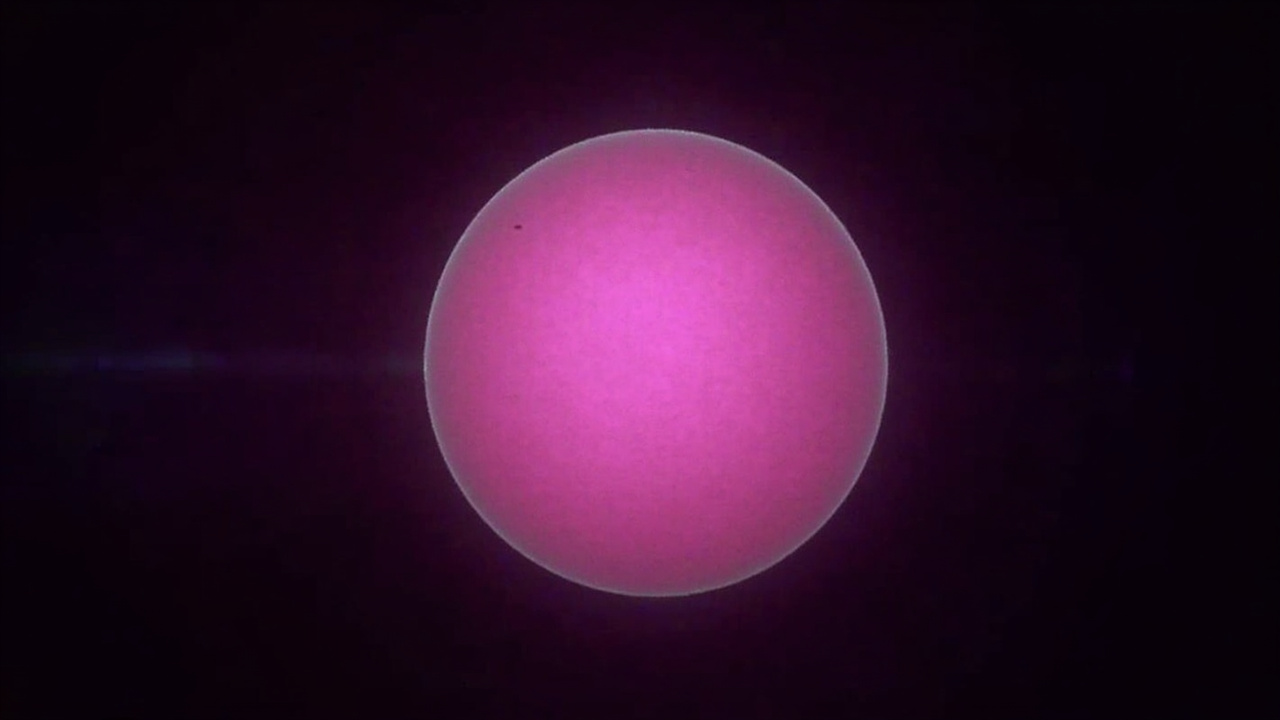
Okay, I need you to picture this with me: there's a planet out there — not too far from us, actually, just 57 light-years — and it's pink. Like, genuinely, genuinely pink. Scientists have been scratching their heads over this world, known as GJ 504 b, ever since it was discovered back in 2013. And now? The James Webb Space Telescope just dropped some absolutely wild news about it.
Salt clouds. Actual salt clouds.
What's the Big Deal?
Let me break this down because it sounds like something from a sci-fi movie. Scientists have long suspected that salt clouds might exist on extremely cold objects in space, but actually finding them? That's been another story entirely. Most of the exoplanets we've studied are absolute furnaces — we're talking 1,000 to 2,000 degrees Fahrenheit. Hot enough to melt... well, pretty much everything.
But GJ 504 b? It's only about 550 degrees Fahrenheit (290 Celsius). That's roughly the temperature inside your oven when you're baking bread. Compare that to the surface of Venus (about 900 degrees Fahrenheit) or even Mercury (way, way hotter), and you start to understand why this little pink world is so special. It's practically a walk in the park by exoplanet standards.
At that temperature, weird chemistry starts happening. And according to new research from Northwestern University published in the Astronomical Journal, that weird chemistry includes — you guessed it — clouds made of salt.
The Pink Planet Mystery Deepens
Here's what's wild about GJ 504 b: scientists aren't even 100% sure it's actually a planet. I know, I know, that sounds confusing. But GJ 504 b is about 25 times the mass of Jupiter. That's... a lot. So much, in fact, that it sits right on the boundary between "really big planet" and "small failed star" (what we call a brown dwarf). The researchers call it a "planetary-mass companion," which is a fancy way of saying "we're not entirely sure what to call this thing, but it's cool and we're going to study it anyway."
The object is also ancient — between 2.5 and 4 billion years old. That age helps explain why it's so relatively cool. Think of it like this: giant planets are born super hot (like, molten-core hot), and they gradually cool down over billions of years. GJ 504 b has been cooling for a long, long time.
Enter James Webb
Here's where things get exciting. For over a decade, scientists tried to study this pink world's light using ground-based telescopes. And you know what happened? Nothing. It was too faint. Too tricky. Like trying to photograph a firefly next to a spotlight — the host star's glare was completely overwhelming.
But James Webb? James Webb doesn't play by those rules.
"When we finally obtained its spectrum, it immediately looked interesting," said Aneesh Baburaj, the Northwestern researcher who led the study. "But once we started digging deeper into the data, we realized it was not like anything we have analyzed before."
The team pointed JWST at GJ 504 b for just two hours. Two hours. And they got more usable data than years of observations with some of the world's largest ground-based telescopes. This thing is sensitive.
So... Salt Clouds?
Now here's where it gets really interesting. When the researchers analyzed the light spectrum from GJ 504 b, they found signs of water vapor, methane, carbon dioxide, ammonia, and other molecules. But when they tried to recreate what they were seeing using computer models, things got weird.
The models kept producing results that didn't make physical sense. You know that feeling when you're following a recipe exactly but your cake comes out as a soggy mess? It was like that, but for planetary atmospheres.
Then someone had an idea: what if there were clouds?
Once they added clouds to the simulations, everything clicked. The inconsistencies vanished. The data made sense. And when they tested three different types of clouds — guess which one fit best?
Salt clouds.
Not the fluffy white stuff you'd put on french fries (though now I'm hungry). We're talking about clouds made of sodium chloride and possibly potassium chloride — the same compounds that make up regular table salt. These exotic clouds appear to be obscuring deeper layers of the atmosphere, essentially creating a veil that's influencing exactly what we see when we look at GJ 504 b.
Why Should You Care?
I know what you're thinking: "Cool space fact, but why does this matter to me?"
Here's why: discoveries like this are teaching us that the universe is way stranger and more diverse than we ever imagined. We're finding worlds with conditions so exotic they barely seem real. And each discovery like this one helps us understand a little bit more about how planets form, how atmospheres work, and just how many different flavors of "planet" are out there waiting to be discovered.
Plus, let's be honest — the image of a pink world floating through space, shrouded in shimmering salt clouds, is just... objectively amazing. It sounds like something a creative writer would invent. But it's real. And we're living in an era where we can actually see it.
The James Webb Space Telescope continues to blow our minds, one discovery at a time. And personally? I can't wait to see what weird and wonderful thing it finds next.