
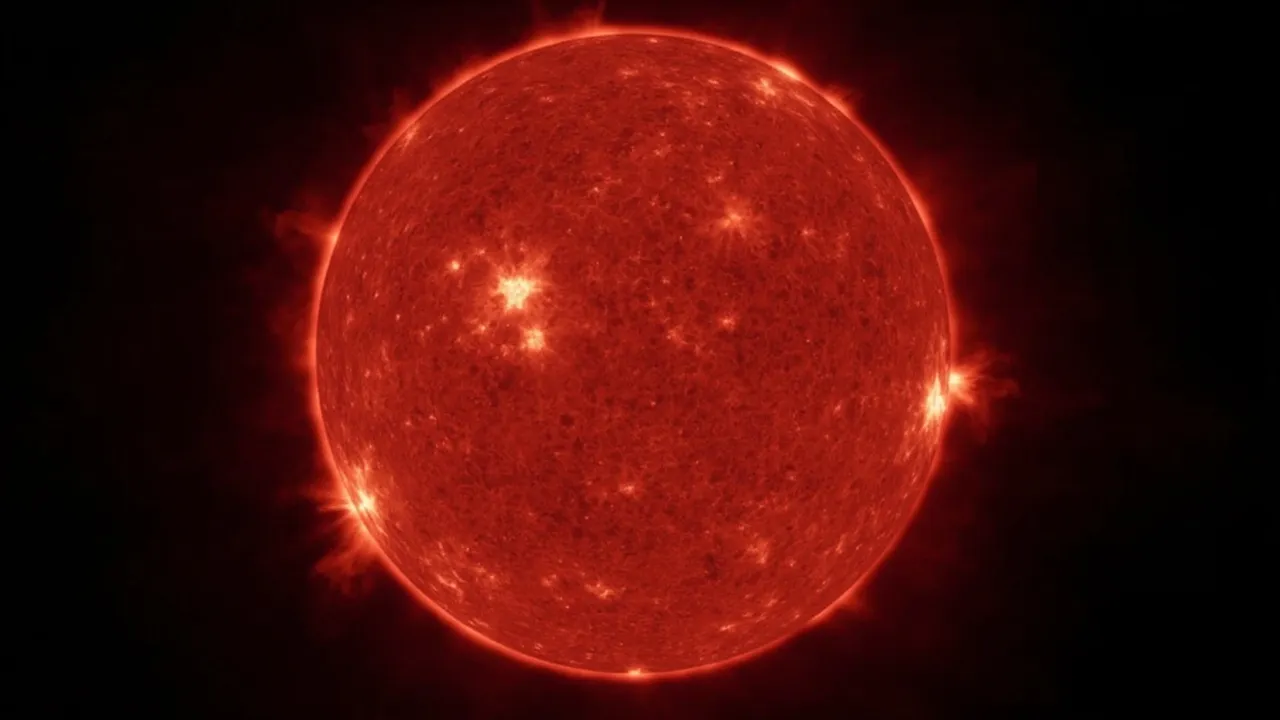
Okay, I need to share something that kept me up at night after reading about it. Our sun? It might be on its best behavior, and that should honestly freak you out a little.
The Neighborhood Nuisance
Picture this: you're living in a quiet suburban neighborhood, and all your neighbors are absolutely unhinged. One house down the street spontaneously combusts every few decades. Another regularly shoots fireballs into the sky. The one across the way seems to exist in a permanent state of explosive chaos.
But your house? Yours is suspiciously, almost eerily calm.
That's basically what's happening in our cosmic neighborhood. Scientists have been studying sun-like stars using NASA's Kepler telescope and the European Space Agency's Gaia mission, and here's the unsettling part: many of them are way more volatile than our own sun. Some of these stellar neighbors regularly produce what's called a "superflare"—an explosion anywhere from 100 to 10,000 times more powerful than a typical solar flare. We're talking about energy equivalent to a trillion hydrogen bombs going off all at once.
And get this: our sun appears to be the only "quiet" one in the bunch. Out of 56,450 sun-like stars studied, about 20% had produced superflares within the observation period. On average, these happen roughly once per century for each star. So statistically speaking, our sun should have done something dramatic by now.
But it hasn't. Which brings us to the new research...
The Close Call We Never Had
A recent study led by scientists at the Max Planck Institute and the University of Colorado Boulder asked the question nobody wanted answered: can our sun actually do this? And more importantly, has it ever come close?
The researchers developed a method to estimate the power of historical solar flares by analyzing something called "flare ribbons"—those glowing remnants left behind after a solar eruption. Think of them like the scorch marks on a wall after something explodes. The bigger the ribbon, the bigger the blast.
When they applied this technique to historical sunspot data spanning 400 years, two events stood out: the famous Carrington Event of 1859 (which you might have heard about—it literally set telegraph wires on fire and created auroras visible near the equator) and the Great Sunspot of 1947.
Now, the Carrington Event was scary, sure. But according to this research, the 1947 sunspot was actually worse—and it's not even close. This monster covered about 0.6% of the solar surface, which sounds tiny until you realize that's roughly 40 Earth diameters wide. The magnetic energy coiled up in that region? It reached the low end of what qualifies as a true superflare.
The sun, for reasons unknown, decided not to pull the trigger. We got lucky.
Why This Should Keep You Up at Night
Here's where I want you to really think about this. Our entire modern civilization runs on electricity and electronics. GPS satellites, power grids, communication networks, banking systems—all of it vulnerable to solar tantrums. Even a moderate solar storm can fry high-voltage transformers and plunge entire regions into blackout. Scientists have warned that a single failure could cascade across interconnected networks, affecting not just neighborhoods but entire continents.
Now imagine something a hundred to ten thousand times stronger.
The Carrington Event happened in 1859, when our technological footprint was basically nonexistent. A similar event today would be catastrophic. And the 1947 close call suggests our sun is absolutely capable of doing something far worse.
The Mystery of the Quiet Sun
Why is our sun so unusually calm compared to its stellar siblings? Scientists genuinely don't know. It's one of the biggest puzzles in solar physics. Is it just a statistical fluke? Is there something special about our position in the galaxy? Are we living during an unusually quiet phase?
Honestly? None of these explanations are particularly reassuring.
What we do know is this: the sun has the capability. The 1947 sunspot proved that. Whether it happens tomorrow or in another 500 years, the potential is there, lurking beneath the surface of our apparently well-behaved star.
So the next time you look up at that bright, warm, life-giving sun, maybe give it a little nod of appreciation. Because right now, for reasons we don't fully understand, it's choosing to be nice to us.
Let's hope that continues.
Source: https://www.popularmechanics.com/space/solar-system/a73860013/superflare-great-sunspot