
Why Mars Exploration Has Always Been So Agonizingly Slow
Here's something that really gets me: when you're commanding a rover on Mars, you can't just give it a quick instruction and expect an instant response. There's this cosmic speed bump called the speed of light that means you're waiting anywhere from 4 to 22 minutes just to get a message there. Then you wait again for it to send back pictures and data.
So what do scientists do? They plan everything obsessively. Every move is choreographed in advance like a ballet. The rovers creep across the landscape at a snail's pace—we're talking a few hundred meters per day—because going faster means higher risk and more power drain. It's safe, sure, but it also means Mars rovers are basically the geological equivalent of a tourist who stops to take a selfie at every landmark.
This is incredibly frustrating when you're trying to answer one of humanity's biggest questions: "Is there life out there?" You need to examine lots of rocks, check lots of locations, and gather diverse samples. But when your robot moves at a crawl and needs permission for every action, that becomes nearly impossible.
Enter the Robot That Actually Takes Initiative
A team of researchers just asked a really interesting question: what if we let the robot do some of the thinking?
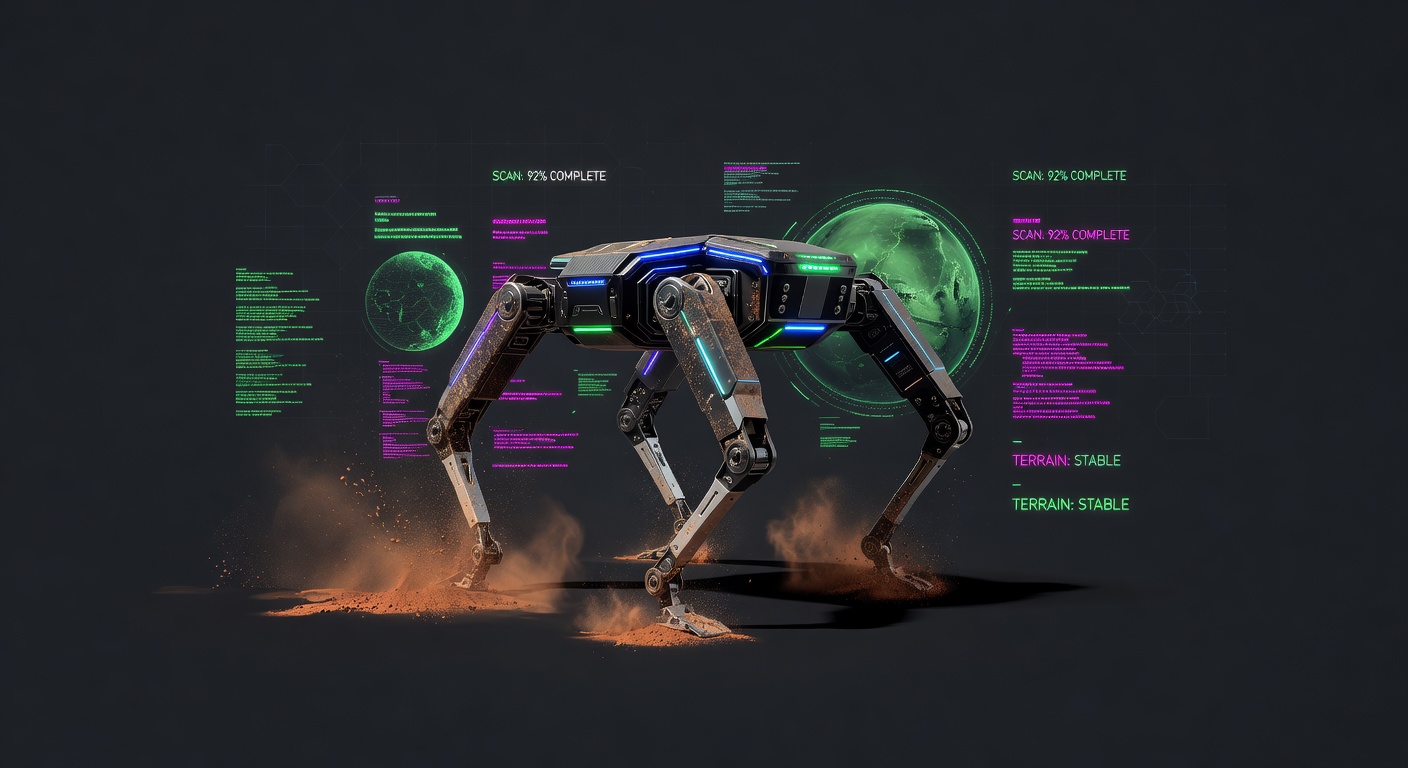
They tested a semi-autonomous robot called ANYmal—yes, that's actually what it's called, and I love it—equipped with a robotic arm and two sophisticated instruments. The robot could navigate on its own, position itself at different rock formations, take measurements, and collect data without waiting for humans to babysit every step.
The results were honestly kind of dramatic. When researchers compared the old method (humans directing a robot to one target) with the new method (robot autonomously hopping between multiple targets), the difference was staggering.
Multi-target exploration: 12 to 23 minutes
Traditional human-guided approach: 41 minutes
Three times faster. For the same quality of science.
The Plot Twist: Smaller Tools, Bigger Impact
Here's what really surprised me about this research: they didn't use massive, complicated instruments. The robot carried compact tools—a microscopic imager and a portable Raman spectrometer (which basically tells you what rocks are made of by analyzing how light bounces off them).
And you know what? It worked perfectly. The robot correctly identified every type of rock it was supposed to find: gypsum, carbonates, basalts, olivine-rich dunite, and anorthosite. These aren't just random rocks—they're scientifically valuable targets. Some of them point to resources that future colonists might actually need.
The researchers tested everything in a facility called Marslabor at the University of Basel, which mimics actual Martian conditions with realistic lighting, dust-analog materials, and terrain. So this wasn't hypothetical—they tested it under conditions that closely match what a real mission would face.
What This Actually Means for Future Exploration
Think about what this opens up. Instead of having one rover meticulously inspect one area at a snail's pace, you could have robots that rapidly scout huge swaths of terrain, gathering preliminary data and flagging the most interesting spots for closer investigation.
Humans wouldn't be cut out of the loop—they'd just work smarter. Scientists could review incoming data and prioritize which locations deserve deeper study, rather than spending hours directing robots to individual rocks.
This matters for both the Moon and Mars. Resource exploration becomes faster. The search for biosignatures—actual evidence of life—becomes more thorough. You're not just gambling that you happened to park your rover near something interesting. You're actively scanning and comparing.
The Bigger Picture
I think what gets me most excited about this research is that it solves a problem that nobody really talks about: the fundamental mismatch between human pace and robot capability.
We've been treating Mars rovers like they're delicate, incompetent children who need hand-holding. But they're actually pretty smart machines. They just needed permission to be smart without constant supervision.
This isn't about removing human oversight—it's about redirecting it. Instead of micromanaging every movement, humans become more like a strategic advisor reviewing information and making big-picture decisions. The robot does what it's actually good at: moving quickly and systematically through rough terrain.
If we want to seriously search for life on Mars, or establish a human presence on the Moon, we need to move faster than we currently do. This research suggests we finally have a way to do that without sacrificing scientific rigor.
Pretty cool, right?