
(markdown formatted)
So here's a fun story from the cosmos.
Scientists were tracking a particularly sneaky particle called a neutrino — you know, one of those ghost-like things that zips through everything, including the Earth, without anyone really noticing. They traced it back to a ridiculously distant galaxy and figured they'd find what usually powers these neutrino-spewing objects: a supermassive black hole doing its thing.
But when they actually looked? Zero black hole activity. Nothing. Zilch.
Instead, they found a galaxy absolutely stuffed with newborn stars, working overtime like some cosmic assembly line. And this discovery has physicists pretty excited, because it might explain where a whole lot of these mysterious neutrinos are actually coming from.
What's the Big Deal About Neutrinos?
Let me break this down real quick. Neutrinos are basically the introverts of the particle world. They don't like to interact with anything — not matter, not energy, not even each other much. Trillions of them pass through your body right now as you read this, and you have zero chance of detecting even one.
Scientists have been hunting down where high-energy neutrinos come from for decades. They've found a few sources, mostly galaxies with active black holes at their centers. But those known sources don't add up to explain all the neutrinos floating around out there.
That's the puzzle this new research might help solve.
Say Hello to the "Shadow Blaster"
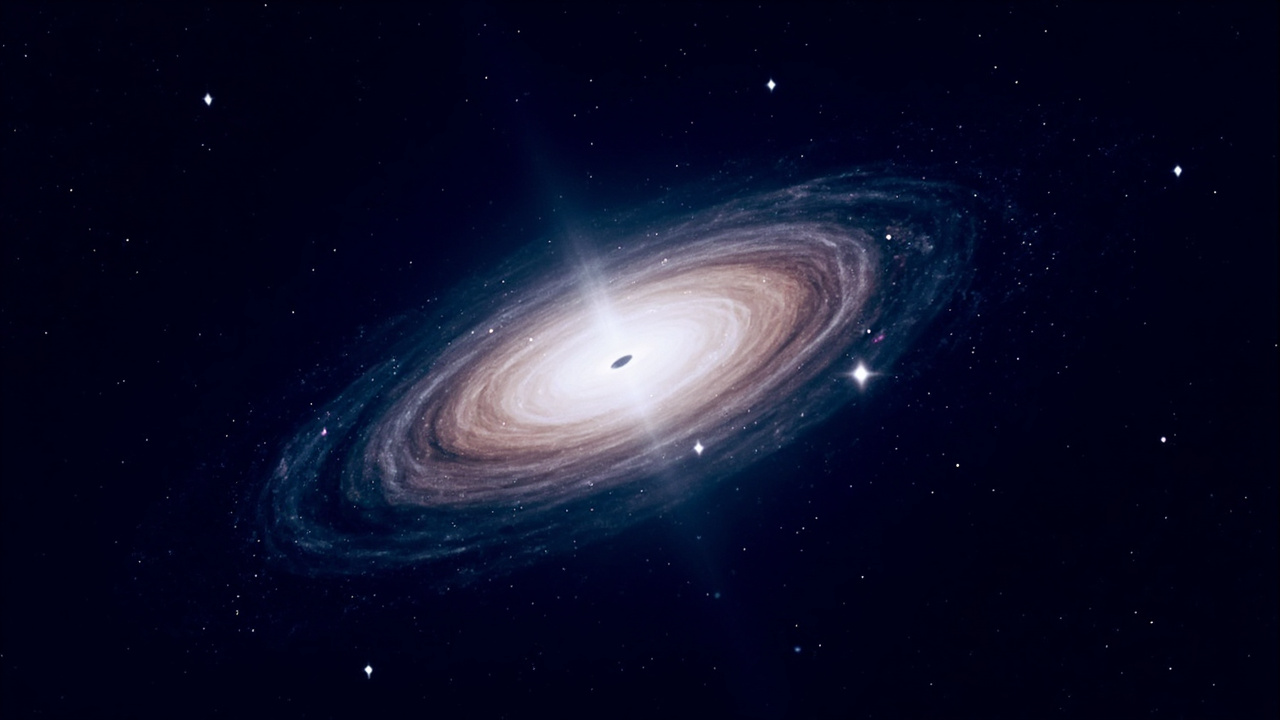
The galaxy in question is called JCMT0402−0424, but the researchers gave it a way cooler nickname: Shadow Blaster. Why? Because this thing is hidden — it's so dusty that regular telescopes can't see its core in visible light. It's only visible at certain submillimeter wavelengths, where it absolutely blazes with brightness.
This galaxy sits about 11 billion light-years away, which means we're seeing it as it looked when the universe was only a few billion years old. It's also incredibly luminous — one of the brightest galaxies ever observed at those wavelengths.
Here's where things get interesting. The scientists expected to find an active black hole, the kind that shoots out jets and radiation like nobody's business. That's what typically powers these bright, neutrino-making galaxies. But when they looked closer? Nothing. No black hole signatures at all.
So what was making all that light?
The Natural Telescope Trick
Now, studying something 11 billion light-years away is no easy feat. Even the best telescopes struggle to make out details at those distances. But the researchers got lucky — there was another galaxy sitting between Shadow Blaster and Earth.
That foreground galaxy's gravity bent and amplified the light coming from Shadow Blaster, acting like a natural magnifying glass. This phenomenon, called gravitational lensing, let the team see much more detail than they normally could. Think of it like the universe doing them a solid.
With this boost, they could peer deep into Shadow Blaster's core and figure out what was really going on.
Star Formation on Steroids
The verdict? The galaxy's incredible brightness isn't coming from a black hole — it's coming from absolutely insane star formation.
Shadow Blaster has a dense core packed with gas and dust in a region only about 1,500 light-years across. For reference, our entire Milky Way is about 100,000 light-years wide, so imagine squeezing enormous amounts of material into a tiny, tiny space.
This kind of extreme environment creates the perfect conditions for producing neutrinos. Stars form, stars explode, stars die — and in these dense, energetic conditions, the particles get shot out into space.
Why This Changes Everything (Maybe)
Here's the thing that has scientists excited: if star-forming galaxies like Shadow Blaster can produce neutrinos, that might explain a huge gap in our understanding.
The researchers estimate that these compact, dusty, starburst galaxies could account for up to 20% of all high-energy neutrinos floating around the universe. That's a significant chunk — and it means we've been missing a major source this whole time.
It's like discovering that a whole group of people in your city have been quietly producing something you thought only a select few could make.
Of course, more research is needed to confirm whether star-forming galaxies are really this important. But if this holds up, it reshapes how we think about where neutrinos come from — and reminds us that the universe is always full of surprises.
Sometimes the most expected answer turns out to be completely wrong. And honestly? That's what makes science so much fun.
Source: ScienceDaily