
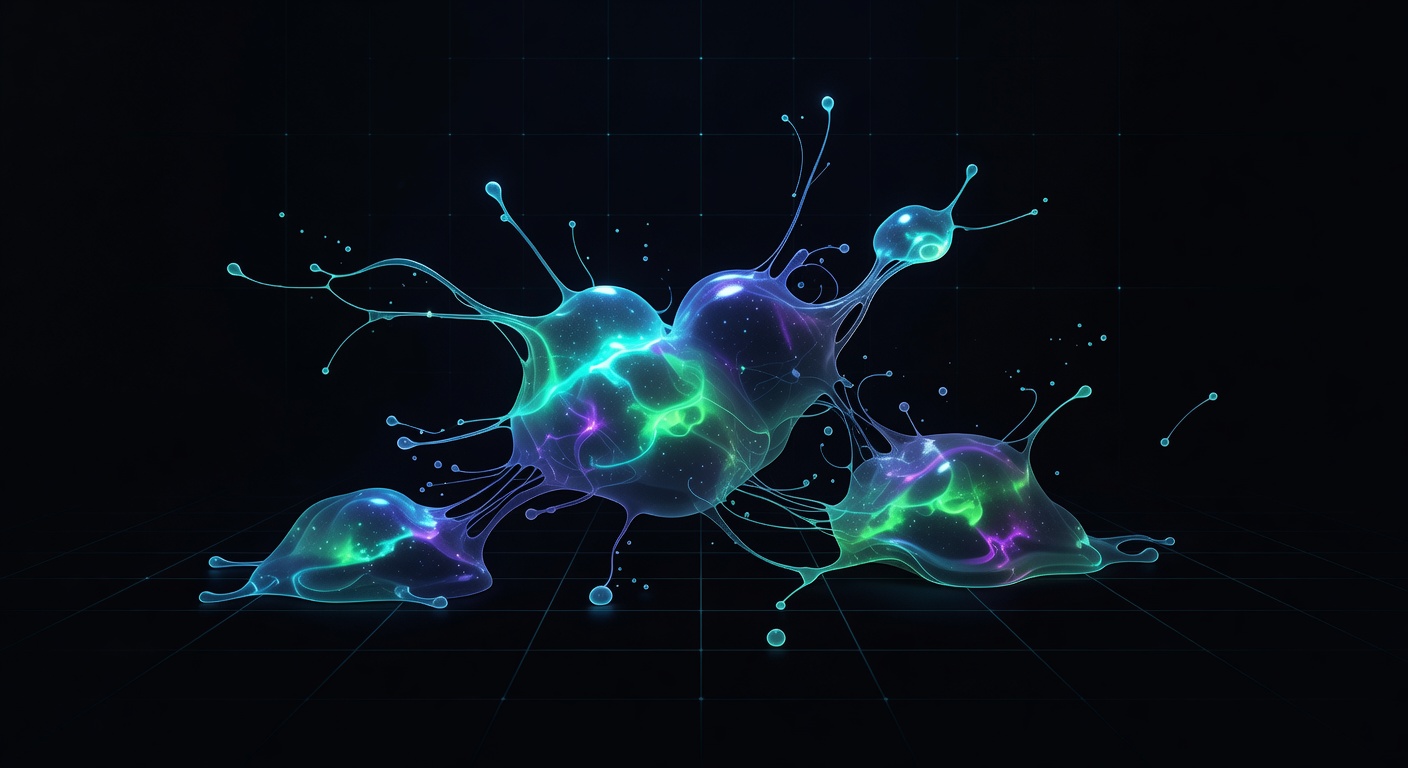
Picture This: Life's First Neighborhood Was Made of Slime
You know that gross biofilm that builds up in your sink drain? Well, it turns out something similar might be responsible for kickstarting all life on Earth. I know, I know—it's not exactly the romantic origin story we might have hoped for, but hear me out because this is actually pretty amazing.
Why the "Simple Start" Theory Doesn't Cut It Anymore
For years, scientists have been trying to figure out how life began by focusing on the simplest possible chemical reactions. It's like trying to understand how a city works by studying individual bricks instead of looking at neighborhoods, infrastructure, and communities. The problem? Life isn't simple—even at its most basic level, it's incredibly complex.
Think about it: a single cell has to manage energy, reproduce, respond to its environment, and maintain its structure all at once. That's a lot to ask from a few random molecules bumping into each other in some ancient pond.
Enter the Gel Theory: Life's First Co-Working Space
Here's where things get interesting. Researchers Tony Z. Jia and Kuhan Chandru have proposed something completely different: what if life didn't start in individual cells at all? What if it began in something more like a biological co-working space—a gel-like matrix where different chemical processes could hang out, share resources, and gradually figure out how to work together?
These "prebiotic gels" would have been like the biofilms we see today (think of that slimy stuff that bacteria create to protect themselves). But instead of being made by living organisms, these ancient gels would have formed naturally from the chemical soup that existed on early Earth.
Why Gels Make Perfect Sense as Life's Launching Pad
The more I think about this theory, the more brilliant it seems. Here's why these gels would have been the perfect nurseries for early life:
Resource Sharing: Just like roommates splitting the rent, organisms in gels could share the metabolic workload. No more going it alone in the harsh primordial world.
Built-in Protection: These gels would have acted like natural sunscreen and armor, protecting delicate early life forms from radiation, toxins, and other nasties that were way more intense on young Earth.
Flexible Development: Instead of one rigid path to life, gels could have supported multiple evolutionary experiments happening simultaneously. It's like having several startup companies in the same building—some might fail, but others could hit the jackpot.
Two Ways Life Could Have Emerged from the Goop
The researchers suggest two possible pathways for how protocells (life's rough drafts) could have formed in these gels:
Phase separation: Think oil and water separating, but with biological molecules. This could have naturally created little pockets where life-like processes could get started.
Direct formation: Molecules in the gel could have organized themselves into "proto-films"—basically, life's first attempt at creating organized communities.
Both scenarios are way more sophisticated than the "lightning strikes a puddle" theories we're used to hearing about.
What This Means for Finding Alien Life
This is where my mind really starts racing. If life on Earth began in gels rather than simple cells, what does that mean for life elsewhere in the universe?
We've been searching for life by looking for things that resemble Earth life—water, carbon-based molecules, cell-like structures. But what if alien life evolved in completely different "gels" made from entirely different chemistry? The researchers call these hypothetical alien biofilms "xeon-films," and honestly, that sounds like something straight out of science fiction.
This could mean we need to completely rethink our approach to astrobiology. Instead of just looking for "life as we know it," maybe we should be scanning for complex, organized chemical systems that might not look anything like what we'd expect.
The Beautiful Complexity of It All
What I love about this gel theory is that it embraces the messiness and complexity that life actually involves. Rather than trying to reduce everything to the simplest possible explanation, it acknowledges that even the earliest life was probably a collaborative, community-driven effort.
It makes me wonder: if life really did begin in these cooperative gels, maybe that explains why collaboration and symbiosis are so fundamental to biology even today. From the bacteria in our guts to the mitochondria powering our cells, life seems to be all about different parts working together.
Who knows? Maybe that ancient slime wasn't just life's beginning—maybe it taught us everything we know about cooperation.
Source: https://www.popularmechanics.com/science/a70355588/primordial-ooze-life-on-earth