
Markdown formatted blog content
So... Nukes in Space Actually Happened?
I need to start by admitting something: when I first heard about this story, I thought it was straight out of a 1960s sci-fi novel. Nuclear weapons orbiting Earth, ready to drop on unsuspecting cities without any warning? That sounds like the kind of thing Dr. Strangelove would come up with after one too many espressos.
But here's the thing—it's real. And it's back.
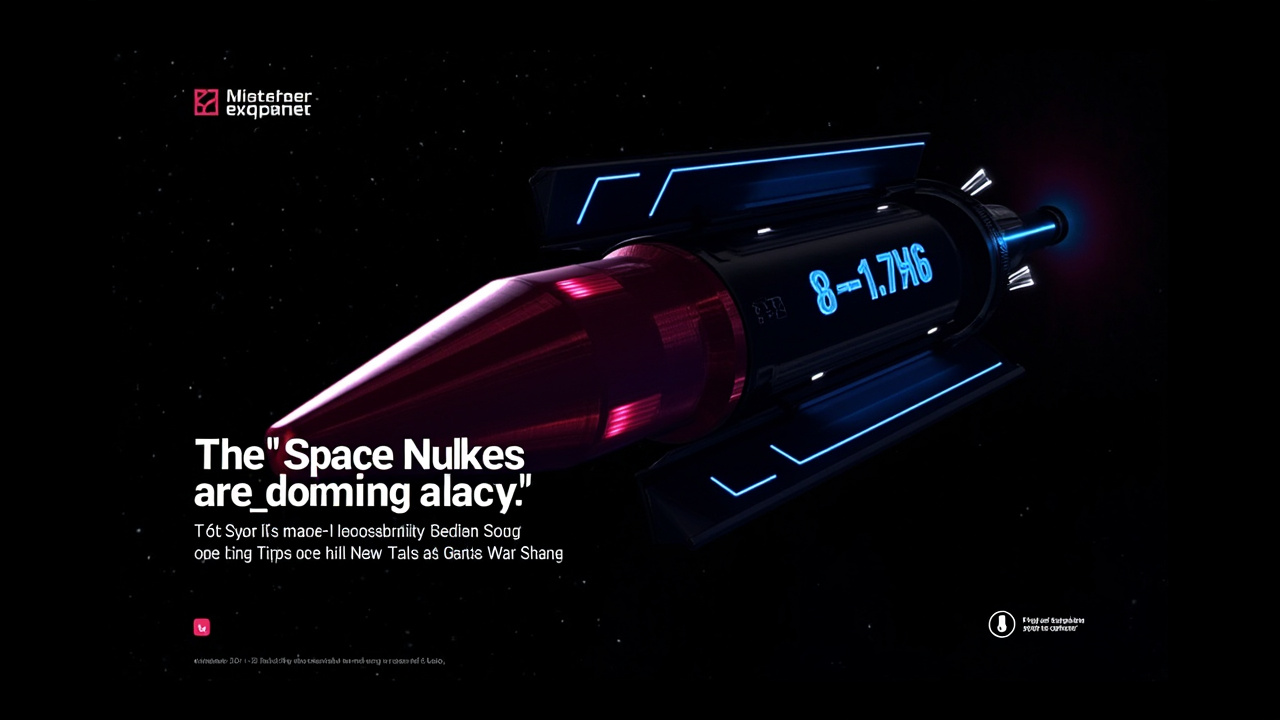
Back during the Cold War, while everyone was focused on intercontinental ballistic missiles arcing across oceans, the Soviet Union was quietly working on something far more sinister. They called it FOBS, or Fractional Orbital Bombardment System. The idea was elegantly terrifying: instead of shooting a missile directly at the United States (which would light up every early warning system on the planet), you could launch it into space, let it orbit just partway around Earth, and then drop it on a completely unexpected trajectory.
Imagine trying to defend against an attack that comes from above, behind, or from a direction your defenses aren't even looking. That's FOBS.
The Soviet Version: "No Nukes in Space" (Technically)
Here's where it gets genuinely wild. You might remember that in 1963, the US, UK, and Soviet Union signed the Limited Test Ban Treaty, promising not to test nuclear weapons underwater, in space, or in the atmosphere. Then came the Outer Space Treaty in 1967, which explicitly stated that no nation should place nuclear weapons in orbit.
But—and this is the clever part—the Soviets found a loophole. FOBS wasn't technically "orbiting" the planet in the traditional sense. It would only go partway around Earth before dropping its payload. So technically, no nuclear weapons were permanently placed in space. They were just... visiting.
Call it the ultimate legal technicality. The Cold War equivalent of finding a "No Swimming" sign and deciding to wade in up to your knees.
Soviet citizens, by the way, had no idea what was happening. When they saw strange lights moving across the night sky in 1967, many genuinely believed aliens were coming. The Pentagon eventually had to spill the beans to stop people from panicking about extraterrestrials when really, they should have been panicking about nuclear annihilation from above.
The Soviets tested their FOBS system in 1968. It worked. American officials had to pretend they weren't concerned, but I imagine more than a few generals had sleepless nights.
The American Response: Building Better Defenses
The good news (sort of) is that the United States eventually figured out how to detect FOBS launches. The early warning system got a major upgrade, and while the element of surprise was theoretically eliminated, the underlying threat remained. FOBS was still a nightmare scenario—just one we could potentially see coming now.
But here's what keeps me up at night: just because we figured out how to handle the Soviet version doesn't mean we've solved it for good. And now there's a new player in town.
China's New Take on an Old Nightmare
So here's where the story gets modern—and frankly, more concerning. China has been developing its own FOBS system, and they've given it an upgrade that makes the Soviet version look almost quaint.
China has combined FOBS with hypersonic glide vehicles. These are missiles that fly at incredibly low altitudes at more than five times the speed of sound. They're already incredibly difficult to shoot down because they don't follow a predictable ballistic arc.
Now imagine that technology married with a system that can launch from space itself.
The Chinese system is called something deeply ironic given its purpose: the Long March. (You know, named after that historic retreat. I guess there's something poetic about 6,000 miles of strategic withdrawal leading to space-based nuclear weapons.)
The combination means potential targets worldwide face a threat that could:
- Approach from unexpected angles
- Move at hypersonic speeds
- Bypass traditional missile defense systems designed for predictable arcs
- Provide almost no warning time
Why Should You Actually Care?
I know what you're thinking: "This sounds like Cold War fearmongering. Are we all going to die in a nuclear fire from space?"
No, probably not. Mutually assured destruction still applies, and no rational actor wants to start a nuclear exchange.
But here's why this matters more than just another military gadget story:
First, the rules-based order around space is eroding. The Outer Space Treaty exists for a reason. When nations start finding creative interpretations of those rules, it creates instability. And space-based nuclear weapons—even theoretical ones—change the calculus of deterrence in ways that could spiral.
Second, early warning systems were designed for specific threats. A FOBS-hypersonic combination is specifically designed to exploit gaps in existing defenses. It's not just about having more missiles—it's about having smarter weapons that our current infrastructure struggles to track.
Third, this is an arms race accelerant. When one nation develops something, others feel pressured to respond. We've already seen how hypersonic weapons have triggered a global development race. Add space-based delivery to the mix, and we have a whole new dimension of competition.
The Bottom Line
Look, I'm not here to make you lose sleep tonight. The world didn't end during the actual Cold War when these systems were active, and it's not going to end tomorrow because of developments in Chinese military technology.
But this story should make you think about how we talk about and regulate weapons in space. The treaties signed in the 1960s were smart and necessary. They kept nuclear weapons out of the final frontier for decades. We need new thinking for a new era.
The next time you look up at the night sky and see a satellite slowly drifting across the darkness, remember: not everything up there is just for communication or scientific research. Some of it might be waiting to drop something very, very bad on someone, from a direction they never saw coming.
Now that's not exactly comforting, is it?