
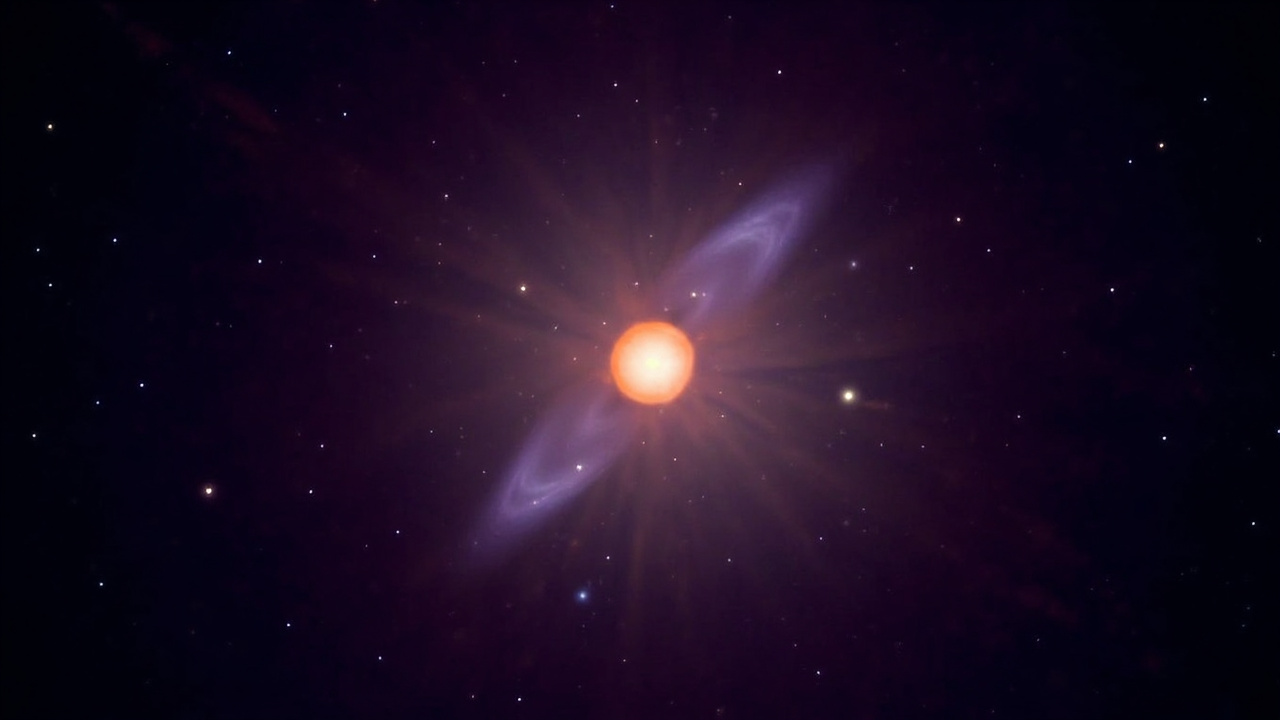
When a Star Decides to Break All the Rules
Imagine discovering something so bizarre that you have to invent an entirely new category just to describe it. That's basically what happened in 1866 when an Italian astronomer named Angelo Secchi pointed his telescope at a star called Gamma Cassiopeiae and went "...wait, what?"
The star was doing something completely weird with its hydrogen. Instead of showing bright emission lines like normal stars, it had dark ones. It was like the star was playing by completely different rules, and Secchi was like "okay, we're gonna need a new classification system." Thus, the Be star was born—a category that still baffles astronomers today.
A Star on Steroids
Here's where it gets wild: Be stars spin incredibly fast. We're talking 70-80% of the speed at which a star would literally tear itself apart from centrifugal force. When I first learned this, my jaw literally dropped. These aren't leisurely rotating spheres—they're like cosmic figure skaters doing the performance of their lives.
All that spinning? It flings gas off the star's equator like a cosmic candy dispenser. The star basically creates this disk of material whirling around it. Pretty metal, right?
The Soviet Scientists Who Got There First
Here's something I think is genuinely fascinating: Soviet astronomers in the mid-20th century figured out that these gas disks weren't smooth envelopes—they were actually individual blobs of gas. But because their work was published in Russian, Western astronomers largely missed it. It's a great reminder that brilliant science happens everywhere, and sometimes the language barrier means game-changing discoveries don't get the global attention they deserve.
The X-Ray Bombshell
Fast forward to 1976. Astronomers using X-ray telescopes pointed them at Gamma Cas and nearly fell out of their chairs. This star was pumping out X-rays at hundreds of times the normal rate for Be stars. Not slightly more—hundreds of times more. The plasma responsible for these X-rays was sitting at a casual 150 million degrees Celsius. Yeah, casual.
For decades, everyone had a theory: there must be something else nearby—maybe a neutron star or white dwarf—stealing material from the Be star and heating it up to extreme temperatures. But proving it? That's the tricky part.
Finally, the Answer
This is where modern technology saves the day. Scientists using JAXA's XRISM space telescope (which basically has X-ray superpowers) finally caught Gamma Cas red-handed. The mystery companion? A white dwarf—the ultra-dense remnant of a dead star—orbiting Gamma Cas and drawing material from it.
After 150+ years of "we don't know what's going on with this thing," astronomers could finally say "okay, we figured it out."
But Wait, There's More
Here's the thing about solving big mysteries: you usually end up with new questions. Scientists thought this kind of Be star + white dwarf pairing should be super common throughout the universe. But the data says otherwise—it's actually pretty rare, and it tends to show up around high-mass Be stars rather than low-mass ones.
Yaël Nazé, the lead researcher on the study, summed it up perfectly: understanding how these two stars actually interact with each other is the next frontier. Now that we know Gamma Cas has a companion, scientists can build specific models for binary systems like this and totally revamp our understanding of how binary stars evolve over time.
The Bigger Picture
What I love about this story is that it's a perfect example of how science works. One astronomer notices something weird in 1866. Soviet scientists make progress in the 1950s. X-rays hint at something mysterious in 1976. And in 2024, finally, a space telescope provides the answer.
It's not flashy or instant. It's slow, international, built on the work of people across continents and decades. And honestly? That's way more interesting to me than if someone had just figured it out immediately.
Gamma Cassiopeiae might be the 63rd brightest star you can see from Earth, but it just earned the title of "one of the most scientifically significant stars we keep studying." Not bad for a star that spent 150 years confusing everyone.