
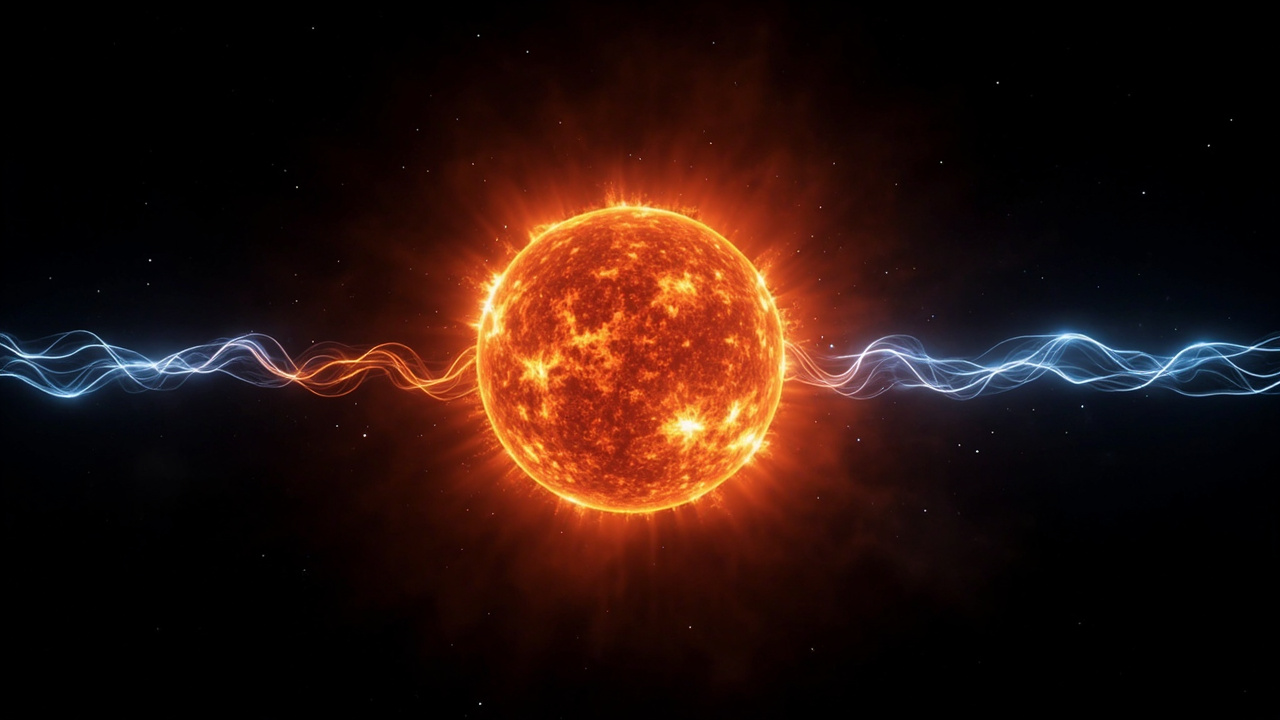
When the Sun Decides to Talk (and Talk... and Talk)
Imagine if someone rang your doorbell, and instead of leaving after a few seconds, they just kept holding the button down. That's essentially what happened to NASA scientists last August when they picked up an unusual radio burst emanating from our favorite star.
At first, it seemed totally normal. Solar radio bursts happen all the time—they're basically the Sun throwing little electromagnetic tantrums. Usually, they last anywhere from a few hours to maybe a few days, then fade away quietly. Scientists barely bat an eye at them anymore.
But this one? This one had other plans.
The Burst That Refused to Die
For 19 consecutive days, this radio signal just kept broadcasting. Nineteen. Days. To give you perspective, the previous record holder clocked out at just five days. That means this new burst lasted nearly four times longer than anything scientists had documented before.
This wasn't some tiny blip on the radar either—researchers were absolutely gobsmacked. It's like expecting someone to hold their breath for 10 seconds and watching them do it for 40. Totally unexpected.
The burst belonged to a category called "Type IV radio bursts," which are created when super-energetic electrons get trapped inside the Sun's incredibly powerful magnetic fields. Think of it like electrons bouncing around in a cosmic pinball machine, releasing radio waves as they ping around.
Why This Actually Matters
Here's where it gets interesting: while the radio waves themselves are harmless to us here on Earth (they can't penetrate our atmosphere), they're actually a signal that something more dangerous might be brewing.
The same magnetic conditions that produce these radio bursts can also trigger coronal mass ejections (CMEs)—basically massive explosions of charged particles and magnetic energy that can shoot through space at mind-boggling speeds. If one of those is headed toward Earth, it could wreak havoc on our satellites, power grids, and spacecraft. So scientists take these things seriously because they're essentially the Sun's warning system.
Teamwork Makes the Dream Work
To figure out what was going on with this weirdly persistent burst, NASA didn't go it alone. They assembled a cosmic detective squad: the Parker Solar Probe, the Wind spacecraft, NASA's Solar Orbiter (working with the European Space Agency), and the STEREO mission.
Here's the clever part: because the Sun constantly rotates, different spacecraft were positioned at different angles to observe the burst as it rotated into their field of view over those 19 days. It's like having security cameras positioned all around a building—each one captures a piece of the action, and when you put the footage together, you see the whole story.
Following the Clues Back to the Source
Using data from STEREO, the research team developed a new technique to trace the burst back to its origin point. They discovered it came from a massive magnetic structure in the Sun's outer atmosphere called a "helmet streamer"—think of it as a giant magnetic bubble anchored to the Sun's surface.
But here's the plot twist: scientists suspect the reason this burst lasted so long might be because three separate coronal mass ejections erupted from the same region of the Sun, essentially refueling the radio signal and keeping it alive. It's like someone kept ringing that doorbell over and over again, and each time, the signal got pumped up again.
What This Means for the Future
The team published their findings in the Astrophysical Journal Letters, and here's why it matters for all of us: understanding these unusually long bursts helps scientists get better at predicting dangerous solar weather.
Space weather forecasting is kind of like weather forecasting for the cosmos—the better we understand the patterns, the better we can warn people when something dangerous is headed our way. Satellites that power our GPS, communications, and weather monitoring? They're vulnerable to solar storms. Astronauts in space? Even more vulnerable. Power grids on the ground? You guessed it—vulnerable too.
By getting better at recognizing and understanding these weird, long-lasting bursts, scientists can improve their ability to predict when the Sun is about to throw a tantrum big enough to cause real problems down here on Earth.
The Bigger Picture
What I love about this discovery is that it's a perfect example of why we still need to study our Sun, even though we've been living under it for our entire evolutionary history. We think we know it, but then it surprises us. And those surprises teach us something new every time.
The fact that a solar phenomenon could last almost four times longer than the previous record shows how much we still have to learn. The Sun is basically the biggest thing affecting weather and space conditions in our entire solar system, and it's still throwing curveballs at our best scientists and most advanced equipment.
It's humbling, honestly. And kind of cool.
Source: https://www.sciencedaily.com/releases/2026/05/260522023120.htm