
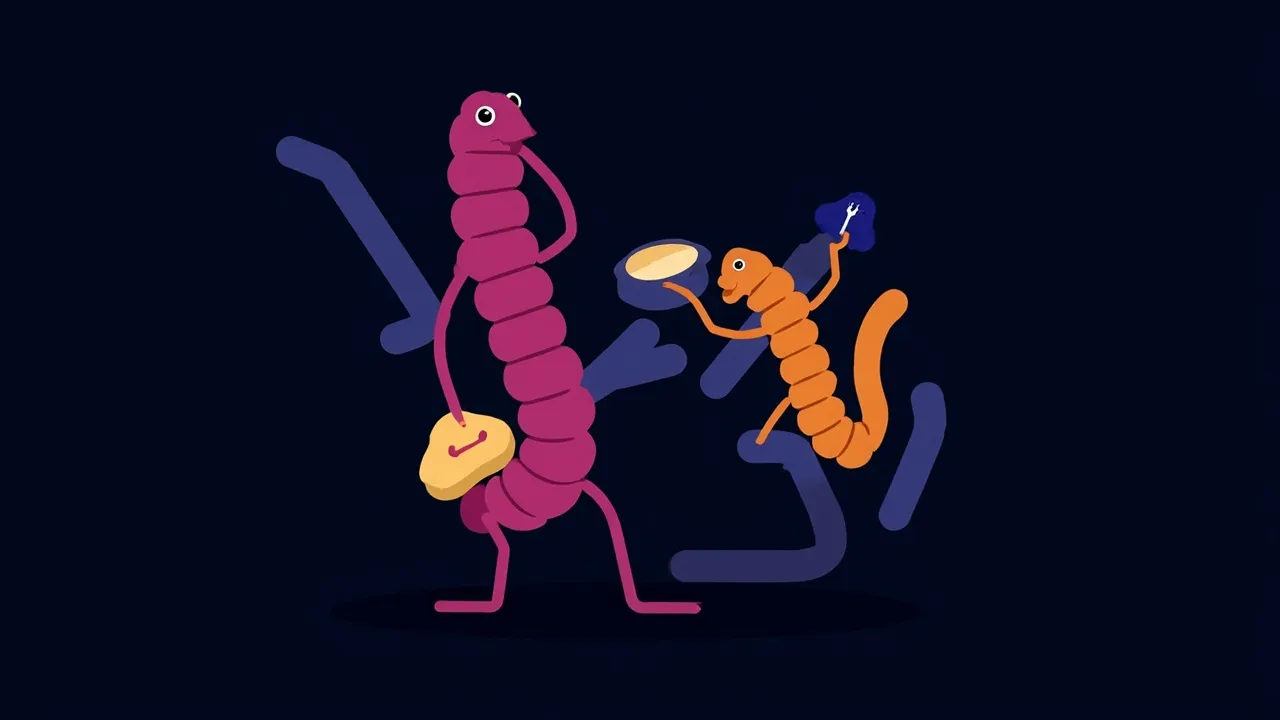
So, Your Gut Bugs Need Breakfast?
Okay, I need to tell you about something that sounds completely bonkers but is actually backed by real science. Apparently, some intestinal worms—yes, parasites—might actually be good for you. But here's the plot twist: they're only helpful when you're eating enough fiber.
I know, I know. It sounds like the setup to a bad joke. "What do tapeworms and oatmeal have in common?" But hear me out, because this research is genuinely fascinating.
The Hygiene Hypothesis Gets a New Twist
For most of human history, having a few uninvited guests in your intestines was just... normal. Then came modern plumbing, medicine, and an obsession with being squeaky clean. Suddenly, those little worm-y roommates became rare in developed countries.
And here's where things get weird: around the same time we kicked out the parasites, autoimmune disorders and inflammatory bowel diseases started skyrocketing. Coincidence? Scientists didn't think so either.
About twenty years ago, researchers started exploring something called "helminth therapy"—basically, deliberately introducing intestinal worms to help calm inflammation. The results were promising but inconsistent. Sometimes it worked beautifully. Sometimes nada.
That's what led a team at the Biology Centre of the Czech Academy of Sciences to ask the million-dollar question: Why?
The Fiber Connection
After a bunch of experiments, they found the answer hiding in plain sight—fiber.
The researchers used tapeworms (don't worry, a harmless species) and fed some rats high-fiber diets while others got the processed food equivalent of a Western diet. The difference was striking.
On a fiber-rich diet, the tapeworms thrived. They were healthy, happy, and most importantly—actively reducing inflammation in their hosts. But when fiber was scarce? The worms basically went into energy-saving mode. They shrank, never reached adulthood, and failed to produce any offspring. Their anti-inflammatory superpowers? Gone.
"It's like they enter a hibernation state," the researchers explained. "Without fiber, they just... stop doing their job."
Your Gut Is Basically an Ecosystem
Here's what really got me about this study: it highlights how interconnected everything in your gut really is.
When you eat plenty of fiber, good bacteria flourish. Your microbiome becomes diverse and healthy. Those beneficial microbes then help the worms thrive. And when the worms are happy, they help calm your immune system. It's like a little ecosystem working in harmony.
But when you skimp on fiber? That whole system starts falling apart. The microbiome loses diversity. Bad bacteria move in. The worms check out. And inflammation can run wild.
The numbers are kind of staggering when you think about them. Health experts recommend around 25-30 grams of fiber daily. Most people in Western countries don't even hit half that. Meanwhile, traditional populations eating whole foods get an estimated 80-120 grams per day. That's a massive difference.
What This Means for You
Now, I'm not suggesting you run out and adopt a tapeworm (please don't). But this research points to something pretty profound: what we eat affects way more than just our digestion.
Our gut ecosystem— parasites and all—responds to what we feed it. And when we feed it the processed, low-fiber Standard Western Diet, the whole system suffers.
The good news? Fiber is everywhere. Vegetables, fruits, legumes, whole grains. You don't need to go full ancestral to give your gut what it craves. Just... maybe add an extra serving of veggies today. Your microscopic roommates will thank you.
And honestly? I find something kind of comforting about this. We're not just individuals with bodies—we're whole ecosystems. Taking care of ourselves means taking care of all the tiny creatures that call us home.
Now pass me some oatmeal.