
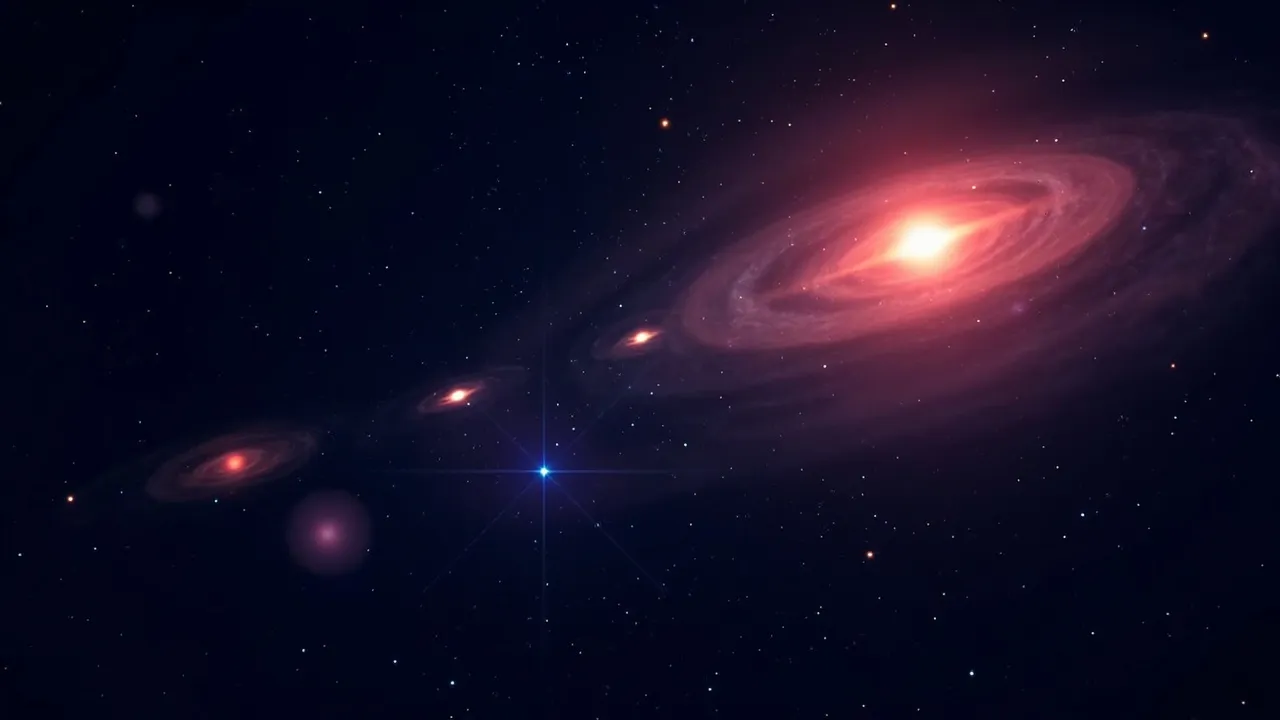
The Galaxy's Gas Tank Problem
Here's something that bugs astronomers: our galaxy, the Milky Way, has roughly 100 billion stars. That's a lot of stars! But galaxies like ours are surrounded by something even bigger and more important—it's called the circumgalactic medium, or CGM for short. Think of the CGM as a massive gas tank that surrounds a galaxy like a hazy cloud, extending about 10 to 20 times farther than the stars we can actually see.
This gas is basically the fuel for future star formation. Over time, some of it cools down, drifts inward, clumps together, and eventually ignites into new stars. Since stars are where planets form, and planets are where life can potentially arise, this gas tank is kind of a big deal.
So here's the puzzle: if galaxies are sitting in all this potential star-forming fuel, why aren't they cranking out way more stars? There must be something preventing that gas from cooling and collapsing, but what?
The Smallest Things With the Biggest Influence
Enter the supermassive black holes. These monsters lurk at the centers of most large galaxies, and they're absolutely tiny compared to the galaxies they inhabit. We're talking about something the size of our solar system influencing something 100 billion times more massive.
"It's like an ant somehow affecting something hundreds of kilometers away," said Namrata Roy, an astronomer at the Raman Research Institute. "How can something so small energetically impact something so enormous?"
It's a fair question, and honestly, it's one of the most mind-bending aspects of modern astronomy.
The Jets That Could Change Everything
New research by Sanchayeeta Borthakur from Arizona State University and Namrata Roy might have found an answer. Their study, recently published in the Astrophysical Journal Letters, shows that when black holes are actively feeding, they can launch incredibly powerful jets of superheated plasma that shoot out into the surrounding gas.
These jets don't just heat up nearby material—they actually change the chemistry and ionization state of gas that's mind-bogglingly far away.
The team studied galaxies with active black holes that produce these jets. They were looking for a specific signal: the faint glow of ionized hydrogen, known as H-alpha. The problem is, this signal is too weak to detect around a single galaxy. So they got clever—they combined observations from hundreds of galaxies using data from the DESI survey and the LOFAR radio telescope.
The Beam, Not the Lamp
When they averaged the signals from every direction around these galaxies, the H-alpha glow was pretty weak. But when they looked specifically along the paths of the jets—where the plasma was actually shooting out—the signal was dramatically stronger.
This tells us something important: the jets aren't just illuminating everything around them like a lamp. They're more like a flashlight beam, directly affecting the gas they pass through.
"The surprising question is: how can something so small energetically impact something so enormous?" Roy noted. Now, thanks to this research, we might finally be getting an answer.
What This Means for Galaxy Evolution
This discovery could help explain the cosmic mystery of "quenched" galaxies—galaxies that have stopped forming new stars. If black hole jets are constantly disturbing the gas reservoir that galaxies need for star formation, that could put the brakes on stellar production.
"This is a pathbreaking result that solves the long-standing mystery of how black holes influence galaxies, their stars, and life as we know it!" said Borthakur. "This work opens a new direction to explore further the intricacies of the connection between the supermassive black holes trillions of miles from where we are to how we came to be here."
That's actually pretty profound when you think about it. The same black hole activity that shapes galaxy evolution might ultimately influence whether the conditions for life can exist in the first place.
So the next time you look up at the night sky and see a star, remember: it probably exists because a black hole somewhere decided to leave it alone. And if that black hole had been a little more active with its jets, that star might never have formed at all.
Pretty wild stuff, right?
Source: ScienceDaily