
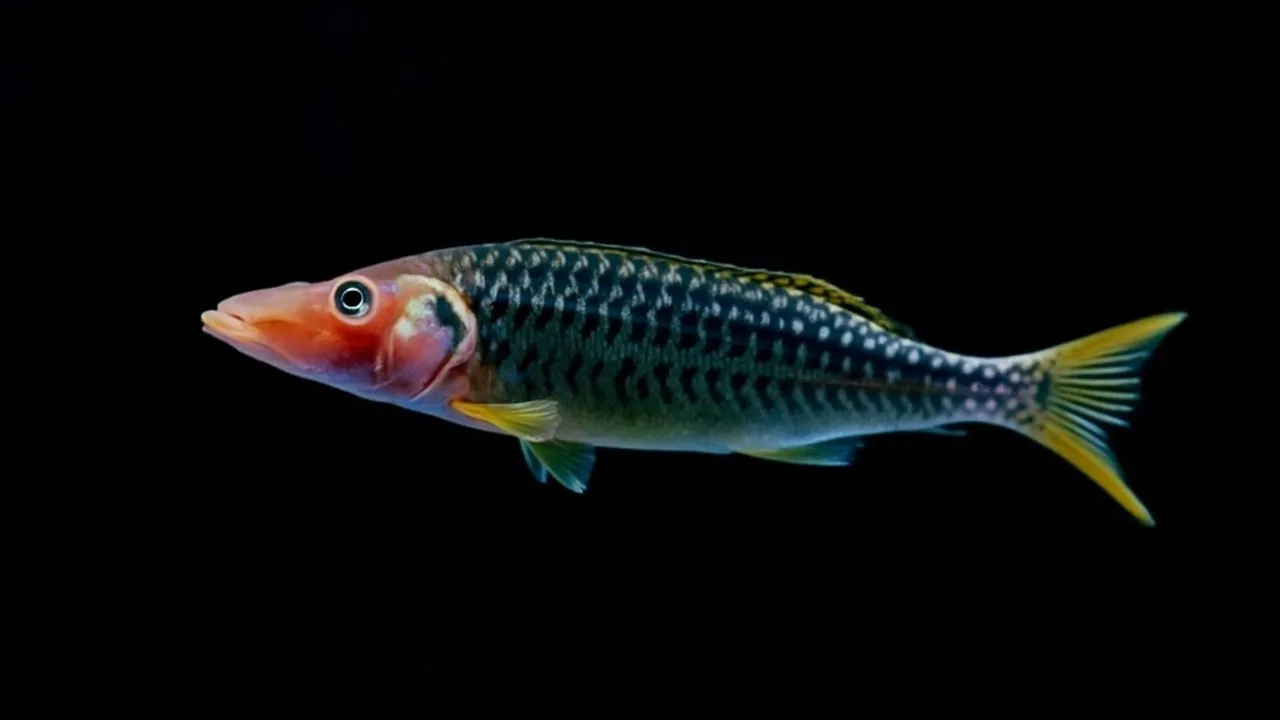
Wait, They Gave Fish Magic Mushrooms?
Okay, I know what you're thinking—they did WHAT?
Before you start drafting angry letters to the ethics committee, let me explain. Researchers in Canada recently tested psilocybin on a particular species of fish, and the results were honestly kind of fascinating. We're not talking about fish taking trips to the aquarium equivalent of Coachella. We're talking about very small doses that seem to take the edge off aggressive behavior.
The fish in question is the mangrove rivulus—a tiny, amphibious creature that can technically fertilize itself (yes, really) and happens to be absolutely territorial when it spots another member of its species. Think of it as the自然界's equivalent of that neighbor who loses their mind every time someone parks in "their" spot.
Why This Little Fish Is a Big Deal for Science
Here's what makes these fish so useful for research. First, they're naturally combative. When they see another rivulus, they don't politely ask for personal space—they basically start beefing immediately.
Second (and this is the cool part), they can fertilize themselves and produce genetically identical offspring. This means scientists can run experiments with fish that are basically clones, ruling out the possibility that differences in behavior come down to genetics rather than whatever they're testing.
So when researchers wanted to see how psilocybin affects aggression, these little fighters were basically the perfect test subjects.
What Happened When They Dosed the Fish
The experiment was pretty straightforward. Researchers put a fish in a tank with a barrier separating it from another fish, let them get used to each other's presence, then removed the barrier and watched what happened. They recorded aggressive behaviors—things like rapid swimming bursts that signal "I'm about to attack."
Then, 24 hours later, they put the same fish in water with a low dose of psilocybin and repeated the whole process.
The results? The fish on psilocybin were significantly less aggressive. They moved around less and showed way fewer of those high-energy attack bursts. But here's the interesting part—they didn't completely shut down. Their more casual social behaviors remained largely intact.
The researchers called it a "selective" effect. Psilocybin seemed to specifically target the energetically costly, escalated aggression while leaving the less intense social behaviors alone.
Why Should We Care About Aggressive Fish?
Now, I know what some of you are thinking: This is fun trivia, but who cares if some fish are less punchy?
Fair question. Here's why it matters.
We still don't fully understand how psilocybin works in the brain. We know it interacts with serotonin receptors—the same system that affects mood, appetite, and yes, aggression in humans. Research like this helps us piece together the puzzle of how this compound affects social behavior more broadly.
If psilocybin can selectively reduce escalated aggression in fish without making them unresponsive to social cues, that's worth noting. It suggests the compound might be doing something more nuanced than just making everything feel fuzzy and calm.
The researchers themselves are careful to point out that we can't directly translate fish behavior to humans. But understanding the mechanism in a simpler system gives scientists clues about where to look next.
The Bigger Picture
Look, I'm not here to tell you that magic mushrooms are the solution to human aggression (though if that's where your mind went, you're not alone). Science doesn't work that way. You don't go from "fish calmed down a bit" to "we've solved violence."
But this research is another piece of evidence that psilocybin does something interesting to aggressive behavior. And as researchers keep studying it—carefully, with actual evidence rather than just vibes—we might learn things that help with conditions where aggression is a real problem.
For now, though, I'm just going to sit here and appreciate the sheer weirdness of it all: scientists in Canada dosing self-fertilizing fish with psychedelic compounds to see what happens. If that's not science at its most gloriously curious, I don't know what is.
Source: https://www.sciencedaily.com/releases/2026/10/261017230036.htm