
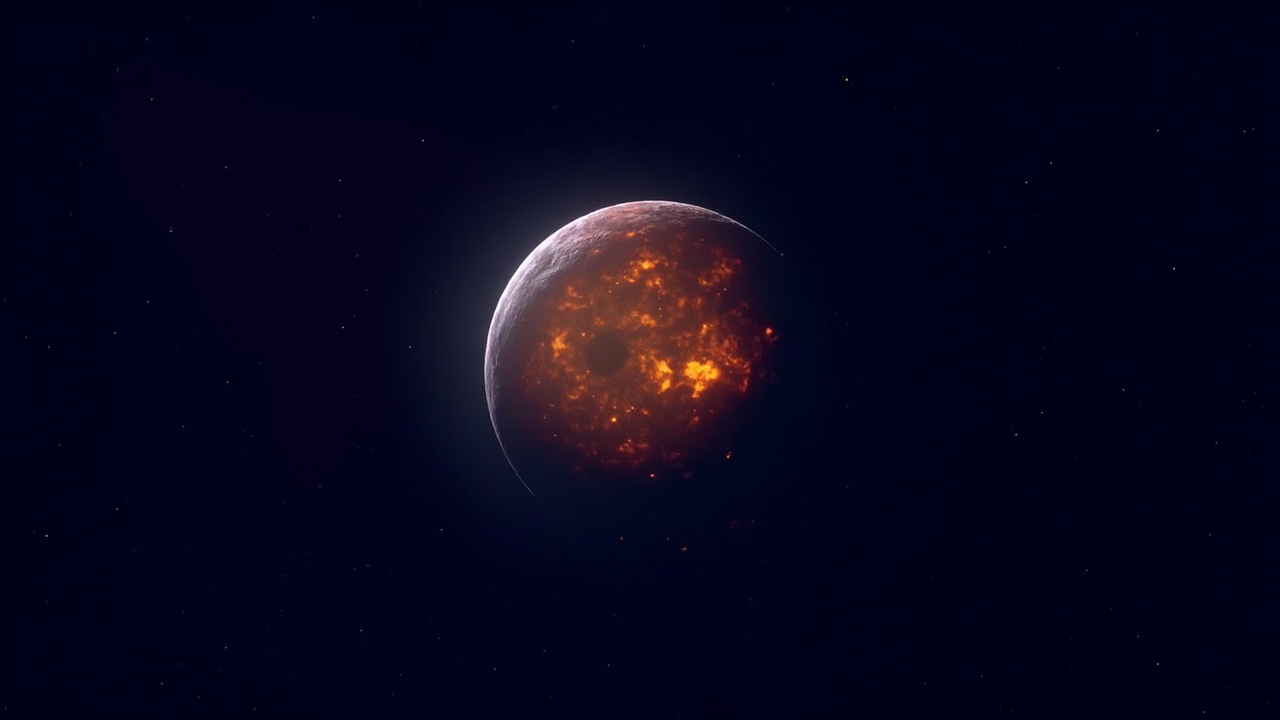
When a Space Rock Gets an Unexpected Atmosphere
Here's a weird thing about the outer Solar System: the farther you go from the Sun, the fewer surprises you'd expect to find. It's a frozen, sparse neighborhood where objects are so small and gravity is so weak that holding onto anything — including a protective layer of gas — should be basically impossible.
So imagine the shock when Japanese astronomers found evidence that a distant icy body called 2002 XV93 has an atmosphere.
This is not supposed to happen.
Why This Is So Surprising
Let me break down the cosmic rules here. Atmospheres are fragile things. To keep one, you need enough gravity to hold the gas molecules from floating off into space. Earth does this fine with our chunky 12,742-kilometer diameter. Even Jupiter laughs at atmospheric loss.
But 2002 XV93? It's only about 500 kilometers across — smaller than Chile. And it's hanging out way, way beyond Neptune, where temperatures plummet and the Sun's warmth is basically nonexistent. In those conditions, any gas molecules should zip away into space like they're on an escape pod.
Yet there it was.
The Clever Detective Work (Starring a Background Star)
The astronomers didn't just stumble upon this by accident. They used a technique called a stellar occultation — which is basically cosmic photobombing.
On January 10, 2024, the small object passed directly in front of a distant star as viewed from Earth (specifically from Japan). Here's the clever part: if 2002 XV93 had no atmosphere, the star's light would simply vanish and reappear — like flipping a switch. Cut off, then back on.
But if there was an atmosphere, the gas would bend and filter the starlight, making it fade gradually instead of disappearing all at once.
A team led by Ko Arimatsu at Japan's NAOJ Ishigakijima Astronomical Observatory observed this event from multiple locations, and sure enough — they saw that gradual fade. The light dimmed smoothly, exactly like it would if passing through a thin layer of gas.
Atmosphere confirmed. Mysteriously.
The Plot Thickens: Where Did This Air Come From?
Here's where it gets really weird. Scientists did the math, and this atmosphere shouldn't stick around. It would dissipate in less than 1,000 years unless something keeps replenishing it. That's basically a blink of an eye in cosmic terms.
So the question becomes: how did 2002 XV93 get an atmosphere in the first place? And more importantly, how is it keeping one?
The researchers looked for the obvious answer: maybe there's frozen gas on the surface slowly sublimating (turning from ice directly into vapor). That would be a natural way to maintain an atmosphere. But when they checked using data from the James Webb Space Telescope, they found... nothing. No evidence of frozen gases that could be feeding the atmosphere.
That's when things get speculative — and honestly, kind of cool.
The Theories on the Table
So if there's no frozen gas supply, what's going on? Scientists are considering a few ideas:
Theory One: Something inside the object stirred, bringing material to the surface and releasing gas in the process. Maybe internal heat or even seismic activity is venting material.
Theory Two: A comet or asteroid hit the place, and the impact excavated enough material to temporarily create an atmosphere.
Either way, we're talking about a temporary situation. This little world is basically having a brief moment of having air before it dissipates forever.
Why Should We Care About a Tiny, Distant Rock?
I get it — this seems like an obscure discovery. But it actually matters quite a bit.
First, it shows us that our models of how planetary systems work might be incomplete. We assumed small, distant objects couldn't hold atmospheres, so we didn't really expect to find them. Surprise findings like this are how science actually progresses.
Second, it opens new questions about how many other tiny worlds out there might have temporary atmospheres. Are these common? Rare? We don't know yet.
And finally, it's just a good reminder that the universe loves to keep us humble. No matter how many rules we think we've figured out, space finds a way to break them.
What Happens Next?
The astronomers aren't done. More observations are coming to figure out what's actually happening with 2002 XV93. We need to understand the composition of this mystery atmosphere, confirm how long it'll stick around, and dig deeper into what caused it in the first place.
It's the kind of cosmic mystery that might sound boring if you're just scrolling headlines, but it's genuinely fascinating stuff — scientists discovering that reality is weirder than our assumptions.
And honestly? That's why I love space exploration.