
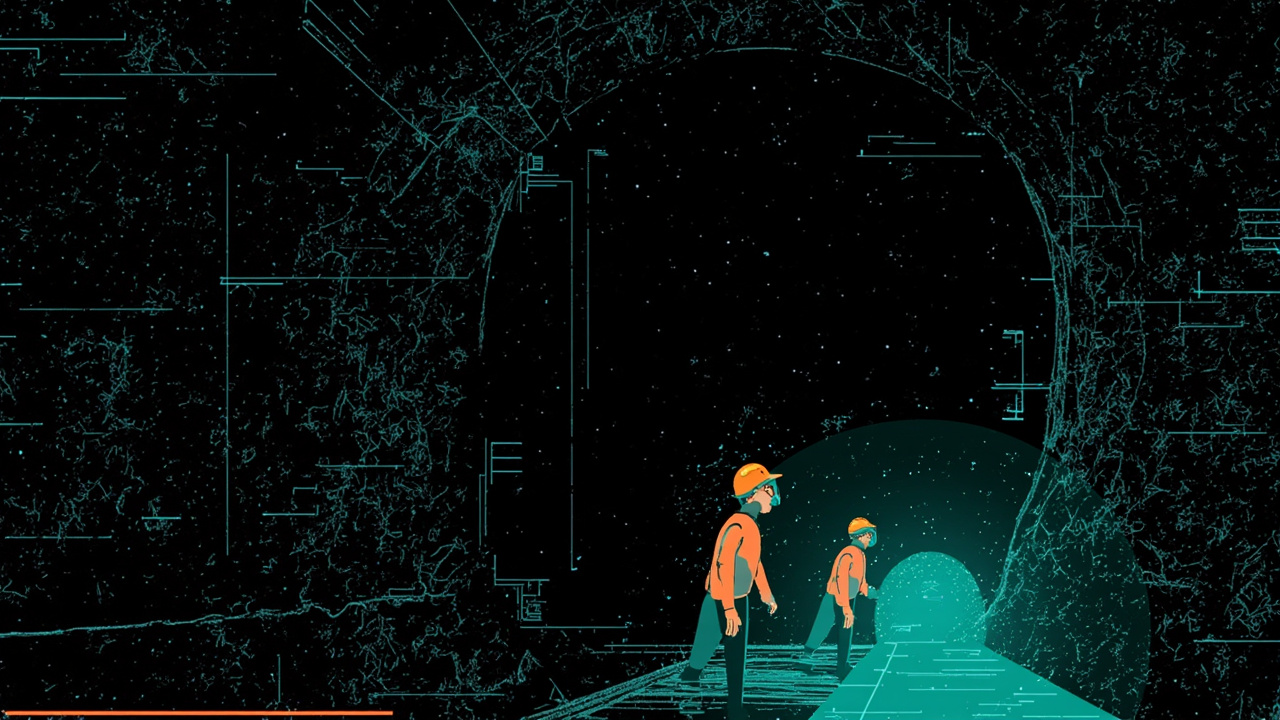
The Tunnel That Turned Profit Into Poison
Imagine being hired for what seems like a straightforward job: help build a tunnel through a mountain. Steady work, decent pay for the time. You show up, ready to work hard. What you don't know is that you're literally breathing in something that will slowly destroy your lungs over the next decade.
This is what happened at Hawk's Nest, a remote outcropping above the New River in West Virginia, during the early 1930s.
A Project With Two Purposes
Union Carbide Company had a plan: carve a 3-mile tunnel through Gauley Mountain to redirect water to a brand new hydroelectric power plant. Sounds like straightforward infrastructure, right?
Here's where it gets sinister: the company knew the mountain was almost entirely made of silica—and silica wasn't just a byproduct of tunnel-blasting. It was gold to them. Union Carbide planned to extract roughly 300,000 tons of silica from that tunnel and use it to feed their industrial furnaces.
The silica would be processed into ferrosilicon, an alloy used in steel production. In metallurgy, ferrosilicon is incredibly valuable because it removes oxygen from molten steel, preventing the defects and impurities that would otherwise ruin the final product.
But here's the problem: inside a controlled factory, silica is manageable. Inside a tunnel being blasted open with dynamite? It becomes something else entirely.
When Useful Becomes Deadly
When you blast rock, drill through stone, and shovel debris in a confined space, something happens that nobody in the tunnel thought about: the silica transforms into microscopic particles so tiny they're essentially invisible to the naked eye.
OSHA actually has a name for these particles: respirable crystalline silica. We're talking about bits of rock that are literally one hundred times smaller than ordinary sand. They're sharp, glass-like fragments that float in the air like ghosts.
Here's what makes them so dangerous: when you breathe these particles in, they don't just sit in your lungs and then leave. They travel deep into your respiratory system, embedding themselves in your lung tissue. Over time—and I mean years—your body tries to heal itself. But instead of healing, scar tissue forms. Your breathing gets worse. Your lungs become less and less able to do their job.
Slowly, your body suffocates from the inside.
The Worst Part? They Knew
And this is what absolutely enrages me about this story: Union Carbide's engineers and executives knew the danger.
By 1930, when construction began at Hawk's Nest, the industrial world already understood the hazards of silica dust. Experts had documented it. They knew that proper ventilation and water management could significantly reduce the danger.
Union Carbide had blueprints of the mountain showing massive silica deposits before they started digging. Their own internal documents proved they understood what they were dealing with.
But the company made a choice: profit over safety. They didn't invest in ventilation. They didn't spray water to suppress the dust. They didn't provide proper respiratory protection to workers.
They just kept them digging.
A Disappearing Tragedy
What gets me even more is how this disaster nearly vanished from American history. Thousands of workers got sick. Many died. But the story was suppressed, workers were silenced, and for decades, Hawk's Nest was barely a footnote in our collective memory.
This wasn't just a workplace accident. It was a choice made by people in positions of power who valued corporate profit more than human lives. It was a cover-up designed to make the tragedy disappear.
Why This Matters Now
The reason I'm writing about this decades-old disaster is because it's not really ancient history. The same dynamics still happen today—just sometimes in less visible ways. Companies cutting corners on safety. Workers not knowing the full risks they're taking. And powerful interests trying to bury inconvenient truths.
Hawk's Nest reminds us that industrial progress comes with a real human cost, and it's always important to ask: who's paying that price, and do they actually know what they're signing up for?
The workers at Hawk's Nest certainly didn't.
Source: https://www.popularmechanics.com/science/a71306794/hawks-nest-tunnel-disaster-silica-dangers