
The Day a Shark Diving Guide Accidentally Discovered Something Incredible
Picture this: It's 1986, and Kihachiro Aratake is just looking for cool spots to take tourists to see hammerhead sharks off the coast of Yonaguni Island. You know, the westernmost Japanese island, basically chilling 70 miles from Taiwan. Normal day at work.
And then—bam!—he stumbles across something that makes his heart nearly leap out of his chest.
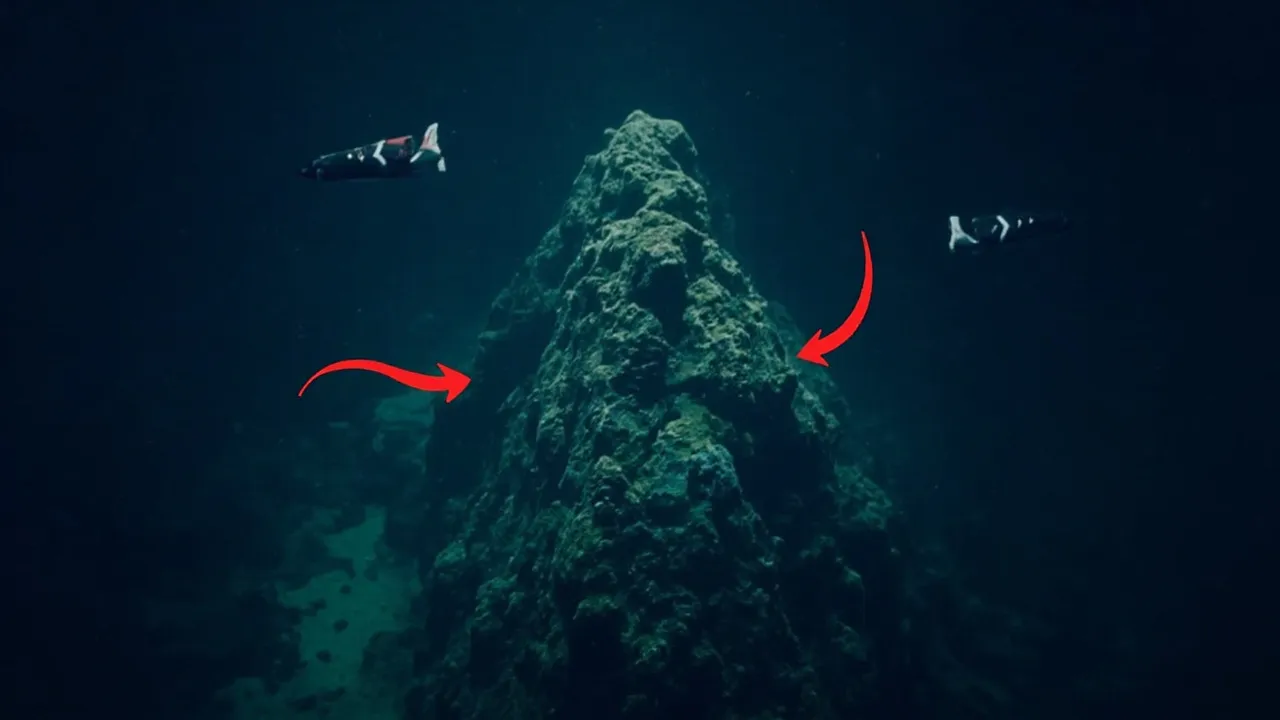
An underwater formation with rocks carved at nearly perfect 90-degree angles. Like someone had carefully sculpted terraces into the seafloor, leading down to what looks unmistakably like the remnants of a structure built by human hands.
"I had goosebumps all over," Aratake told the BBC decades later. "It was overwhelming."
Honestly? I would've done the exact same thing.
So... What Exactly Did He Find?
What we now call the Yonaguni Monument is pretty impressive stuff. We're talking about a structure that's roughly 50 meters long and about 20 meters wide—all sitting peacefully (well, peacefully now) under the waves of the East China and Philippine seas.
The timing is wild, too. Remember, we're only talking about 35-40 years ago here. This wasn't some ancient discovery from the 1800s. This is recent history. Someone literally just... found it.
The most famous scientist associated with this mystery is Masaaki Kimura, a geologist from the University of the Ryukyuus. He's spent years studying the site, and his take? This thing is a step pyramid, baby. Probably constructed several thousand years ago—back when these rocks were high and dry above sea level.
You see, after the last Ice Age ended, all that ice melted and sea levels rose. A lot. Which means all kinds of coastal areas that were once above water? Gone. Submerged. Maybe places like this monument, right along with whatever civilization built it.
Some people have gone even further, connecting the Yonaguni Monument to Mu—a legendary lost continent in the Pacific that supposedly sank beneath the waves. It's basically the Pacific's version of Atlantis, and honestly, the idea of a whole advanced civilization disappearing underwater is the kind of thing that keeps me up at night thinking about.
The Case FOR It Being Man-Made
Kimura has been pretty firm about this. "It's very difficult to explain away their origin as being purely natural," he told National Geographic.
And look, I get it. When you see those sharp, angular formations—those distinct terraces—it really does look like someone carved them. The precision is... eyebrow-raising, to say the least.
If this is man-made, it completely rewrites what we thought we knew about the Ryukyu Islands. We're talking about reshaping the entire archaeological understanding of the region.
But Wait... There's Another Side
Now, here's where things get interesting. Not everyone's buying it.
Robert Schoch, a professor of natural sciences at Boston University, has been one of the loudest voices pushing back against the "ancient civilization" theory. And honestly? He's got some compelling points.
"Based on all the evidence, it is primarily a natural structure," Schoch has written. Ouch.
His argument is actually pretty clever. See, the rocks down there? They're sandstone and mudstone. And here's the thing about those rock types—they naturally erode in flat planes and fracture horizontally. That means they naturally form what looks exactly like human-made terraces.
It's kind of like how some caves have amazing formations that look sculpted, but nope, just water and time doing their thing.
Schoch even draws a comparison to prehistoric cave paintings. The caves themselves are completely natural, but humans added the art on top. Maybe the Yonaguni Monument is similar—mostly nature, with perhaps some human "touch-ups" over the centuries.
Oh, and there's another geologist, Takayuki Ogata from Ryukyu University, who actually backs up this natural explanation. He pointed out that the underwater formations are continuous with similar rocks still visible on the island's surface. Same processes. Same materials. Just... one happens to be underwater.
So... What's the Verdict?
Here's the honest truth: The Japanese government doesn't recognize it as culturally significant. Neither the Agency for Cultural Affairs nor Okinawa Prefecture has given it any official historic designation.
Which is kind of a shame, honestly. Even if it is purely natural, it's still a remarkable geological feature. The fact that rocks can naturally form what looks so much like ancient architecture? That's fascinating in its own right.
But I also can't help but wonder: What if there's some truth to the man-made theory? What if ancient people saw these natural formations and said, "Hey, we can work with this"? Like Schoch suggested—maybe they admired it, used it, even added to it.
Why This Story Stuck With Me
I'll be real with you—there's something about underwater mysteries that just gets me. Maybe it's because we know so little about our oceans. We keep discovering new species, new underwater volcanoes, entire ecosystems in the deep dark. Of course there could be lost cities down there too.
The Yonaguni Monument reminds me that history isn't just about digging up dusty old tombs on land. Sometimes the most incredible discoveries are just... waiting for someone to go snorkeling at the right moment.
Forty years later, and Kihachiro Aratake was absolutely right. Whether it's a masterpiece of ancient engineering or just nature showing off, the Yonaguni Monument has become a treasure for that small Japanese island.
And honestly? Maybe the mystery is part of the magic.
What do you think—was this an ancient civilization's lost accomplishment, or just geology doing its thing? Either way, I think we can all agree that sometimes the most amazing discoveries happen completely by accident.