
When Planet-Making Gets Wild
Imagine you're trying to bake a cake, and halfway through, half the batter suddenly decides to behave completely differently from the other half. That's basically what astronomers just discovered happening in a distant galaxy, and honestly? It's kind of blowing their minds.
The Hubble Space Telescope recently captured some incredibly detailed images of a young star surrounded by an absolutely massive disk of gas and dust — the kind of place where planets are being born. The funny part is that this disk doesn't look anything like what scientists thought these cosmic nurseries should look like.
Meet "Dracula's Chivito"
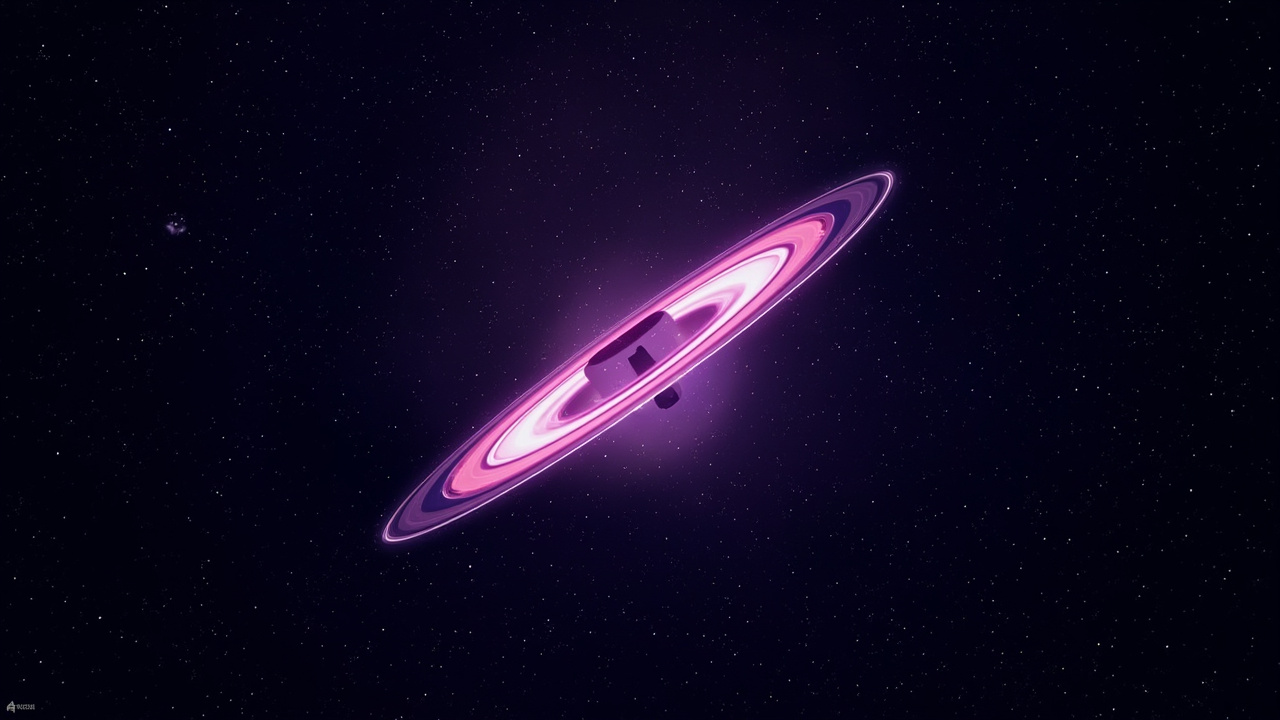
I love the name of this thing. Scientists call it IRAS 23077+6707, but the research team nicknamed it "Dracula's Chivito" because one researcher is from Transylvania and another is from Uruguay (where a chivito is apparently a beloved sandwich). When you see the Hubble images, you totally get it — the thing looks like a cosmic hamburger when viewed from the side. Dark in the middle, with glowing gas layers above and below. It's actually pretty beautiful.
This isn't just some random space object, either. The disk is absolutely enormous. We're talking about 400 billion miles across — which is roughly 40 times bigger than our entire solar system, including everything out to the Kuiper Belt where the icy objects hang out. It's centered on a young star (possibly two stars) that's hidden behind all those layers of dust.
The Chaos Nobody Predicted
Here's where things get interesting. Astronomers expected these planet-forming disks to be relatively organized and symmetrical — like a nice, neat spinning record. But this one? It's anything but organized.
The Hubble images revealed weird, wispy filaments of gas and dust shooting up from one side of the disk like cosmic tentacles, while the opposite side is basically smooth and well-behaved. It's asymmetrical in a way that's making scientists scratch their heads.
According to lead researcher Kristina Monsch from the Harvard & Smithsonian Center for Astrophysics, this level of detail in visible light is actually rare. "We're seeing this disk nearly edge-on," she explained, "and that gives us an unprecedented view of how active and chaotic these planet nurseries can really be."
What Could Cause This Cosmic Mess?
The researchers aren't entirely sure why one side looks so different from the other. But they think it might have something to do with fresh material constantly falling into the disk, or maybe gravitational interactions with nearby cosmic objects. Basically, the system is in active chaos mode, and we're getting to witness it.
Co-investigator Joshua Bennett Lovell said something I really like: "We were stunned to see how asymmetric this disk is. Hubble has given us a front row seat to the chaotic processes that are shaping disks as they build new planets."
And that's the thing — we still don't fully understand how planets form, even after decades of study. Finding a system this extreme gives us a new laboratory to figure it out.
A Planetary System in the Making
So what's actually going to happen here? Scientists think the disk contains somewhere between 10 to 30 times the mass of Jupiter, which is... a lot. That's more than enough material to create an entire planetary system of giant planets.
The cool part is that this system might actually be like a snapshot of what our own solar system looked like billions of years ago, except at a much larger scale. Of course, studying planet formation in such a massive and chaotic environment could completely change how we think about it.
"We have more questions than answers right now," Monsch admitted, "but these new images are a starting point for understanding how planets form over time and in different environments."
Why This Matters
This discovery is a really good reminder of something I find fascinating: the universe is way messier and more dynamic than we often imagine. Our theoretical models are useful, but reality keeps throwing surprises at us.
The Hubble Space Telescope, which has been doing science for over 30 years now, continues to be this amazing tool for expanding what we know. And every time it points at something new, we learn that the cosmos is even weirder than we thought.
The next step? NASA's James Webb Space Telescope is already looking at similar systems, providing complementary views. By combining observations from multiple telescopes, astronomers are building a much clearer picture of how planets — including ours — were born from cosmic dust.
Pretty wild stuff if you think about it.