
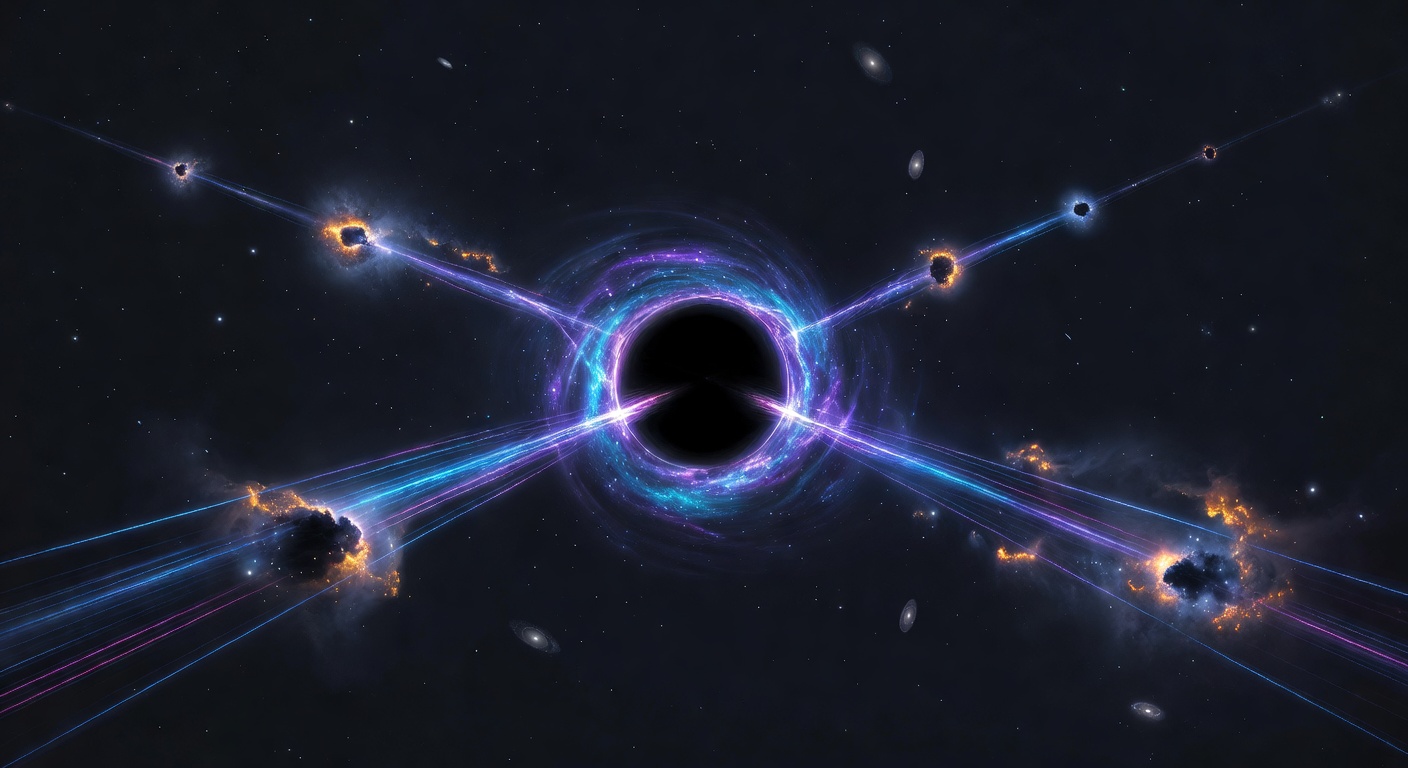
The Universe Isn't As Independent As We Thought
For the longest time, astronomers assumed galaxies were kind of like hermits. Sure, they exist in the same universe, but they figured each one pretty much did its own thing, evolving independently from its neighbors. Think of them like distant relatives who don't really keep in touch.
But here's where things get wild: a team of researchers led by Yongda Zhu at the University of Arizona just discovered that's completely wrong. Turns out, the universe is way more connected than we ever realized.
Enter the Cosmic Bullies: Supermassive Black Holes
At the heart of most galaxies—including ours—sits a supermassive black hole. These aren't your typical black holes. We're talking about monsters containing millions or billions of times the mass of our sun. Our Milky Way's central black hole, Sagittarius A*, is actually relatively modest by comparison.
When these black holes start actively feeding on surrounding material, they transform into something called a quasar. Picture this: all that matter spiraling into the black hole heats up to insane temperatures and releases an absolutely enormous amount of energy. We're talking so bright that a single quasar can outshine an entire galaxy containing billions of stars. That's not a metaphor—it's literally true.
The JWST Plot Twist
Here's where the story gets interesting. When the James Webb Space Telescope started peering at the early universe, astronomers noticed something odd. Around some of the brightest quasars, there seemed to be fewer galaxies than expected.
At first, Zhu admits with a laugh, they wondered if the billion-dollar telescope was actually broken. But then they had an "aha!" moment. What if the galaxies weren't missing at all? What if they were just too faint to see because something was preventing them from making new stars?
The Evidence: A Cosmic Chain Reaction
To test this theory, the team focused on one of the brightest known quasars: J0100+2802. This beast is powered by a black hole with 12 billion times the mass of our sun, and its light has been traveling through space for over 13 billion years. When we look at it, we're literally seeing the infant universe.
Using JWST's incredible capabilities, they measured something called O III—ionized oxygen that's produced when stars form. Here's what they found: galaxies sitting within about a million light-years of this quasar showed surprisingly weak O III signals compared to what they should have.
This is the smoking gun. It means star formation in those galaxies had been throttled. But how?
The Physics Behind the Cosmic Shutdown
It turns out that making stars is incredibly demanding. You need massive clouds of cold molecular hydrogen gas to accumulate and eventually collapse into new stars. It's like the raw ingredients for a recipe—without them, you can't make the dish.
The intense radiation blasting out from an active quasar does something brutal: it tears apart that molecular hydrogen. The energy from the radiation is so extreme that it literally breaks the molecules apart, preventing them from clumping together. Without the fuel, no stars can form. It's like someone sabotaging your garden by destroying all your seeds.
Scientists already knew quasars could do this within their own host galaxy. The revolutionary part of this discovery is realizing the effect spreads way, way farther—millions of light-years across intergalactic distances.
Welcome to the Galaxy Ecosystem
Zhu uses a brilliant analogy: think of it as a cosmic ecosystem. A hungry predator doesn't just affect the animals immediately around it; it shapes the entire food web. Similarly, an active supermassive black hole doesn't just reshape its own galaxy—it influences the development of neighboring galaxies that are nowhere near it.
This completely flips how we understand galaxy evolution. For decades, we've assumed galaxies developed in relative isolation, each following its own path. But what if galaxy growth is actually a collaborative (or competitive) process? What if the universe operates more like an interconnected web than a collection of isolated islands?
What This Means for Our Understanding
This discovery has huge implications. It suggests that understanding how galaxies grow requires looking at the bigger picture. A galaxy's fate isn't determined solely by what's happening within its own borders—it's also influenced by aggressive neighbors millions of light-years away.
It also explains some mysteries about the early universe that had been puzzling astronomers. Those "missing" galaxies around bright quasars? They're probably there, just having their star-making ability suppressed by radiation from their cosmic overlords.
The Bigger Picture
What I find most fascinating about this research is how it reminds us that the universe is fundamentally interconnected. We often think of space as this vast, empty void where things are isolated. But the reality is messier and more interesting—everything influences everything else, sometimes across unimaginably large distances.
This is the kind of discovery that makes you question your assumptions. The universe didn't have to work this way. It could have been much simpler. But instead, we live in a cosmos where violent cosmic events ripple outward, affecting star formation across millions of light-years.
Pretty humbling when you think about it.