
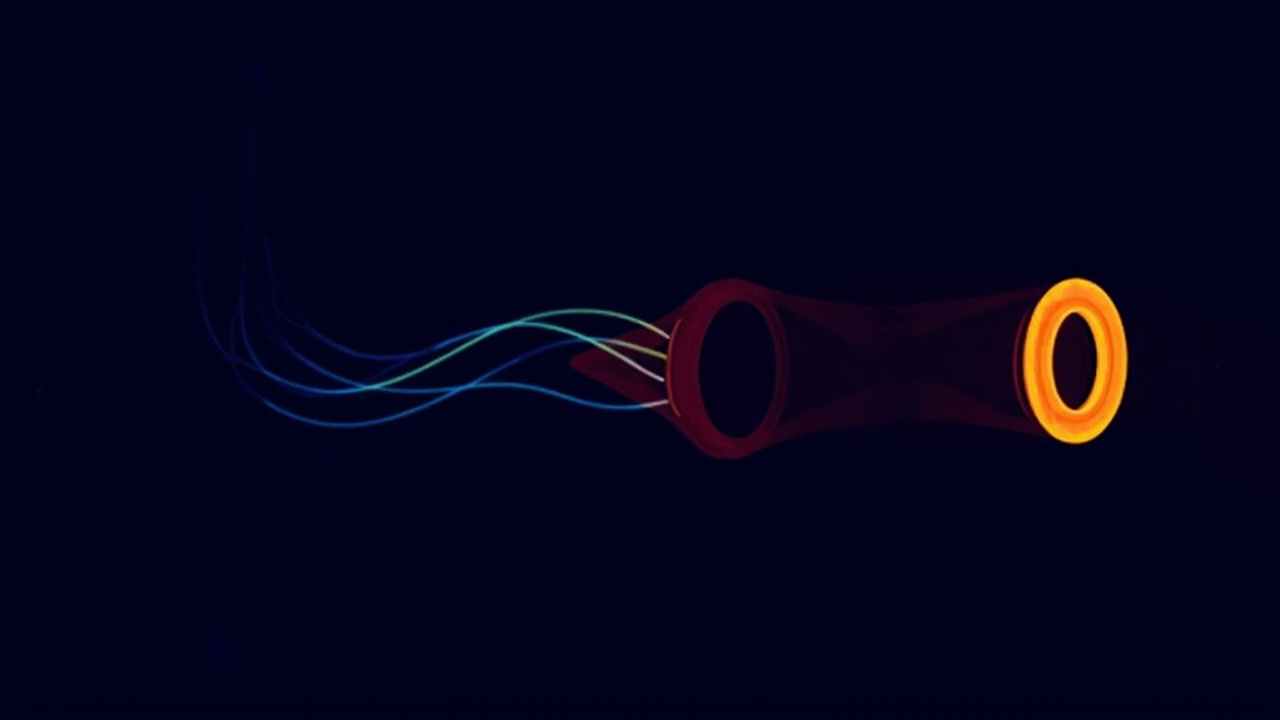
Why Has Shrinking Light Technology Been So Frustrating?
Here's something that might surprise you: making things work with light is actually harder than making electronic devices smaller. We've gotten really good at miniaturizing computer chips—they keep getting tinier and faster. But light? Light is a total diva about being squeezed into small spaces.
The reason is pure physics. There's this fundamental principle that says the smaller you try to trap light, the bigger its wavelength has to be. It's like trying to fit an ocean into a bathtub—the physics won't allow it. For regular visible light, this means you can't really confine it into anything much smaller than about a thousand times its own wavelength. It's been a major roadblock for optical technology.
The Old Solution That Came With Baggage
Engineers knew about one workaround: use metal to force light into smaller spaces. This approach, called plasmonics, actually works—kind of. The problem? Metals get really hot when you try to do this. All that light energy gets converted into waste heat, which kills efficiency and makes the whole system impractical for real-world applications.
It's like trying to compress a spring by hand. Sure, you can do it, but your hand gets tired and hot really quickly. Not ideal for technology you want to scale up.
Enter the Narwhal Wave Discovery
In 2024, a team of researchers at Peking University in China—led by Ren-Min Ma—figured out something genuinely clever. They realized you don't need metal at all. Instead, you can use regular dielectric materials (the same stuff used in capacitors and insulators) to trap light at impossibly small scales without generating all that pesky heat.
Their secret? Something they're calling "narwhal-shaped wavefunctions." And yeah, that's a real technical term.
What Exactly Is a Narwhal Wave?
This is where it gets genuinely cool. These aren't ordinary waves. They have two distinct personalities:
Up close to the center, the electromagnetic field gets super intense in a very localized spot. Think of it like the concentrated tip of a narwhal's tusk—all the power is focused right there.
Farther away, the field rapidly fades away to nothing. It doesn't linger. It doesn't spread out gradually. It basically disappears through exponential decay.
Combine these two behaviors, and you get something that can trap light in a space that's about 500 million times smaller than its wavelength. That's genuinely ridiculous—in the best way possible.
They Actually Built This and Tested It
The researchers didn't just theorize about this. They physically built a 3D resonator and measured what was happening inside it using near-field scanning techniques. The measurements matched their predictions perfectly. They achieved something called an "ultrasmall mode volume" of 5 × 10⁻⁷ λ³—which is scientific notation for "impossibly tiny."
A Microscope That Can See the Unseeable
With this extreme light confinement, the team created something genuinely new: a microscope that uses these narwhal waves to see details at a resolution of λ/1000. That's about a thousand times finer than normal optical microscope resolution.
They literally imaged subwavelength patterns and wrote letters small enough to prove the concept. We're talking about seeing things that are smaller than the wavelength of light being used to observe them. That shouldn't be possible with conventional optics, but here we are.
This Could Be the Beginning of Something Bigger
The researchers are calling this new field "singulonics"—a framework for controlling light at scales that were previously just considered physically impossible without massive energy losses.
The implications are genuinely exciting: ultra-compact photonic chips, super-resolution imaging systems that could transform medical diagnostics, new quantum optical technologies, and information processing devices that use light instead of electrons. No waste heat. No bulky metal components. Just pure, confined light doing exactly what we want it to do.
Why This Matters (Outside the Lab)
For years, we've hit a wall with optical technology. Our phones use electronic chips because we've gotten so good at making them small. But optical technology stayed bulky because of these fundamental physics constraints. This discovery suggests those constraints might be more bendable than we thought—at least with the right approach.
If singulonics lives up to its promise, we could be looking at a completely different era of technology. Faster optical computers. Better microscopes for medical research. More efficient quantum technologies. And all without the heat dissipation that's plagued previous attempts.
The narwhal wave might sound like something from a science fiction novel, but it's very real, and it's probably going to matter a lot in the coming years.