
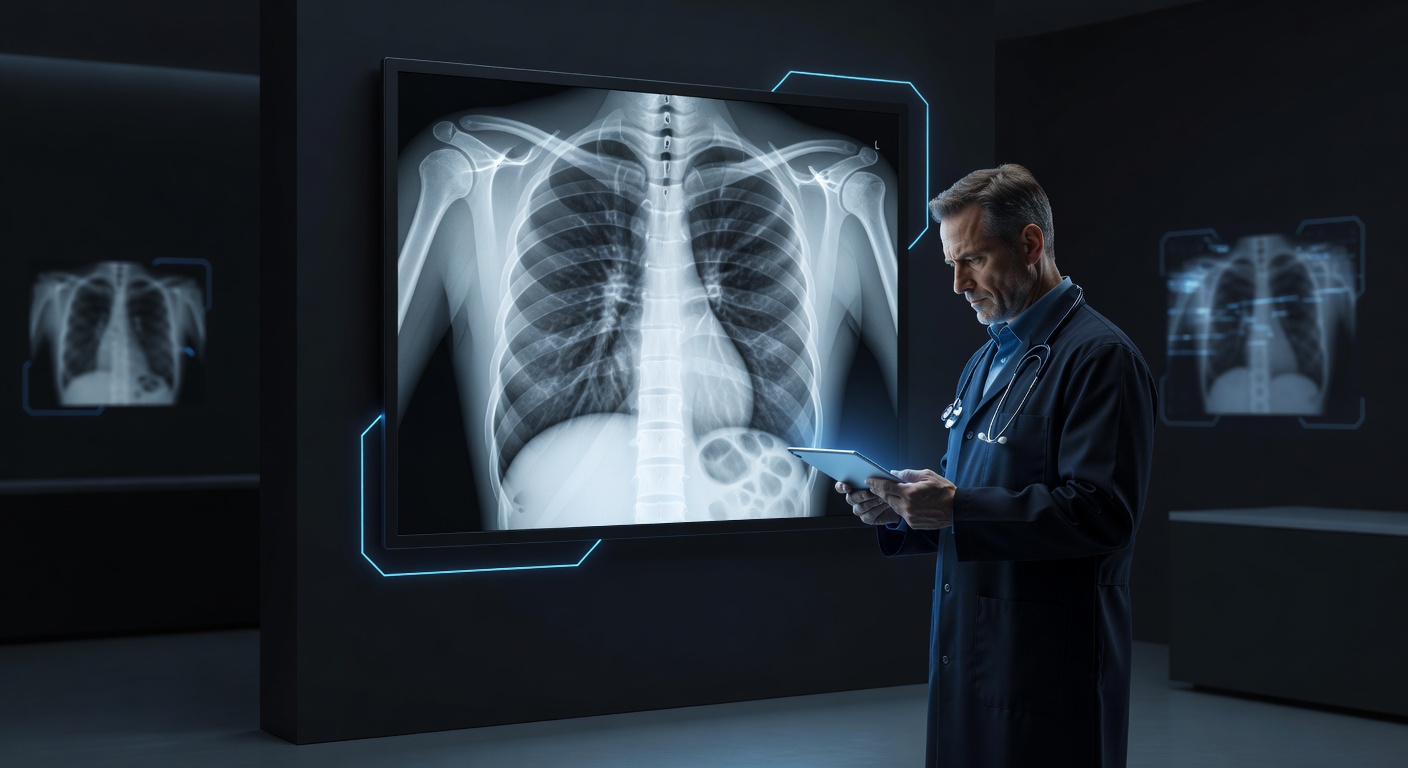
When Technology Gets a Little Too Good at Lying
Remember when deepfakes were mostly about celebrities in silly videos? Yeah, those days are long gone. We've officially entered the era where AI can fool actual medical professionals, and honestly, that should keep us all up at night.
A recent study published in Radiology dropped a bombshell: even the world's best-trained doctors—radiologists with decades of experience—can't reliably distinguish between real X-rays and ones created by artificial intelligence. We're not talking about a marginal difference here. We're talking about X-rays so convincingly fake that they could potentially be used to frame someone in court or manipulate patient care.
The Study That Changed Everything
Researchers brought together 17 radiologists from across six countries—people with anywhere from fresh-out-of-med-school experience to 40 years of hardcore practice. They showed these experts 264 X-ray images, half of which were the real deal and half were AI-generated fakes.
Here's the kicker: when doctors didn't know that fake images were even in the mix, they only caught 41% of the AI-generated ones. That's basically a coin flip. But when they were told to expect fakes? They improved to about 75%. Still not great when you think about what's at stake.
The performance varied wildly between different radiologists too. Some caught as few as 58% of the fakes, while others got up to 92%. So basically, whether you got a good catch-the-fake radiologist was kind of a lottery.
AI Trying to Catch AI (And Failing)
Here's where it gets really weird: they also tested whether AI systems could spot these deepfakes. They used Google's Gemini, Meta's Llama, and OpenAI's GPT models to see if machines could recognize their own synthetic creations.
Spoiler alert: they couldn't reliably do it either. Accuracy ranged from 57% to 85%—basically the same hot mess as the human doctors. Even GPT-4o, the same AI that generated the fake X-rays in the first place, couldn't consistently identify its own work. It's like asking a forger to spot a forgery. Sometimes they do, sometimes they don't.
The Telltale Signs (If You Know What to Look For)
One of the most fascinating discoveries was that deepfake X-rays often look too perfect. And I mean unnaturally perfect.
Real human bones aren't perfectly smooth. Real spines have natural curves and imperfections. But AI? It tends to make everything symmetrical, clean, and almost artistically ideal. Lungs appear too evenly balanced. Blood vessels look like they were drawn with a ruler. Fractures have that weirdly clean, single-sided appearance that doesn't match real injury patterns.
Dr. Mickael Tordjman, who led the study, put it perfectly: "Deepfake medical images often look too perfect." It's kind of ironic—the AI is so good at creating images that it accidentally makes them too good, like uncanny valley but for bones.
Why This Actually Matters (Beyond Spooky Stories)
I know this sounds like science fiction, but the real-world risks are genuinely serious. Imagine someone creating a fake X-ray showing a fracture that never existed and using it in a legal case. Imagine a hacker breaking into a hospital's system and inserting synthetic images to corrupt patient records or cause chaos in diagnoses.
These aren't hypothetical worst-case scenarios anymore. They're possibilities we need to actively plan for.
The study also found something interesting: experience doesn't guarantee you'll catch the fakes. A radiologist with 40 years under their belt isn't automatically better at spotting AI-generated images than someone newer to the field. The only group that consistently performed better were musculoskeletal specialists—doctors who focus specifically on bones and joints. Their familiarity with normal bone patterns apparently gave them a slight edge.
What Happens Next?
The researchers are already working on solutions. They're recommending invisible watermarks embedded directly into medical images and cryptographic signatures tied to whoever captured the image. Think of it like a digital seal of authenticity—proof that this image really came from this person at this exact moment.
They've also released a training dataset with interactive quizzes so doctors and hospital staff can start practicing how to spot these fakes. Because let's face it: we're probably not going to stop deepfakes from being created. We just need to get better at catching them.
And here's the scary part: this is just the beginning. The researchers point out that we're "potentially only seeing the tip of the iceberg." The next frontier? AI-generated 3D medical images like CT scans and MRIs. Those are exponentially more complex than X-rays, and if AI can fool radiologists with 2D images, imagine what it'll do with 3D ones.
The Real Takeaway
This study isn't a reason to panic—it's a wake-up call. Medical institutions, tech companies, and security experts need to team up now to build better detection tools and train healthcare professionals to stay vigilant. The technology isn't going away. AI is only getting better at this stuff.
The good news? We still have time to get ahead of this problem, but the clock is ticking. Because the one thing worse than a disease is a fake disease, and the one thing worse than that is doctors who can't tell the difference.