
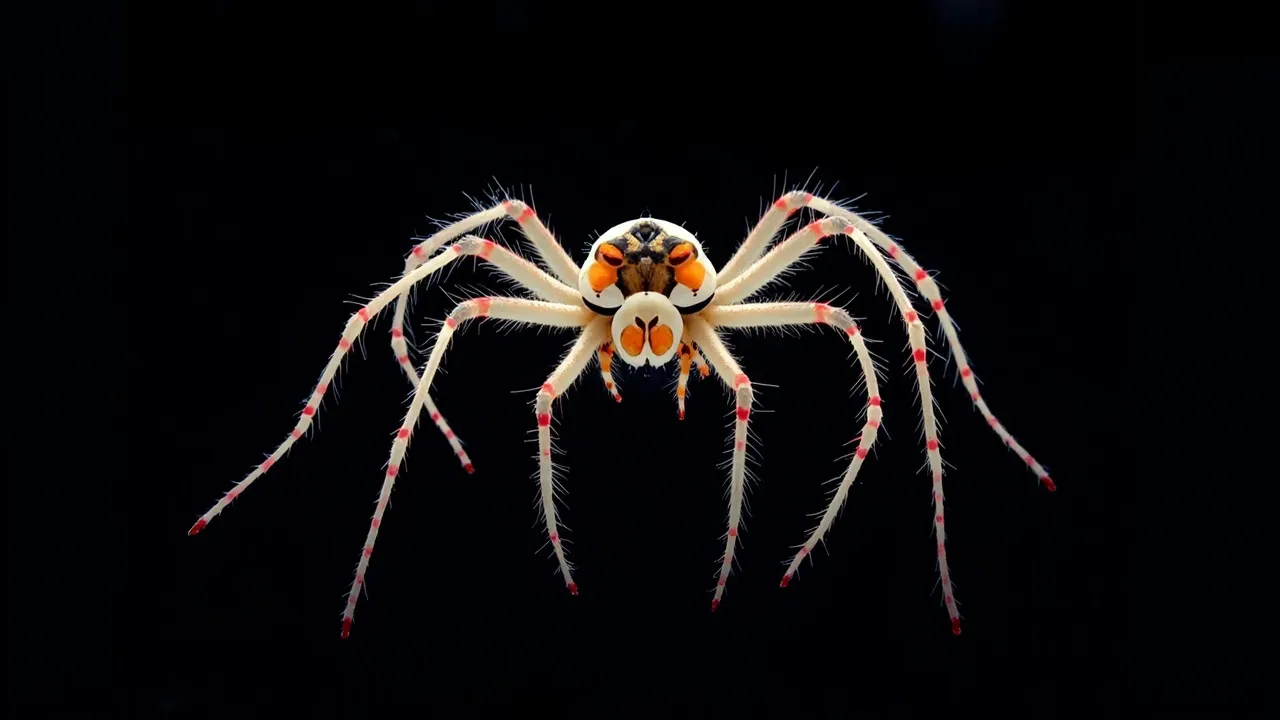
Okay, I need to tell you about these sea spiders.
I know what you're thinking — "Sea spiders? How scary can something that lives in the ocean actually be?" And friend, I was right there with you until I saw the photos. Now I'm lying awake at night picturing tiny red eyes staring up at me from the seafloor.
The Discovery That Took Nearly a Century
Researchers at the University of British Columbia have just identified two completely new species of sea spiders living in the Salish Sea, which is basically the waters around Vancouver Island. What's wild is that this is the first time in almost 100 years that anyone has officially described a new sea spider species from this region.
The lead researcher, Cormac Toler-Scott, got interested in these creatures because he wanted to study how climate change affects marine life. But here's the problem: nobody really knows what species even exist out there. It's like trying to understand how a city is changing when you can't even name all the residents.
Let Me Introduce You to Your New Nightmares
The Hairy-Footed Nightmare (Callipallene pilosuspedes)
This little guy has earned his nightmare fuel status. First of all, his legs are covered in long, curved spines — which is why scientists named him "hairy feet" in Latin. But that's not even the scary part.
His eyes are red. Just... red. Piercing little red dots staring at you from the ocean floor.
And then there's his mouth. Imagine a tiny triangular opening divided into three lips, surrounded by what can only be described as sensory tendrils. The researchers compared it to a miniature Sarlacc pit from Star Wars. You know, the one that swallowed people whole and kept them alive for a thousand years? Yeah, that image is now living in my brain whenever I think about swimming in the ocean.
Oh, and his egg-carrying legs double as grooming tools. Under a microscope, scientists watched this creature wrap those legs around itself and comb through its body hair. Nature is deeply weird, and I mean that with complete affection.
The Parasite Apartment Complex (Tanystylum kiixin)
The second species was named after an ancient Indigenous village site, pronounced "kee-hin" — which refers to the sound of waves crashing. That's actually kind of beautiful.
But here's where it gets less beautiful and more horrifying: this sea spider can't groom itself very well because its egg-carrying limbs are small and inflexible. So what happens?
Dirt and debris just... stick to them. Plus, they're covered in tiny parasites. Like, covered.
The researcher described it as "an ecosystem within an ecosystem within an ecosystem." I'm not a marine biologist, but I'm pretty sure "covered in parasites" isn't on most people's bucket lists.
So What Even Are Sea Spiders?
Let me give you the basics because these creatures are genuinely fascinating in ways that go beyond "why do they look like that."
Sea spiders belong to an ancient family that dates back roughly 500 million years. We're talking about animals that were already swimming around before dinosaurs existed. They're related to land spiders, scorpions, and horseshoe crabs, but they decided to stay in the ocean while their cousins went terrestrial.
Some fun facts:
- They can have up to 12 legs (most spiders have eight)
- They breathe through their skin (no lungs required!)
- The males carry and raise the babies (ladies, you've been freed from parenting duty, evolutionarily speaking)
- Females have ovaries that extend into their legs (I told you these creatures were bizarre)
In shallow waters, many sea spiders are parasites. They use a straw-like proboscis to suck the life juices out of larger animals. It's honestly a lot.
Why Should You Care?
I know what you're thinking — these things are terrifying and I live nowhere near the ocean, so why should I care?
Here's why: we can't protect what we don't understand.
Toler-Scott started this research because he wanted to study how climate change affects marine creatures. But he quickly realized nobody had even catalogued what species exist in these waters. It's impossible to track changes if you don't have a baseline.
The researchers combined physical observations with DNA analysis to create an identification guide for sea spiders in the region. This kind of basic science — figuring out what lives where — is the foundation for understanding everything else.
Plus, honestly, don't you want to know that somewhere out there in the cold waters off Canada, there's a tiny creature with red eyes and a three-lipped mouth just... existing? Nature is so much stranger and more wonderful than we give it credit for.
My Verdict
I've spent way too long looking at photos of these creatures, and I still can't decide which one I'm more horrified by. The hairy-legged red-eyed one with the creepy mouth? Or the parasite-covered mess that's just trying its best?
Actually, you know what? I'm going with both. Nature doesn't owe us aesthetic creatures, and these weird little guys have been doing their thing for 500 million years without asking our opinion.
Maybe that's the real lesson here. The ocean is full of surprises, and most of them are way weirder than anything we'd invent in our nightmares.
Source: https://www.sciencedaily.com/releases/2026/09/260925005412.htm