
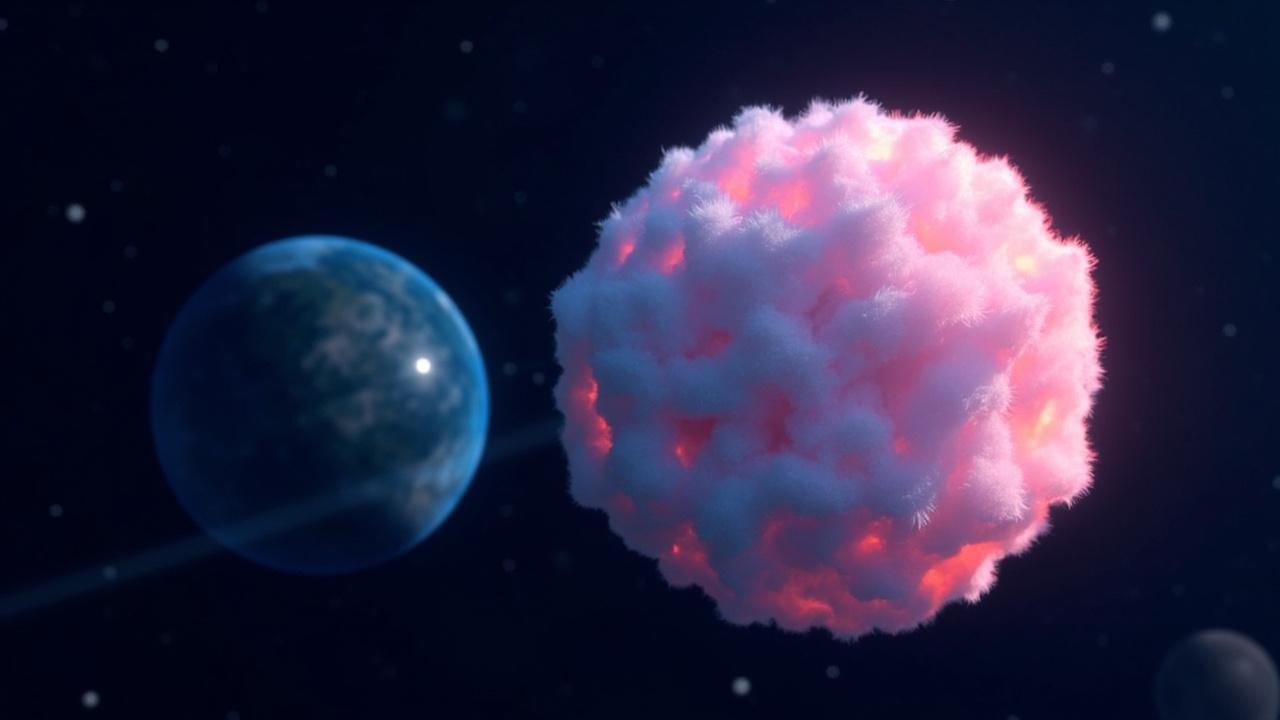
Wait, Planets Can Be Lighter Than Candy Floss?
Okay, I need to tell you about something that genuinely blew my mind this week. Astronomers found two planets out there in the cosmos that are, get this, less dense than cotton candy. Yes, you read that correctly. There's actual hard science showing us that somewhere out there in the constellation Volans (the Flying Fish, if you're curious), there are worlds floating around that are fluffier than the stuff they sell at fairs.
The team, led by researchers from the University of Oxford with help from colleagues in France and the UK, published their findings recently. And honestly? I think this might be one of the coolest space discoveries we've had in a while.
Meet TOI-791 b and TOI-791 c
So what are we dealing with here? These two planets orbit a star about 1,110 light-years from Earth. They're roughly the size of Jupiter—one of the biggest planets in our own solar system—but here's where things get wild.
Jupiter is chunky. It has a density of about 1.33 grams per cubic centimeter. Solid, hefty, planetary. Now compare that to these newcomers: one has a density of just 0.038 grams per cubic centimeter, and the other comes in at 0.047 grams per cubic centimeter. That means Jupiter is roughly 28 to 35 times denser than these cotton candy twins.
For reference, cotton candy itself sits at about 0.05 grams per cubic centimeter. So if you could somehow float a piece of fairground candy floss in space, it would technically be denser than these entire planets. How wild is that?
The Citizen Scientists Who Spotted Them First
Here's something I love about this story: regular people helped find these planets. The Planet Hunters TESS project—a citizen science initiative where volunteers sift through space telescope data—first flagged these worlds back in 2019 and 2023. It just goes to show that you don't need a PhD to contribute to real astronomical discoveries. How cool is that?
The data came from NASA's TESS satellite, which watches stars for tiny dips in brightness that might indicate a planet crossing in front of them. When these dips showed up in the TOI-791 system, researchers knew they had something interesting on their hands.
Why Antarctica Was Essential
Now here's a detail I found fascinating: part of this discovery was made possible because of observations from Antarctica. Specifically, a telescope at Concordia Station called ASTEP spent years watching this system.
Why Antarctica? Well, the planets take over 11 hours to transit their star—11 hours! That's incredibly long for a transit observation. Most ground-based telescopes can't watch something that long without interruption from daylight or weather. But Antarctica has months of continuous darkness during winter. The researchers could literally watch these planets cross their star for hours on end without stopping. According to the study, these are the longest continuous planetary transits ever fully observed from the ground.
That's dedication. Antarctic astronomers braving brutal conditions just to watch some planets float by. I have to respect that level of commitment to science.
They're Dancing Around Each Other
These planets aren't just hanging out independently—they're locked in a gravitational waltz. Specifically, they're in what's called a 5:3 mean-motion resonance. What does that mean in plain English? For every five times the inner planet completes an orbit, the outer planet completes almost exactly three. They keep pulling on each other as they go around their star, and those gravitational tugs create tiny timing variations in when each transit occurs.
Scientists measured those tiny timing shifts to figure out the planets' masses. It's incredibly clever, actually—like listening to two musicians play slightly off-beat and using that information to figure out where each one is standing.
So How Do You Even Get a Planet This Light?
This is where things get genuinely mysterious. How do you end up with an entire planet that's less dense than spun sugar?
The leading theory suggests these planets have enormous atmospheres made mostly of hydrogen and helium. Think of it like this: you have a small rocky core, but around it is this massive, puffy envelope of gas. That gas takes up tons of space but doesn't add much mass, resulting in an overall density that's surprisingly low.
Scientists think these puffy atmospheres might form when planets are much farther from their star, in colder regions of the protoplanetary disc—the swirling cloud of gas and dust that surrounds young stars. In those frigid outer reaches, gas can pile up around a solid core much more easily.
The problem? These planets appear to be much closer to their star now than where they likely formed. So something must have pulled them inward over time. But what? That's the puzzle scientists are still trying to solve.
Only a Handful Exist
Here's how rare these super-puff planets are: only four other planetary systems in the entire universe are known to contain multiple super-puff planets. Four! Out of the billions of stars out there, we can count these systems on our fingers. That's why finding two together in the TOI-791 system is such a big deal—it's an exceptionally rare opportunity to study how these unusual worlds form and evolve.
Dr. George Dransfield from Oxford put it well: "Only a handful of these super-puffy planets are known, and it is even rarer to find two in the same system. Their extremely low densities make them fascinating targets for understanding how planetary systems form and evolve."
What's Next?
The team wants to point the James Webb Space Telescope at these worlds to see what's in their atmospheres. They're hoping to detect carbon, nitrogen, and oxygen compounds that could reveal clues about where these planets came from and what they're made of.
I don't know about you, but I genuinely can't wait to hear what they find. The universe keeps surprising us with worlds that don't behave the way we expect. And honestly? That's what makes astronomy so exciting. Every time we think we understand how planets work, something like this comes along and reminds us how much we still have to learn.
So here's to the fluffy planets—the cotton candy giants floating around a distant star, light-years away from anything we can easily explain. You do you, TOI-791 b and c. You're weird, and we love you for it.