
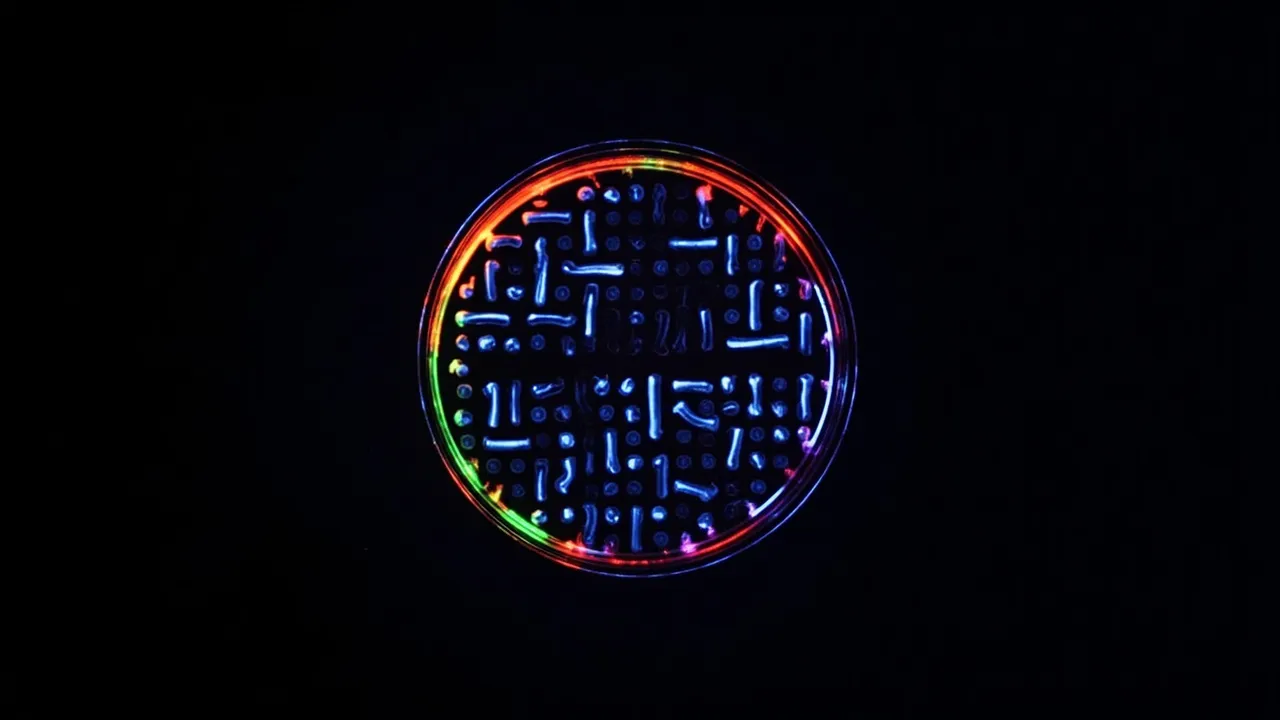
Okay, I need you to really sit with this for a second: scientists have just created living computers using bacteria.
Not metaphorical living computers. I mean actual, living, reproducing, growing bacteria that function exactly like the transistors in your phone or laptop. Wild, right?
Wait, What's a Transistor?
Let me break this down in the simplest way possible. You probably know computers work with electricity — ones and zeros, on and off. A transistor is basically the tiny switch that decides whether electricity flows through a circuit or not. Billions of them in your devices make everything work.
The MIT team, led by postdoc Hamid Doosthosseini, figured out how to make bacterial cells do the same job. Instead of controlling electrical current, these little guys control the movement of tiny signaling molecules. Those molecules carry information to other bacteria, kind of like passing notes between teammates.
Here's the Really Cool Part
Traditional synthetic biology (the field that designs living systems for useful purposes) usually tries to cram entire circuits into one cell. It's like asking one person to do every job in a company — it gets overwhelming fast.
The MIT team took a different approach. They spread the work across multiple bacterial cells, each one acting as a simple, specialized component. Think of it like breaking down a massive project into tasks and assigning each task to a different team member.
They created five bacterial strains that work together:
- Two types of transistors that can switch on or off
- Three relay strains that pass signals along like a biological game of telephone
Together, these five components can be rearranged to build essentially any circuit imaginable. The researchers demonstrated circuits that can add numbers, process multiple inputs at once, and even route information to specific destinations.
Building a Living Circuit Board
To create these biological computers, the team prints bacterial colonies onto agar (the stuff in Petri dishes) with each colony positioned about 5 millimeters from its neighbor. That spacing is crucial — it ensures signals only reach the next colony in line, creating a one-way information flow just like a traditional circuit board.
The largest circuit they built contained 24 interconnected bacterial colonies working together. Twenty-four! That's like a tiny city of microscopic computers.
Why Should You Care?
Here's where things get genuinely exciting. The bacteria they used — Pantoea agglomerans — naturally lives on plant surfaces. The researchers envision printing these living circuits onto plant leaves or roots, where they could monitor environmental conditions and help plants respond to threats.
Imagine crops that can detect drought stress and activate survival mechanisms before the damage is done. Or plants that sense pest attacks and produce natural defenses. This isn't just science fiction anymore — we're talking about engineering plants that are essentially self-diagnosing and self-protecting.
Looking Ahead
There's obviously a lot of work ahead before we see bacterial computers protecting our crops. But this research represents a fundamental shift in how we think about biological engineering. By thinking modularly — like engineers building with standardized parts — scientists might finally break through the complexity barriers that have limited synthetic biology for years.
"We can get toward more complicated functions by linking up simpler functions in individual cells," said Christopher Voigt, head of MIT's Department of Biological Engineering and senior author of the study.
And honestly? I think we're only scratching the surface of what's possible when biology and computing merge. The future might be less about silicon and more about cells.