
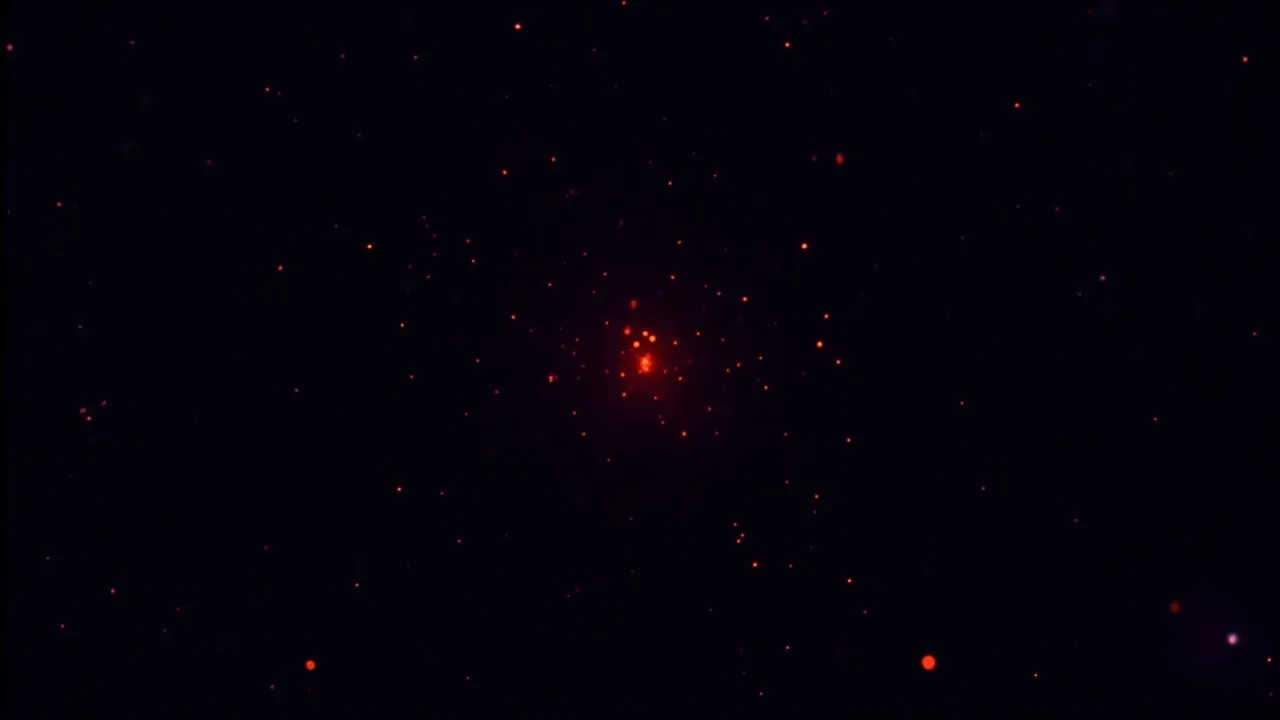
Wait, What Are "Little Red Dots"?
Okay, so here's something wild. When the James Webb Space Telescope (JWST) started sending back images, astronomers noticed something unexpected — a whole bunch of tiny, intensely red objects scattered across the early universe. They weren't quite galaxies, and they weren't quite... anything else anyone recognized. So scientists did what scientists do: they gave them a delightfully uncreative name. Little Red Dots, or LRDs for short.
These little guys are so red that they practically glow on infrared images. And they're small — at least, small compared to the massive galaxies we expected to find in the early universe. This threw researchers for a loop. What were they looking at?
Well, new simulations might have just cracked the case.
The Supercomputer Solution
A team led by Sunmyon Chon from the Max Planck Institute for Astrophysics decided to investigate using Japan's ATERUI III supercomputer — one of the most powerful machines on the planet for this kind of work. They ran incredibly detailed simulations of the early universe, zooming in from galaxy-scale all the way down to individual clouds of gas.
What they found was fascinating.
In the early universe, things were intense. Galaxies were forming at breakneck speed, blasting out radiation like nobody's business. This intense far-ultraviolet radiation from neighboring galaxies had a strange effect on some gas clouds: it prevented normal star formation. Instead of breaking apart into dozens of smaller stars, the gas would collapse into one single, absolutely massive star — we're talking hundreds or even thousands of times the mass of our Sun.
And here's where it gets interesting. These supermassive stars wouldn't last long. They'd collapse under their own gravity and — voila — create a black hole seed.
Growing Pains (But Much, Much Faster)
But the real magic happens after the black hole is born.
The simulations showed that these newborn black holes would find themselves surrounded by thick disks of incredibly dense gas. In the modern universe, black holes have trouble eating — the radiation from the material they're consuming literally pushes other material away, creating a sort of cosmic speed bump. But in the early universe? Those gas-rich environments trapped that radiation. The black holes could basically pig out without any interruptions.
The result? Black holes that grew dozens of times faster than anything we see today.
No exotic physics. No unlikely coincidences. Just the natural conditions of a young, chaotic universe doing its thing.
Why This Matters
Here's why I'm genuinely excited about this: astronomers have been scratching their heads for years over how supermassive black holes got so big so fast. Some of these monsters contain billions of times the mass of our Sun — and they existed less than 600 million years after the Big Bang. That should be impossible based on everything we thought we knew about how black holes grow.
The Little Red Dots might be the missing piece of that puzzle. They're not just weird cosmic objects anymore. They could be snapshots of black holes caught in the middle of their growth spurt — a growth spurt that was only possible in those specific early-universe conditions.
And here's the beautiful part: it all happened naturally. No need to invent new physics or assume some incredibly rare event occurred. The early universe was just... different. More chaotic. More generous with its black hole feeding opportunities.
The Universe's Wild Youth
The more I think about it, the more amazing this is. We're literally watching the universe grow up in these images. JWST lets us peer so far back in time that we're seeing an era when black holes and galaxies were still figuring out how to coexist — an era that ended billions of years ago.
These Little Red Dots, once a mystery, are now telling us a story about the universe's wild, messy adolescence. And honestly? I can't wait to see what else JWST discovers.
The cosmos has a way of humbling us, doesn't it?