
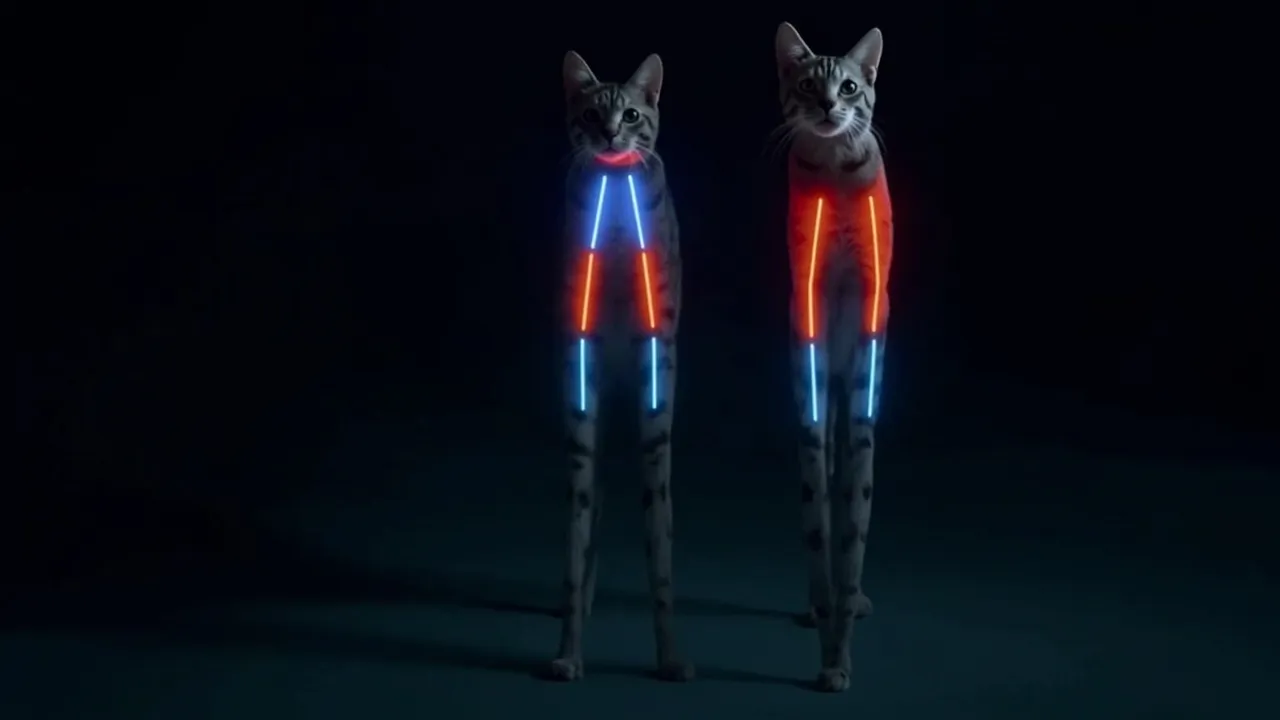
Okay, I have to admit — when I first heard about two cats named Gary and Shaggy helping scientists crack a genetic mystery, I had to stop and read more. And friends, I'm so glad I did.
Meet the Boys
Gary and Shaggy are brothers. From the moment they were kittens, something was... different about them. These weren't your typical house cats with their adorable stubby legs and cozy proportions. No, these guys were tall. Unusually tall. Their limbs seemed to stretch on forever, making them look like they belonged in some kind of cat version of a basketball team.
As they grew older, veterinarians noticed other things too. Their eyes had some structural abnormalities, and here's where it gets serious — their aorta (that's the big artery pumping blood away from your heart) was enlarged. Now, this isn't just a random collection of oddities. Put these symptoms together and something specific starts to emerge.
The Marfan Connection
What Gary and Shaggy were experiencing looked a lot like something called Marfan syndrome — a genetic disorder that weakens connective tissue throughout the body. Connective tissue is basically the glue that holds everything together, so when it's compromised, all kinds of systems can be affected. The skeleton, the eyes, the blood vessels — nothing is immune.
In humans, Marfan syndrome affects about 1 in 4,000 people. It's the kind of thing that famous violinist Niccolò Paganini might have had (his crazy flexibility made perfect sense if you think about it), and it's also been associated with Abraham Lincoln's tall, thin frame. But here's what really surprised me: despite Marfan being well-documented in people, nobody had ever confirmed a case in domestic cats before.
Until Gary and Shaggy came along.
The Science Behind the Discovery
Researchers at Cornell University got curious about these lanky brothers and decided to dig deeper. They ran thorough medical exams and analyzed the cats' DNA looking for clues.
What they found was a mutation in a gene called FBN1. This gene is responsible for producing something called fibrillin-1, a protein that's absolutely crucial for healthy connective tissue. Think of it like the steel beams in a building — you need it for structural integrity.
Here's where it gets really interesting. Gary and Shaggy each had two copies of this mutated gene — one from each parent. In humans, you'd typically only need one copy of the mutated gene to develop Marfan syndrome. Having two mutated copies is exceptionally rare and would normally cause a much more severe form of the disorder.
So why are these brothers still alive and doing okay?
A Happy Accident in Genetics
The researchers discovered something unexpected. These cats' particular genetic variant didn't completely break the FBN1 gene. Instead, it messed with how the gene's instructions were processed, but some normal function remained. That residual activity was enough to keep the brothers from experiencing the most severe outcomes.
It's kind of like having a faulty factory machine that still produces some working parts — not ideal, but functional enough to get by.
This is actually a big deal, and here's why I think it's so cool.
Why This Matters
First, it gives veterinarians a foundation for recognizing similar cases in other cats. If a vet sees an unusually tall cat with eye problems and heart issues, now they have a reference point. This wasn't on anyone's radar before.
Second, it opens the door for developing actual genetic tests. If breeders or pet owners are concerned, they might eventually be able to get answers through testing rather than just watching symptoms develop.
And third — and this is the part that really got me thinking — it gives researchers a new way to study Marfan syndrome itself. We can't exactly ask cats to fill out medical questionnaires or report their symptoms. But we can observe them, run tests, and learn things that might eventually help human patients too.
The Bigger Picture
What I love about this story is how it reminds us that scientific discovery isn't always about people in white coats staring through microscopes in silence. Sometimes it's about two goofy-looking cats who stood out from the crowd, a team of curious researchers, and a university willing to pay attention to what most people would just call "funny-looking kittens."
Gary and Shaggy didn't know they were contributing to science. They were just being themselves — unusually tall, probably knocking things off tables with their ridiculous long limbs, living their best cat lives. But their uniqueness gave researchers a window into something important.
So next time you see a pet with unusual features, remember: they might be more special than they appear. Or at the very least, they make for a way better story than another viral cat video (though honestly, Gary and Shaggy deserve their own viral moment).
The findings from this study were published in Scientific Reports, and they represent the first molecular characterization of Marfan syndrome in domestic cats. Pretty remarkable for two brothers who just wanted to be regular cats.