
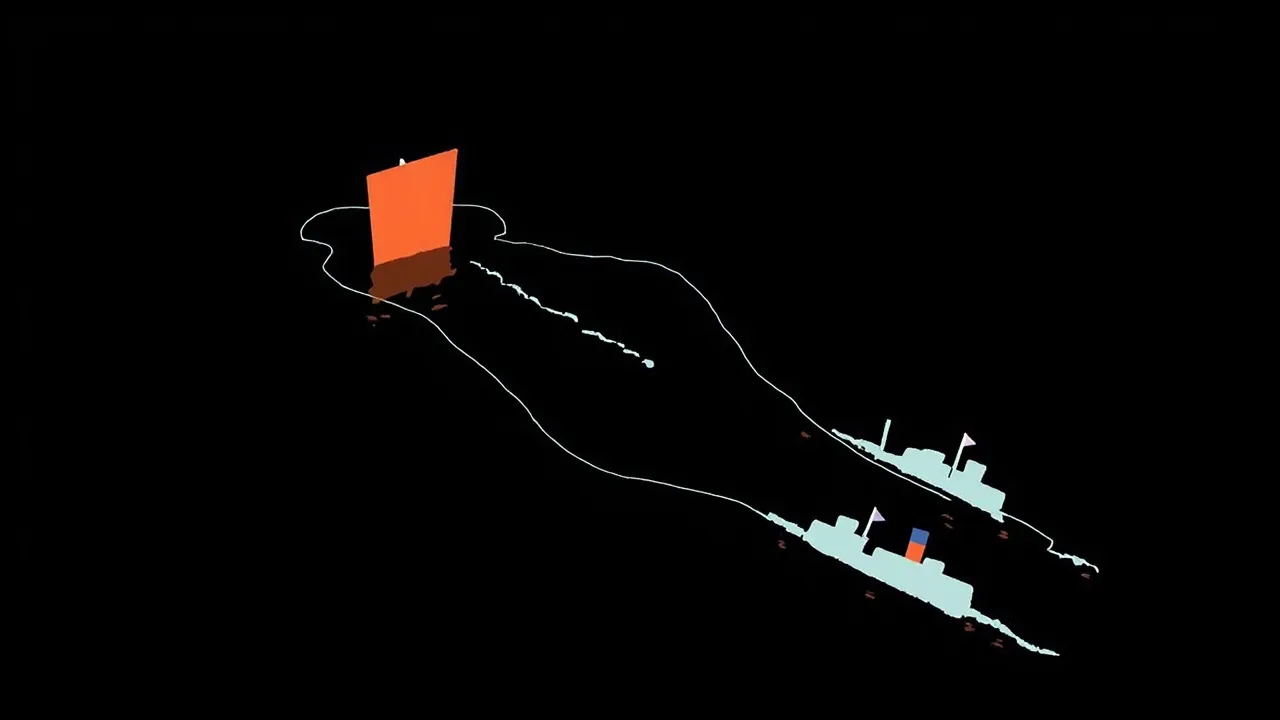
There's something about the Edmund Fitzgerald that refuses to stay buried.
I've been fascinated by this shipwreck story for years — probably like many of you who grew up hearing Gordon Lightfoot's haunting ballad on the radio. But the real story behind the Fitzgerald is somehow even stranger than the song suggests. And a discovery made nearly 20 years after the ship went down proves just how little we actually understand about what happened on that terrible November night in 1975.
The Ship That Shouldn't Have Sank
Let me set the scene for those who might not know the full story. The Edmund Fitzgerald was no ordinary vessel — she was the largest ship ever to sail the Great Lakes at that time. We're talking about a massive iron beast, over 700 feet long, built to handle anything Mother Nature could throw at her.
So when she vanished during a November storm on Lake Superior, people were rightfully terrified. Here's a ship designed to weather the worst conditions, and it just... disappeared. With all 29 crew members aboard.
What makes this even more unsettling? That storm, while certainly dangerous, wasn't considered exceptional by Great Lakes standards. Other ships were out that night and made it through fine. The Fitzgerald had an experienced captain and was in perfect working condition. By all accounts, she should have survived.
But she didn't. And nobody saw it happen.
The Reporter Who Wouldn't Let It Go
For most people, the story would have ended there — another tragic shipwreck to add to the long history of the Great Lakes. But Ric Mixter wasn't most people.
Mixter was a television reporter who became obsessed with understanding what happened to the Fitzgerald. He spent decades investigating, writing a book, and chasing every lead he could find. Honestly, I love this kind of dedication. There's something deeply admirable about someone who refuses to accept "it just sank" as an answer when 29 families never got closure.
In 1994, Mixter finally got his chance to see the wreck for himself.
Deep Below the Surface
Picture this: it's July, and Mixter is aboard a tugboat called the Anglian Lady, hauling a tiny yellow submersible named Delta toward the final resting place of the Fitzgerald. Whitefish Bay in Lake Superior stretches out before them at dawn.
The submersible that Mixter rode down was nothing fancy — just a small craft that would carry him and a pilot down into the darkness. When they reached 550 feet, Mixter expected to see sand on the bottom. Instead, there was just mud and rocks. And rising from that murky floor, the rusted outline of the Fitzgerald's hull.
He filmed everything. The faded letters spelling out "EDMUND." The way the ship had come to rest in two main pieces. The eerie silence of being that deep underwater, surrounded by the remains of something so monumental.
But here's what really got to me about Mixter's account: at one point, he saw water on the floor of the submersible and got genuinely spooked. Can you imagine? This guy had been researching this wreck for decades, and when he finally got down there, he still felt that primal human fear of being trapped in a small metal sphere at the bottom of an enormous lake. I think that moment says something beautiful about how the ocean (or in this case, the Great Lakes) still commands our respect, no matter how prepared we think we are.
The Discovery That Changed Everything
After two mesmerizing hours underwater, Mixter returned to the surface. But the day's dives weren't over.
The next submersible trip carried the owner of the Anglian Lady and his 12-year-old son. And it was this dive that made headlines.
They found a body.
The crewman was lying face-up outside the ship, near an open door on the port side, close to the bow. No one had ever found human remains at the Fitzgerald wreck before. In fact, this might be the only time anyone has ever recovered a victim from this particular tragedy.
Think about that for a second. 29 men went down with that ship in 1975. For nearly 20 years, they rested there undisturbed. And then, somehow, one of them ended up outside the vessel.
The questions practically answer themselves: Did this man try to escape through that door as water rushed in? Was he already outside when the ship went down — somehow knocked overboard during those final chaotic moments? His neck appeared to be broken. Did he fall? Was he pushed? Or — and this is a possibility nobody wants to voice out loud — was he already deceased when the ship sank, for reasons we may never understand?
Technology Is Changing the Game
Here's where things get really interesting for those of us who love a good mystery.
When Mixter made his dive in 1994, the technology was impressive for its time. But the tools available today? They're absolutely mind-blowing.
Remotely operated vehicles (those robot subs controlled from the surface) used to cost around $100,000. Now you can pick one up for roughly $2,000. Sonar systems have gone from government-level equipment to something hobbyists can build in their garages. GPS, electronic navigation, even Google Earth — all of these help researchers pinpoint exactly where to look.
And the images! Modern sonar offers about 50% better resolution than what Mixter was working with. According to researchers, you could literally see a two-inch rope on the seafloor from above the water. That's not science fiction — that's the reality of underwater exploration in 2024.
Scientists are even developing AI programs that analyze data from known shipwrecks to help locate new ones. Autonomous underwater vehicles equipped with sonar are doing the grunt work that once required expensive crewed expeditions.
What Does This Mean for the Fitzgerald?
The tantalizing possibility is this: someday, someone might return to the Fitzgerald with these advanced tools and finally piece together what happened.
They could map the entire wreck in three dimensions without ever getting wet. They could examine debris fields in incredible detail. They could test materials for clues about structural failure.
Mixter himself believes there's so much more to discover. "We could tow a sonar over the top and it would show us resolution right down to a two-inch rope," he said. "We could easily see."
But here's the thing that keeps me up at night: even with perfect information about the ship's final moments, will we ever truly understand what those men experienced? Technology can tell us how the Fitzgerald broke apart. It can't tell us what was going through the minds of the crew as they realized what was happening.
The Mystery Endures
The Edmund Fitzgerald sank 49 years ago. In that time, we've gone from typewriters to smartphones, from landline phones to video calls with anyone anywhere on Earth. We've mapped the human genome and landed robots on Mars.
And yet, the Great Lakes still hold secrets.
That crewman discovered in 1994 — he still lies somewhere near the Fitzgerald, a silent witness to a tragedy that defies explanation. Every time I hear Lightfoot's song, I think about those 29 men and the families who never got definitive answers.
Maybe someday technology will give us the complete story. Maybe the Fitzgerald will keep her secrets a little longer.
But honestly? Part of me hopes the mystery never fully dies. There's something about standing at the edge of the unknown — about accepting that some questions may never be answered — that feels appropriate when you're dealing with the deep.
Lake Superior is cold, dark, and vast. The Fitzgerald rests nearly 550 feet below its surface. And somewhere out there, 29 men are still waiting to tell their story.
If you want to learn more about the Great Lakes and their many shipwreck mysteries, check out some of the excellent documentaries and books out there. This is a piece of American history that's absolutely worth exploring.
And if you ever find yourself near the Great Lakes, pause for a moment and think about the Fitzgerald. Light a candle if that's your thing. These stories deserve to be remembered.
What do you think? Drop a comment below — are you team "solve the mystery with technology" or team "some things should stay mysterious"? I'd genuinely love to hear your thoughts.