
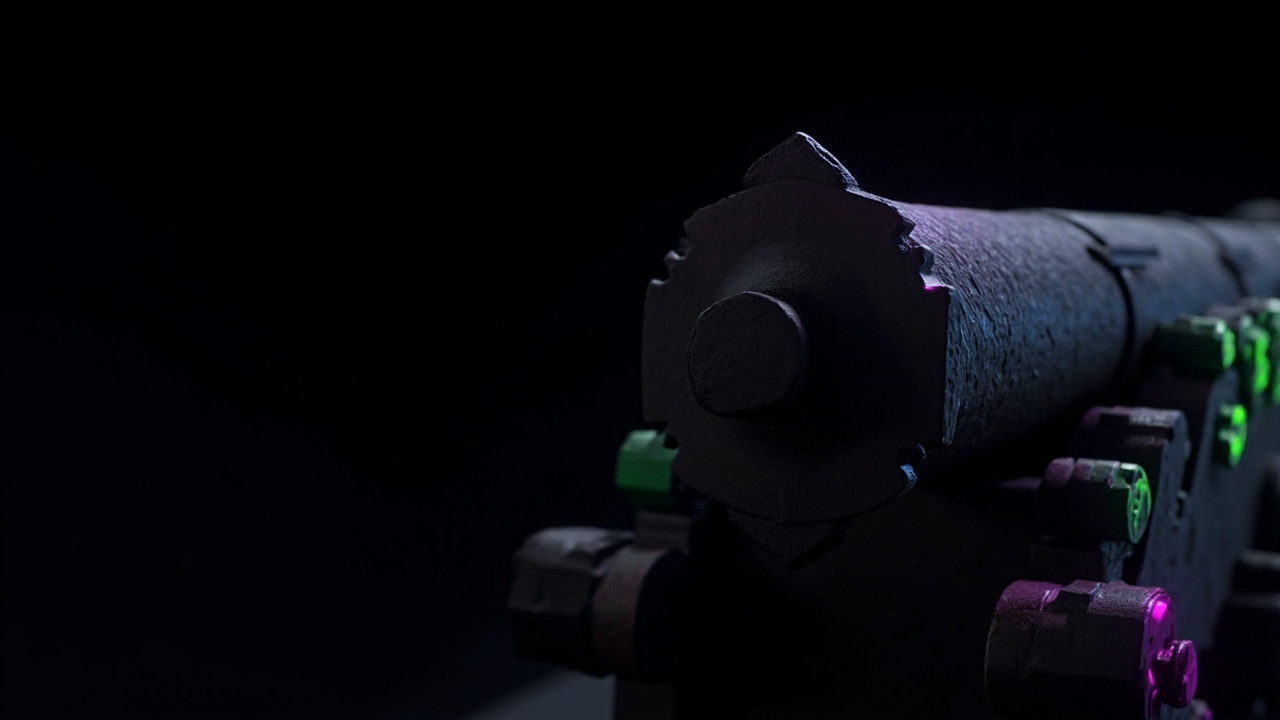
A Cannon That Tells a Story
Imagine working on what you think is just another restoration project, carefully removing bricks from a 400-year-old wall, when suddenly you find a massive cannon staring back at you. That's basically what happened to archaeologists at the Jiankou section of the Great Wall near Beijing in late 2025. But here's the cool part—this wasn't just any old cannon. It's a window into an entire world we'd mostly forgotten about.
The cannon itself is pretty impressive: 35 inches long, weighs 247 pounds, and bears an inscription reading "Chongzhen Year 5," which translates to 1632 in our calendar. For researchers, that inscription is pure gold. It's like the cannon came with its own birth certificate, which is rare for artifacts this old.
A Bridge Between Civilizations
What really got the archaeologists excited isn't just the cannon itself—it's what the cannon tells us about how cultures shared knowledge. This Ming Dynasty weapon has surprising similarities to European-style cannons, especially in its barrel design. According to the research team, finding this physical evidence of Chinese-Western military technology exchange is huge.
Think about it: we're talking about the 1600s, centuries before the internet, when the idea of different civilizations swapping technical knowledge sounds almost impossible. Yet here's the proof, sitting in a watchtower on the Great Wall. It completely changes the story of how innovation actually happened back then.
The Wall Wasn't Just About Defense
Here's what blew my mind about this discovery: the excavation team found 28 turquoise artifacts scattered throughout the site. Those turquoises? They didn't come from nearby. Researchers traced them back to mines in provinces like Hubei, Henan, and Shaanxi—meaning soldiers stationed on this remote wall section had access to goods from across China's vast landscape.
The team also found evidence of crops and medicinal plants, which tells us these watchtowers weren't austere military outposts. People were actually living there, with gardens, food supplies, and medical knowledge. They weren't just defending; they were thriving in their own way.
The Real Treasure: Human Stories
But my favorite discovery isn't the fancy turquoise or the important cannon. It's a brick with an inscription that reads, "nothing but alcohol or worry; three years of toil turned my hair white." Some laborer etched those words into a brick during the Ming Dynasty—over 400 years ago—and we can still read their frustration. That's the kind of thing that makes history feel real.
In Watchtower 118, researchers found evidence of heated brick beds and stoves where soldiers would've slept during brutal winters. In another tower, they discovered a monument dated to 1573 that helped them understand when different sections were built. These aren't just artifacts; they're pieces of daily existence.
How They Built It (And How We Know)
The excavation also revealed some fascinating details about Ming-era construction. Those bricks weren't random—they had inscriptions noting weight specifications, which actually contradicts what historians previously believed about how brick kilns operated. The lime mortar used to hold everything together included plant fibers and high-magnesium lime, a formula that kept these structures standing for centuries.
It's kind of amazing how much you can learn by paying attention to the details that previous generations might have overlooked or dismissed as unimportant.
Why This Matters
What struck me most about this discovery is how it transforms the way we think about the Great Wall. We tend to picture it as this cold, purely military structure—a defensive line drawn across mountains. But it wasn't. It was a functioning settlement where people worked, ate, traded, celebrated, and suffered. It was a cultural crossroads where knowledge flowed in both directions.
The research team, led by associate research fellow Shang Heng at the Beijing Institute of Archaeology, put it perfectly: "These findings transform the Great Wall from a cold military structure into a living historical landscape integrating defense, cultural exchange, and daily life."
What's Next?
The exciting part is that this excavation is just the beginning. The Great Wall is massive—over 13,000 miles of it—and according to the research team, the landscape hasn't changed much since the Ming Dynasty. That means archaeologists can use the geography itself to help piece together how people lived and worked. It's like having a time-travel machine built into the landscape.
I'm genuinely curious what else they'll find as they continue digging. Every brick removed, every artifact uncovered, adds another layer to our understanding of how civilizations actually functioned hundreds of years ago.