
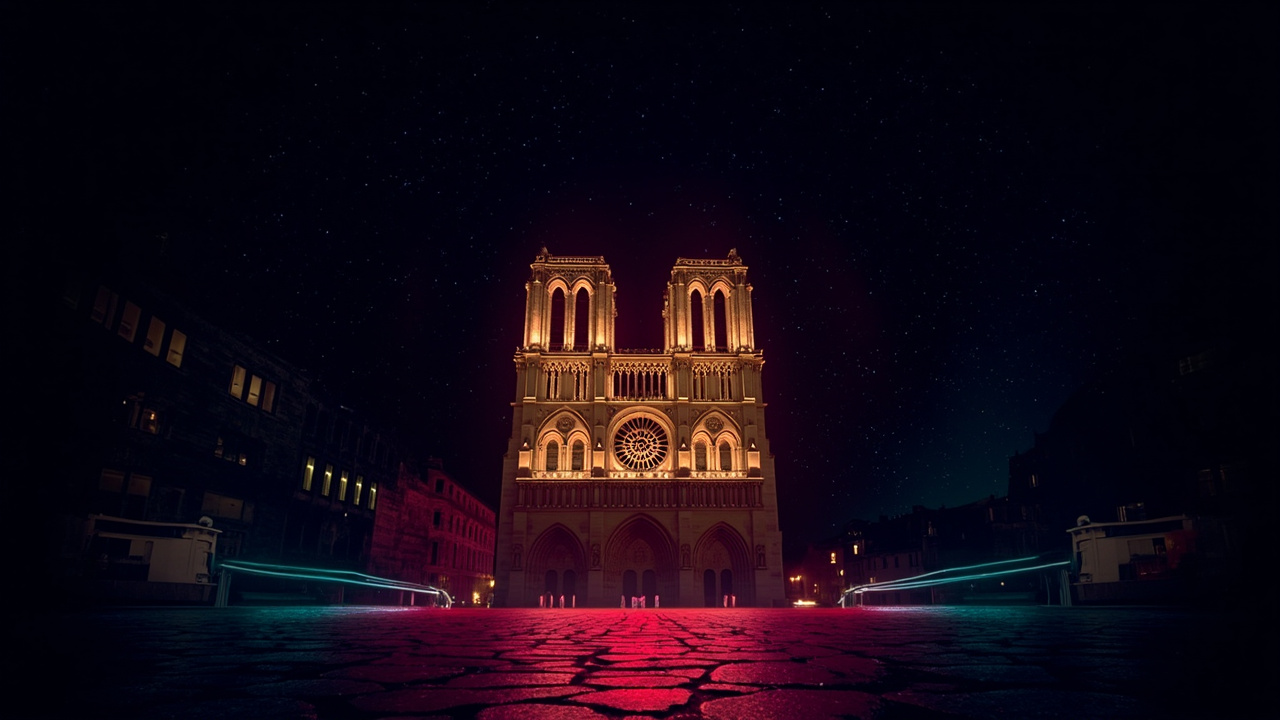
The Secret City Beneath the Cathedral
Okay, I have to be honest with you — when I first read about this dig, I expected the usual stuff. Maybe a few coins, maybe some foundation stones. You know, the kind of "interesting but not groundbreaking" finds that usually make archaeology news.
I was SO wrong.
Turns out, beneath the square outside Notre-Dame in Paris, there's literally 2,000 years of continuous human history just waiting to be uncovered. And we're not talking about scattered fragments here — we're talking about a complete vertical timeline of civilization, right there in the heart of Paris.
A Hole in the Ground That's Rewriting History
The excavation started not because anyone was hunting for treasure, but because the city of Paris wants to rebuild the square outside Notre-Dame. They were planning to add some trees, create a shaded gathering space — basically a nice civic improvement project.
Then someone thought, "Hey, before we dig all this up anyway, maybe we should let archaeologists take a look."
What happened next was like peeling back the layers of a massive onion — except each layer represents centuries of history.
Just about 20 inches down, things start getting interesting. Go deeper — about 13 feet down — and you're looking at evidence of human habitation that never really stopped. From the medieval homes that once crowded around the cathedral, to Roman settlements from the 4th and 5th centuries, to grain pits from the 6th through 10th centuries... it's all there, stacked like some kind of ancient layer cake.
Lucie Altenburg, a conservator with the Paris archaeology unit, put it perfectly: "It's a rare opportunity for us to work on something that's tangibly going to make a difference to the history of Paris."
No kidding.
The Toilet Treasure Trove
Now here's where it gets weirdly fascinating. One of the most exciting discoveries didn't come from some grand temple or noble's house — it came from medieval latrines.
Yep, you read that right. The old outhouses.
Inside these waste pits, archaeologists found intact jugs, cups, and a candlestick that had been preserved for centuries. Why? Because, well, latrines aren't exactly known for their cleanliness — and that grime and... let's call it "organic material"... actually protected these objects from decay.
Archaeologist Calentine Breloux called the discovery "astonishing." And honestly? I have to agree. There's something almost poetic about the fact that the most pristine artifacts were protected by the very mess we usually try to avoid thinking about.
But the real mystery? Among these finds are pottery shards with mysterious red writing on their inner surfaces. Experts have examined them and... nothing. Nobody knows what they say or what they mean. For now, this little red script remains an enigma.
The Roads That Time Forgot
The dig is also revealing how the city physically transformed over centuries. Historical records mention that stone was brought in from elsewhere to secure the site as it evolved from the Roman settlement of Lutetia into the fortified medieval island we know today.
And they've found evidence of this repurposing firsthand — including a Roman doorstep that was literally flipped upside down and used to pave a road. Imagine being the person who casually turned a door threshold into a stepping stone. That wasn't garbage; that was just... resourcefulness.
Archaeologist Hugo Cador put it this way: "They are not treasures, like gold bars, but each element has great scientific value. When you come across entire objects... it makes it possible to reconstruct the daily life of the time."
And that's what makes this dig so special. It's not necessarily finding Crown Jewels or royal tombs. It's finding the ordinary, everyday stuff that tells us how regular people lived, worked, ate, and yes, even... relieved themselves... over two millennia.
Why This Matters More Than You Think
Here's the thing that really gets me about this story. Notre-Dame is famous. Millions of people visit it every year, and after the 2019 fire, the whole world was watching its reconstruction. It's one of the most iconic buildings on the planet.
But all along, there's been an entire invisible city underneath it. Layers of history that most visitors — including me, honestly — never even think about.
One English tourist named Emily Carter put it beautifully after watching the dig: "You come to see the cathedral, then realize there's another city under your feet. That's almost more moving."
And honestly? I think she's onto something. There's something almost spiritual about the fact that this site has been continuously occupied for 2,000 years. Through Roman emperors, medieval kings, revolutions, wars, and reconstruction — people kept coming back to this same spot on the Île de la Cité.
What's Next?
The new square is supposed to open in 2028, with 160 newly planted trees and a water feature to help cool the area during those sweltering Paris summers. But until then, the dig continues.
The team hopes to push even further back in time — maybe to find evidence of occupation before the Romans even arrived. Given what's already been discovered, I wouldn't bet against them.
Above ground, the cathedral stands renewed, its spire reaching toward the sky once again. But below, the centuries keep surfacing — each layer telling its own story about the people who came before us.
I don't know about you, but I think I'm going to look at Notre-Dame a little differently next time I see it in photos. That cathedral isn't just a building — it's the surface layer of an entire buried world.
Sometimes the most incredible discoveries aren't the ones that make the loudest news. They're the ones hiding right beneath our feet, waiting for someone to dig a little deeper.
Source: https://www.popularmechanics.com/science/archaeology/a71496535/notre-dame-cathedral-excavation