
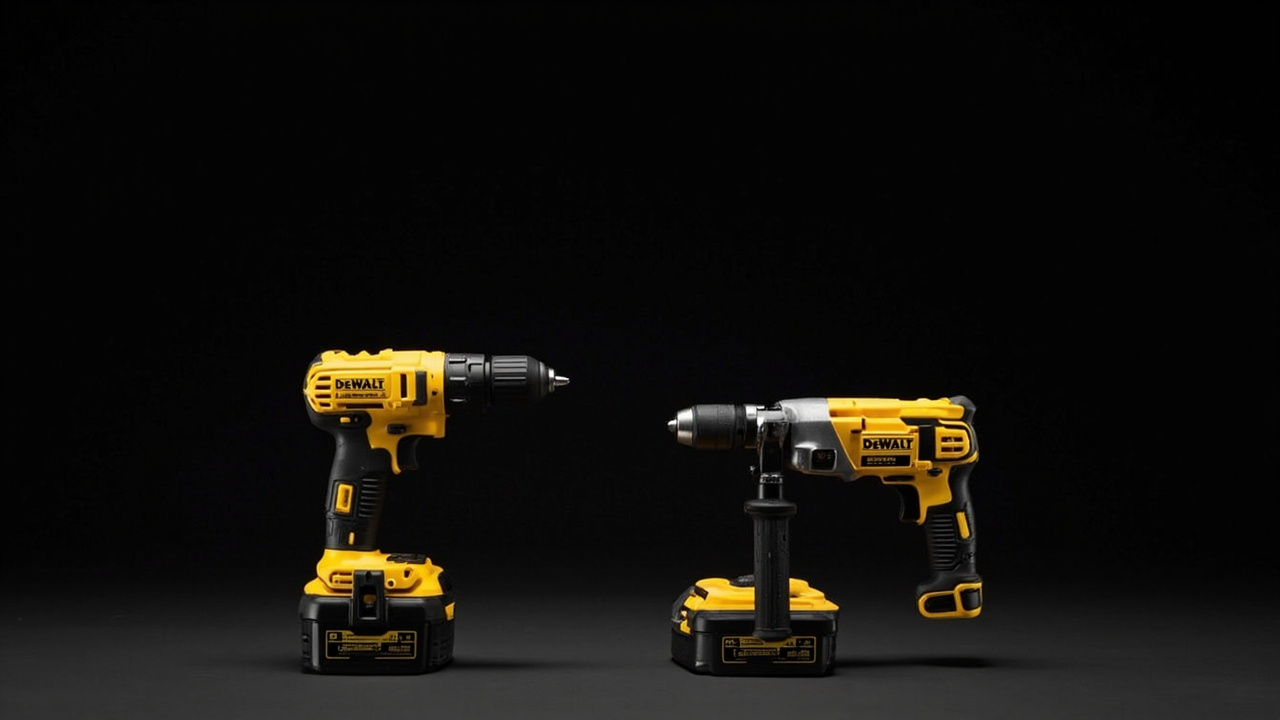
Okay, Let's Talk About This Drill
Look, I'm just going to say it: most people do not need a drill like this. And honestly? DeWalt probably knows that too.
The Max XR hammer drill will set you back around $349 (though I've seen it drop to $250 during sales, which is a bit more palatable). For context, you can grab a perfectly decent drill for under $100 that will handle 90% of what the average homeowner throws at it. So why would anyone spend this much?
Here's where it gets interesting.
Raw Power That Actually Matters
Let me paint you a picture. I bored through a 1/2-inch hole in a 2x4 with a twist bit. You know how long it took? Half a second. Half. A. Second.
And here's the wild part — it did this while running at full speed. Most drills lose serious oomph when you max out the RPMs, but this thing maintained its composure. It was honestly a little unsettling how smoothly it handled that test.
But the real party trick? Paddle bits. I used a 1-inch paddle bit and drilled 20 holes through 1-3/4-inch thick wood. Total time: three seconds. That's not a typo.
Now, I'm not someone who regularly needs to drill through thick wood like some kind of construction professional (I'm more of an "assemble IKEA furniture without reading instructions" kind of guy). But if you've got a deck to build or a shed to frame, this kind of power starts making a lot more sense.
The Concrete Test (Because Why Not)
I got a little excited during testing and decided to see what happened when I pushed this thing against concrete. I dug out an old chunk of curb that I apparently had lying around (don't ask), grabbed a 9/16-inch masonry bit, and went to town.
Medium speed, hammer mode engaged. The drill just... went. Through concrete. Like it was butter. No binding, no hesitation, nothing. It just chewed right through.
Was this necessary? Absolutely not. Did I feel like a superhero? You betcha.
Why Power Alone Isn't The Whole Story
Here's the thing about having a rocket ship of a drill — it can also destroy your weekend project if you're not careful.
I've stripped more screw heads than I'd like to admit over the years, usually because I got overconfident with a powerful drill and went to town on some delicate work. The DeWalt solves this problem in a really smart way.
It has 11 different torque settings on the clutch, plus three speed settings. Translation: you can dial back the power for delicate work while still having access to all that muscle when you need it. I was able to drive in smaller screws without turning them into little metal casualties. It's like having a drill that can be both a race car and a smart car, depending on what the job calls for.
That Anti-Kickback Feature Saved My Wrists
Okay, real talk for a second. Hammer drills are no joke. If a bit catches wrong, the whole thing can twist violently in your hands. I've seen people sprain wrists, and it's not pretty.
DeWalt included an anti-rotation safety feature that cuts the motor if it senses too much rotational motion. This thing is watching your back in a way that most drills simply don't.
They also included a detachable side handle, which gives you a second point of contact. Between the safety feature and the handle, I felt way more confident using this thing than I would with a cheaper model.
Little Details That Made Me Smile
The LED work light has three adjustable positions, which sounds minor until you're trying to see inside a dark cabinet or under a sink. But here's the really clever part — there's a separate button to turn the light on independently, and it stays on for up to 20 minutes after you stop drilling.
Think about that for a second. You finish drilling, set the drill down, and you've still got light for almost half an hour while you figure out your next move. It's these small touches that separate "nice tool" from "this tool gets me."
There's also a little integrated hook on the body for hanging it on your tool belt. Again, small thing. But when you're working on a ladder or moving around a job site, you don't want to be juggling a 6-pound drill while trying to hold boards in place.
The Not-So-Great Stuff
Here's where I have to be honest with you.
This thing weighs 6.3 pounds with the battery installed. That's not "heavy for a drill" — that's "I'm going to feel this in my shoulder tomorrow" heavy.
Is it well-balanced? Yes. Does that make it lighter? Absolutely not. If you're used to a lighter cordless drill and pick this up for the first time, you're going to notice it. Extended use will likely lead to fatigue.
The body is also a bit bulkier than some competitors, though DeWalt gets credit for keeping the head relatively compact at 7.4 inches. It can still squeeze between studs and into cabinets, which matters more than you'd think when you're actually working.
So... Is It Worth It?
Here's my honest take.
If you're a professional contractor who spends all day driving fasteners and boring holes, this drill pays for itself in efficiency and saves your body from repetitive strain. The price tag makes sense when this is your livelihood.
But if you're a homeowner who might tackle a project every few months? You probably don't need this much power. A solid mid-range drill will serve you just fine for 95% of what you'll encounter.
That said — and here's where it gets interesting — if you're someone who tends to take on bigger projects, or you've outgrown your current drill and want something that can handle whatever you throw at it, the Max XR might be worth the investment. The safety features alone give me peace of mind, and the control options mean you're not sacrificing precision for power.
It's one of those tools that says, "I can handle anything," and actually means it.
Source: Popular Mechanics DeWalt Max XR Cordless Hammer Drill Review