
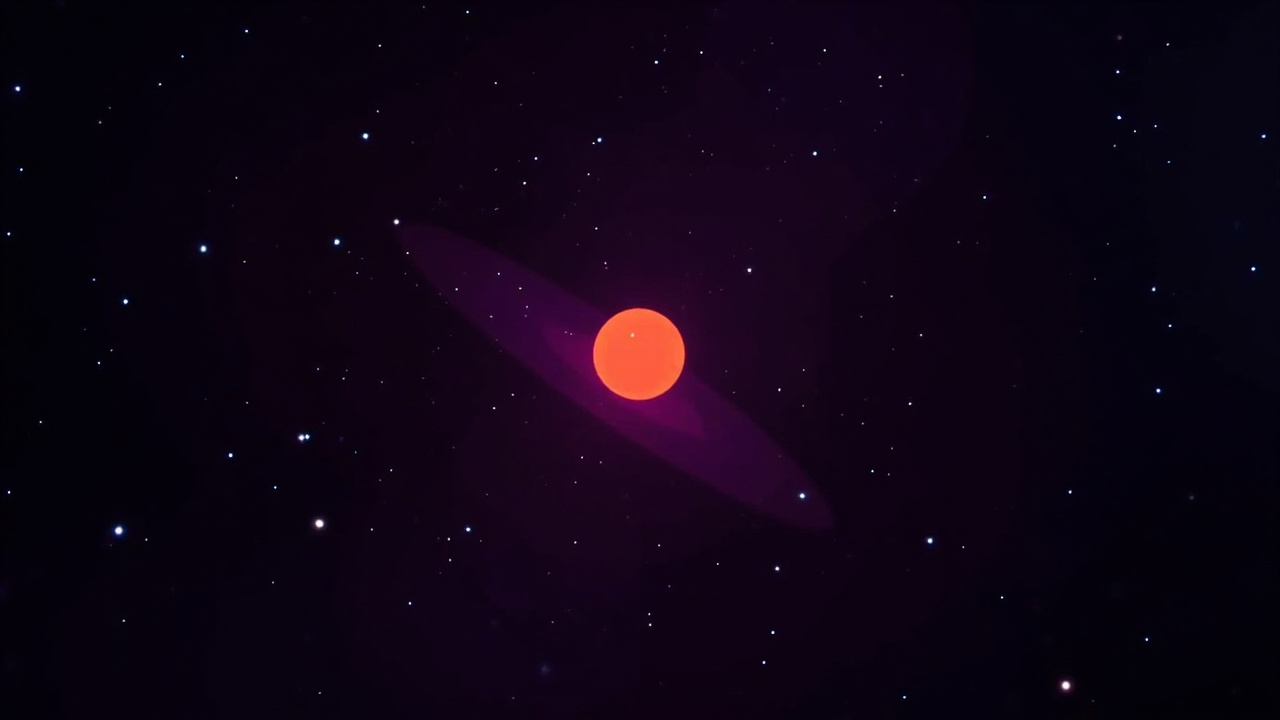
When a Planet Gets a Little Too Close to Its Star
Imagine a planet so baked by its parent star that the surface could literally melt metal. Now imagine that same planet has zero atmosphere to cool things down, no water, and probably no chance of ever hosting life as we know it. Welcome to LHS 3844 b, a planetary bad boy located just 48 light-years away that's teaching us some wild lessons about what happens when rocky worlds get too cozy with their stars.
The wild part? Scientists just used the James Webb Space Telescope to peek directly at this planet's surface—something that was basically impossible before. And what they found is pretty grim but absolutely captivating from a scientific perspective.
A Planet That Can't Escape Its Star
Here's the cosmic tragedy: LHS 3844 b orbits its star so closely that it completes an entire year in just under 11 hours. We're talking about a distance that would make Mercury's orbit look spacious by comparison. The planet is "tidally locked," which is a fancy way of saying one side is permanently roasted while the other is frozen in eternal darkness.
The dayside? We're looking at temperatures around 1,340 degrees Fahrenheit (725 Celsius). That's hot enough to melt lead, let alone anything we'd consider habitable. And since there's no atmosphere, there's nothing to distribute that heat around or shield the surface from its star's relentless radiation.
What Does a Hell-Planet Actually Look Like?
Here's where it gets interesting. Instead of imaging the planet directly (which is technically impossible from this distance), researchers used infrared technology to measure heat radiation bouncing off the surface. Think of it like reading a fingerprint made of light.
The data revealed something unexpected: this planet's surface looks a lot like the Moon or Mercury. It's dark. Really dark. We're talking about a landscape that's basically charred volcanic basalt—the same kind of rock you'd find from ancient lava flows on Earth, or covering much of the Moon's surface.
No Granite, No Water, No Chance
What really surprised scientists is what isn't there. Earth's crust is mostly granite and other silicate-rich rocks that form through a long, slow process involving plate tectonics and water. LHS 3844 b? It's got none of that.
The team compared the planet's infrared signature against every mineral composition they could think of—rocks from Earth, samples from Mars, lunar material, you name it. The results were pretty conclusive: this world doesn't have an Earth-like crust, which strongly suggests it never had plate tectonics or significant water.
Instead, the surface appears to be dominated by solid basalt and magnesium-iron-rich rocks—the kind of material that forms from raw mantle rock or ancient volcanic activity. It's like someone took a planetary embryo, exposed it to intense radiation and meteor bombardment, and just let it sit there for billions of years.
The Surface Is Actually Getting Darker Over Time
Here's a detail that's genuinely cool: the planet's darkness might actually be getting worse. Without an atmosphere to protect it, LHS 3844 b is constantly getting blasted by radiation and hit by space rocks. Over time, this cosmic weathering breaks down rock into fine dust and gravel.
But it doesn't stop there. The radiation and chemical reactions are actually adding iron and carbon compounds to the surface dust, which darkens it even more. It's like the planet is slowly turning itself into charcoal through a combination of cosmic abuse.
Two Possible Futures for a Dead World
The data points to two possible scenarios for what we're actually looking at. Either the surface is covered in relatively fresh basaltic rock (meaning there's been recent volcanic activity), or we're seeing a super-ancient landscape of dark dust and regolith that's been getting pounded for eons.
Honestly? Both options are bleak. If it's still volcanically active, the planet is an unstable hellscape. If it's not, it's just been dead for billions of years.
Why This Matters
You might be wondering: "Cool story, but why should I care about a dead planet?" Here's the thing—studying worlds like LHS 3844 b gives us insights into how rocky planets actually develop. It shows us what happens to planets that don't get the cosmic lottery luck we got.
Earth is actually pretty special. We have plate tectonics, water, a protective atmosphere, and a star that's the perfect distance away. Most rocky planets probably don't have it so good. Some end up scorched and airless. Others might be frozen or perpetually pummeled. By studying the failures, we better understand why we're so fortunate.
Plus, every new observation with JWST pushes us closer to understanding what conditions are actually necessary for life to emerge. And sometimes, learning what doesn't work is just as valuable as finding another Earth.