
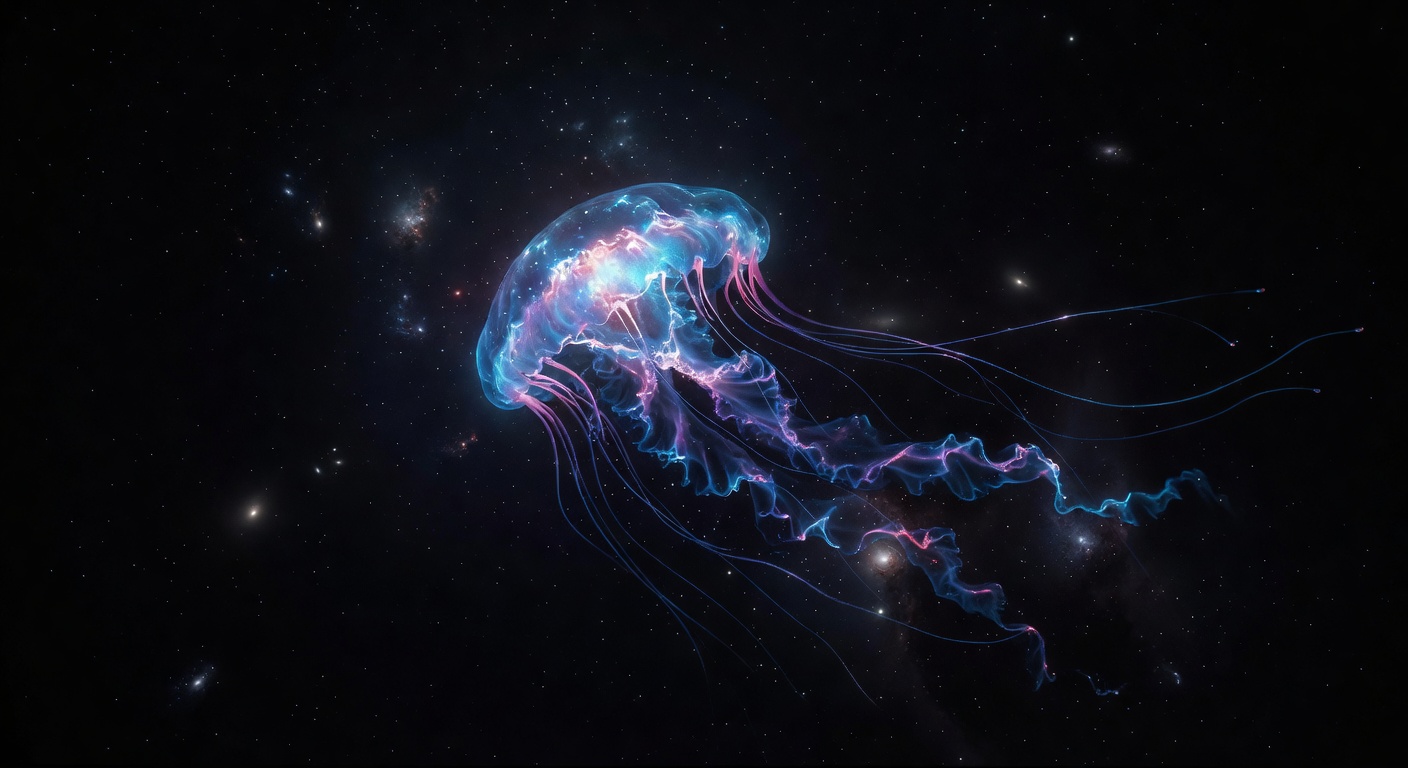
A Cosmic Jellyfish Swimming Through Space
Picture this: you're looking through the most powerful telescope humanity has ever built, peering back through time itself, and suddenly you spot what looks like a glowing jellyfish floating in the cosmic ocean. That's exactly what happened to researchers at the University of Waterloo when they were combing through James Webb Space Telescope data.
But here's the mind-blowing part — this isn't actually a jellyfish. It's an entire galaxy, complete with billions of stars, that's been stretched and twisted into tentacle-like streams as it races through space.
When Galaxies Get a Cosmic Haircut
So how does a perfectly normal galaxy end up looking like a deep-sea creature? It's all about cosmic bullying, basically.
Imagine you're running full speed through a swimming pool. The water pushes against you, right? Now picture that same thing happening to a galaxy racing through a cluster filled with incredibly hot gas. As the galaxy moves, all that surrounding gas acts like a powerful cosmic wind, literally stripping away the galaxy's own gas and stretching it out behind like flowing tentacles.
Astronomers have a fancy name for this process — "ram-pressure stripping" — but I like to think of it as the universe giving galaxies a really dramatic haircut.
Why This Discovery Changes Everything
Here's where things get really interesting. This jellyfish galaxy is so far away that its light has been traveling toward us for 8.5 billion years. We're literally seeing it as it was when our universe was just a cosmic teenager.
Most scientists thought that back then, galaxy clusters were still pretty chill places — still forming and not yet hostile enough to start ripping galaxies apart. This discovery basically says "nope, wrong!" The early universe was apparently a much more violent and chaotic place than we imagined.
Dr. Ian Roberts, who led the research, put it perfectly: galaxy clusters were already "harsh enough to strip galaxies" way earlier than anyone expected. It's like finding out that high school bullies were actually operating in kindergarten.
The Beauty in Cosmic Violence
What really fascinates me about this discovery is how beautiful destruction can be. Those glowing blue tentacles? They're not just pretty — they're brand new stars being born in the stripped-away gas. It's like the galaxy is creating something magnificent even as it's being torn apart.
This reminds me that space has this incredible ability to be both violent and creative at the same time. While this poor galaxy is getting cosmically mugged, it's also lighting up the darkness with fresh star formation. There's something almost poetic about that.
Looking Back to See Forward
The team used the COSMOS field for their observations — basically a patch of sky that astronomers have turned into their favorite cosmic window. It's positioned perfectly away from all the bright, messy parts of our own galaxy that would block the view. Think of it as finding the perfect spot on a hilltop to watch a distant fireworks show.
What excites me most is that this is probably just the beginning. The researchers are already applying for more telescope time to study this cosmic jellyfish in even greater detail. Who knows what other surprises are hiding in those ancient tentacles?
This discovery doesn't just give us a pretty picture — it's fundamentally changing our understanding of how galaxies evolved in the early universe. And honestly, I love when space throws us these curveballs that make us go back to the drawing board.
The universe clearly has more tricks up its sleeve than we thought, and I can't wait to see what we discover next.
Source: https://www.sciencedaily.com/releases/2026/03/260303050635.htm