
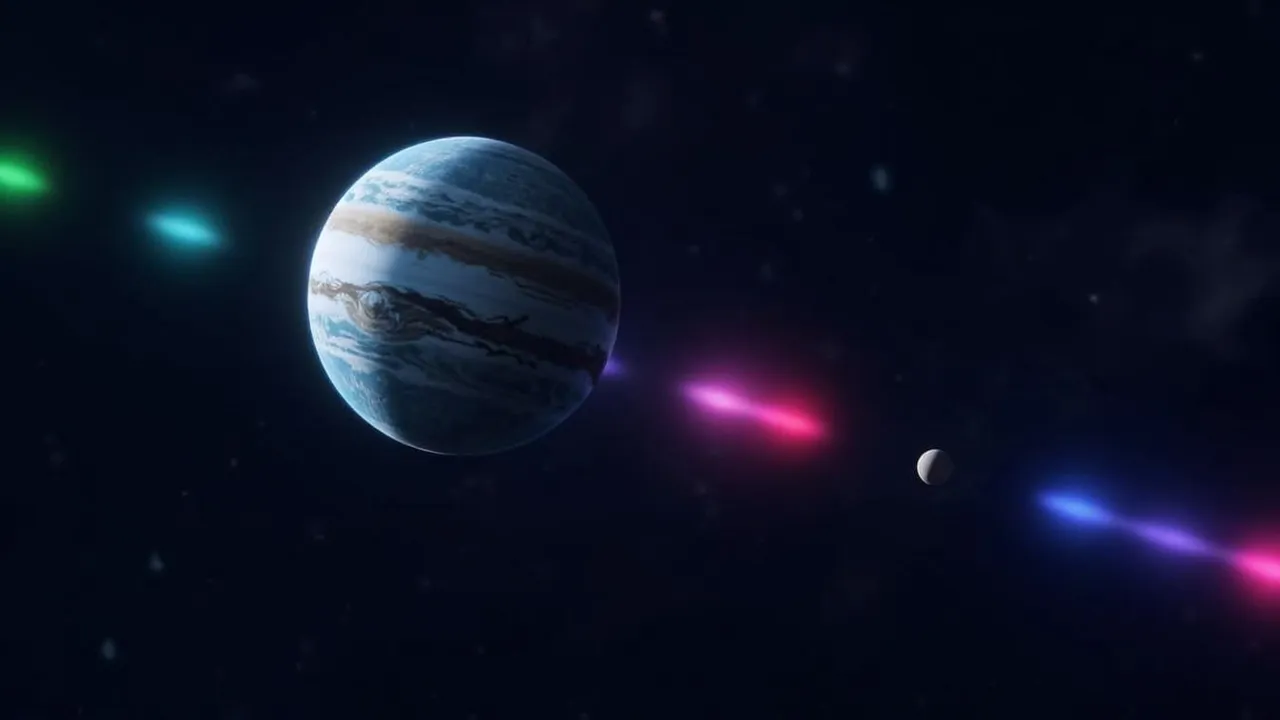
Picture this: you're watching a time-lapse of a human baby growing from a single cell. That's basically what astronomers just did — except the "baby" is a Jupiter-sized planet and the video spans millions of years compressed into a single discovery.
Scientists have confirmed the existence of Elias 2-24 b, the youngest known planet in the entire universe. And here's what makes it absolutely wild: this planet is less than 1 million years old. Our own Earth, by contrast, is a spry 4.5 billion years young. In cosmic terms, this thing just took its first breaths.
What makes this discovery even more exciting is that the planet is still hanging out in the neighborhood where it was born — a thick disk of gas and dust swirling around its young star. It's like finding a toddler still wearing the hospital bracelet. Scientists can actually study this world while planet formation is still in progress, which is basically like catching a recipe mid-cook instead of just examining the final dish.
The researchers, led by Andrea Bernardi from Universidad Diego Portales in Chile, didn't even need to point new telescopes at the sky. They dug through archived observations from the Keck Observatory in Hawaii and spotted the same faint object hanging out in the same spot in 2018 and 2020. By tracking its movement, they confirmed it wasn't just a random dust clump — it was the real deal.
Now, here's where things get really interesting for the science nerds among us. Elias 2-24 b is sitting pretty at a distance about 55 times farther from its star than Earth is from the Sun. That's way out there, people. Current planet formation models say growing a Jupiter-size planet at Jupiter's distance should take roughly 5 million years. So how did this little guy get so big so fast?
"It's like finding out a baby learned to run before it learned to crawl," said Lucas Cieza, one of the researchers. "Our best theories about how planets form simply didn't predict this."
This is exactly the kind of discovery that makes science so exciting. We're not just confirming what we already knew — we're discovering that the universe is stranger and more creative than our models suggested. It's a reminder that nature always has a few tricks up its sleeve.
The star system itself is about 450 light-years from Earth, which in cosmic terms is basically our backyard. And because it's so young, studying Elias 2-24 b gives us a glimpse of what our own solar system might have looked like over 4 billion years ago — back when Jupiter was just a baby gas giant carving out its own path through the protoplanetary disk.
Think about that for a second. We're essentially looking at a snapshot of what our cosmic neighborhood looked like before any of us existed. It's humbling and awe-inspiring at the same time.
Of course, this discovery also highlights how much we still don't know. "The galaxy churns out new stars and planets continuously," Cieza pointed out, "but we are mostly blind to these baby planets right now." The dusty disks where planets form are incredibly difficult to peer through, kind of like trying to watch someone unwrap a gift through frosted glass.
But each new discovery like this one helps us refine our understanding. Scientists will now update their models to account for how planets might form faster or in ways they hadn't considered before. And who knows? Maybe this opens the door to finding even younger planets hiding in other dusty corners of our galaxy.
The bottom line? We've just met the universe's newest planet, and it's already challenging everything we thought we knew about how worlds like ours come to be. That's pretty incredible for something that can't even legally drink cosmic milk yet.