
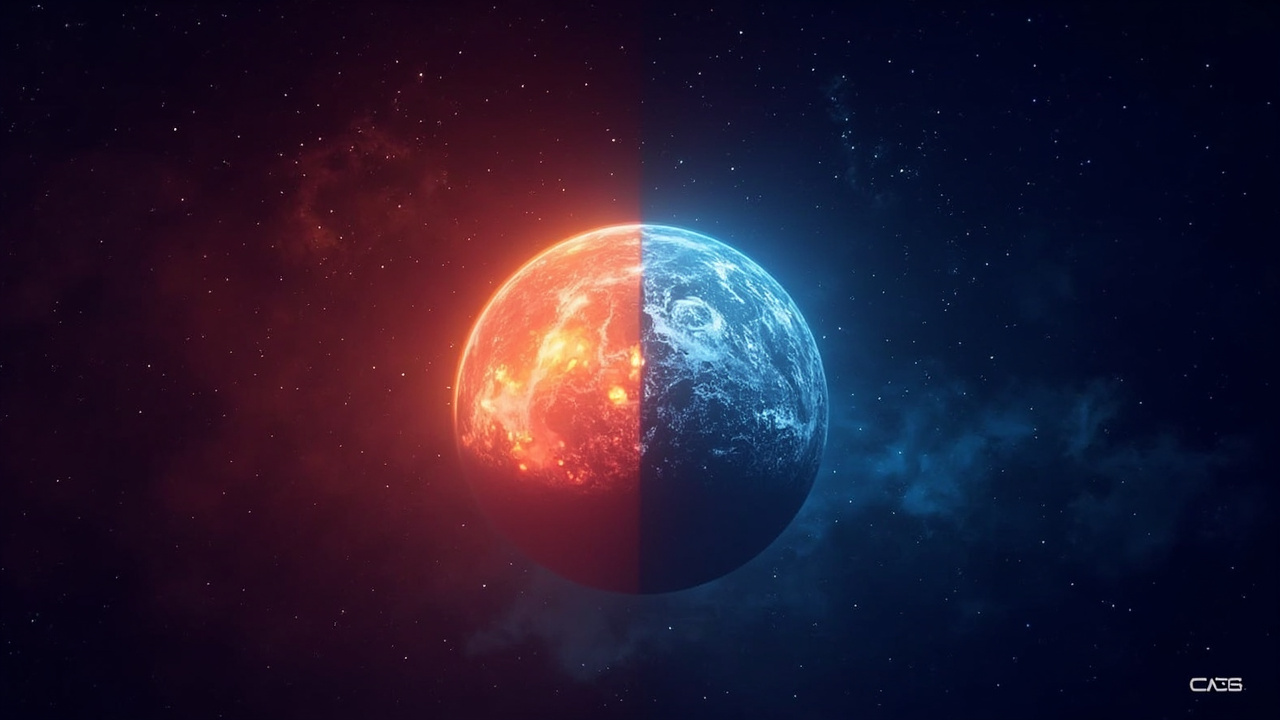
Wait, There's a Planet Where It Never Rises or Sets?
Okay, I need to tell you about something that sounds like it was dreamed up by a very ambitious science fiction writer, but is actually real.
There's a planet called LHS 3844b hanging out about 48 light-years from Earth. And it is weird.
On one side of this planet? Endless, burning daylight. The kind of heat that would make your eyeballs melt — we're talking temperatures around 2,000 degrees Fahrenheit. On the other side? Absolute darkness. Not just "it's nighttime" dark. We're talking near absolute zero, where atoms basically stop moving. You literally cannot get much colder in the universe.
And here's the kicker: this arrangement never, ever changes. There's no sunrise. No sunset. No golden hour for your Instagram. Just the same eternal day and the same eternal night, forever.
So... How Does That Even Happen?
The science-y term for this is "tidally locked," and honestly, it sounds like a punishment from a very creative deity. Here's what's going on:
The planet spins on its axis at exactly the same rate it orbits its star. So it's kind of like when you spin a basketball on your finger — one side always faces up, one side always faces down. In this case, one side of the planet permanently faces its star while the other turns away forever.
The really wild thing? This might be more common than regular planets with day-night cycles like we have on Earth. Because if a planet orbits close to its star — which many of them do — this tidal locking is basically inevitable. It's just physics being physics.
The Doom-and-Gloom Take (And Why Scientists Are Rethinking It)
When I first heard about tidally locked planets, my immediate thought was "well, that's a hard pass on that real estate." I mean, you're either frying or freezing. Where's the middle ground? Where's the sweet spot where a human — or anything alive — could potentially survive?
For a long time, scientists kind of agreed with me. These planets seemed like cosmic wastelands. Too extreme. Too hostile.
But a new study published in Nature Communications is flipping that assumption on its head, and I honestly find it kind of hopeful.
Scientists Recreated an Alien Planet in a Lab
I love this part. The research team — led by Daisuke Noto and colleagues at the University of Pennsylvania — didn't just run computer simulations. They went old-school and built a physical model.
Now, I'll save you the suspense: they didn't actually build a planet. That would've been cool, but probably outside the research budget.
Instead, they created a small tank filled with something called glycerol (very thick, syrupy stuff) and tiny particles that change color depending on temperature. Think of it like a lava lamp, but with science instead of 70s decor.
They then set up heaters and coolers to create temperature differences across the tank, mimicking the extreme contrast between the day and night sides of a tidally locked planet.
"The idea," Noto explained, "was to watch how heat moves through the interior of such a planet over time."
What They Found Was... Kinda Beautiful
Here's where it gets interesting. The experiments revealed a surprisingly organized pattern.
Hot material would rise beneath the day side, flow across the top region, cool down as it reached the night side, sink, and then flow back through the bottom. It was one continuous loop, like a planetary conveyor belt that just kept chugging along. Steady. Predictable. Almost meditative to watch.
"It's not chaotic like Earth's mantle," Noto noted. "It's slow and steady. Predictable. Kind of boring — but in a good way."
Boring, he says, is actually a win. You know what Earth's mantle is like? Chaotic. Messy. Lots of unpredictable hotspots and shifting plates. That's great for geological activity but maybe not ideal for maintaining stable conditions that life might need.
This alien system? It just... works. Like a well-oiled machine.
The Middle Ground Exists
And here's the really cool implication: this circulation pattern might create temperate zones — particularly in the mid-latitudes — where conditions could actually be reasonable. Not paradise, maybe. But maybe, just maybe, survivable.
The researchers measured heat transport rates comparable to Earth's own mantle, which suggests these planets could maintain localized geothermal environments. Think of it like standing near a warm vent in a frozen tundra. The planet as a whole might be hostile, but certain pockets could be surprisingly cozy.
What Does This Mean for the Search for Alien Life?
Honestly? I find this stuff genuinely thrilling.
We keep looking for Earth 2.0 — a planet exactly like ours, with similar temperatures, similar atmospheres, similar everything. And that makes sense. We're looking for familiar conditions because we know familiar conditions support life.
But this research suggests we might be missing the bigger picture. Life, if it exists elsewhere in the universe, might not need Earth-like conditions at all. It might thrive in places we would've written off as too extreme. It might adapt to temperature differences that would kill anything we know. It might find a way.
Scientists call this "temperate niches" — little pockets of moderation in an otherwise extreme world. And if those niches exist on tidally locked planets, then suddenly the universe becomes a lot more populated with potential homes for extraterrestrial life.
The Bottom Line
So the next time someone tells you that alien life needs a planet with beaches and blue skies and a nice day-night cycle — well, maybe tell them about LHS 3844b. Tell them about a world with no sunrise, no sunset, and temperatures that sound like they belong in a nightmare.
And tell them that, according to this new research, life might look at those conditions and think, "Hmm, not bad. I can work with this."
Because honestly? That's kind of beautiful. Life finding a way — even on a world where half is perpetually burning and the other half is colder than space. It gives you hope, doesn't it?
Now, if you'll excuse me, I need to go appreciate the fact that Earth spins just right to give us actual sunrises and sunsets. We really do live in a lovely neighborhood of the universe.