
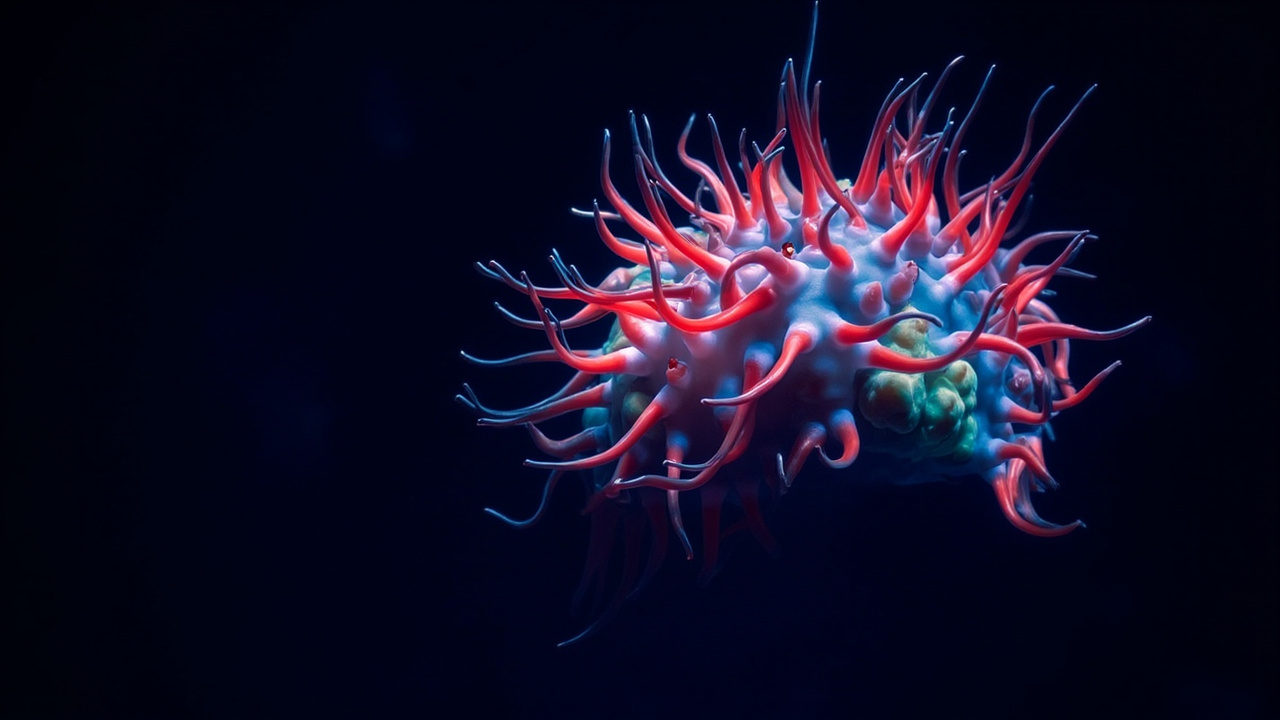
How a Jellyfish Relative Changed Our Understanding of Human Development
Here's something wild: you and a sea anemone are biological cousins in a way that's way deeper than anyone expected. I'm not talking about some distant family reunion either—I'm talking about the actual molecular machinery that builds your body.
The Problem With Sea Anemones (Or Rather, How They're Too Smart For That)
Sea anemones are basically nature's biological minimalists. They float around in the ocean with no brain, no nervous system to speak of, and no obvious "front" or "back." They're radially symmetric, meaning they grow outward from a central point like a flower or a wheel. If you've ever looked at a jellyfish and wondered which end is the head, congratulations—you've just encountered the same architectural puzzle.
Now compare that to us. We have a clear front and back, a top and bottom, a left and right. We have brains that fill an entire skull. We're what biologists call "bilaterally symmetric." On the evolutionary family tree, we're about as far from sea anemones as you can get without leaving the animal kingdom entirely.
So why would sea anemones and humans share a critical piece of body-building machinery?
Meet BMP: The Molecular Text Message System
Before I explain what researchers just found, let me set up what's actually happening inside a developing embryo. Imagine your embryo is like a blank canvas, and your cells are workers who need instructions. They need to know: "Where am I? What should I become?"
That's where BMPs (bone morphogenetic proteins) come in. They're basically molecular text messages sent throughout the embryo that tell cells their location and destiny. High BMP levels in one area? That becomes belly skin. Moderate levels somewhere else? That's where kidneys form. Low levels in another spot? That's where your nervous system develops.
The clever part is that this doesn't happen randomly. There's another molecule called Chordin that acts like a traffic controller, managing how much BMP is flowing through different regions. This creates gradients—zones of high, medium, and low BMP concentration. It's like a sophisticated biological GPS system.
The Plot Twist That Shocked Researchers
Here's where it gets interesting. For years, scientists assumed this BMP shuttling system was something that evolved specifically with bilateral animals—you know, creatures with a left side and right side. It made sense: you need a sophisticated system to build a sophisticated body plan.
But researchers at the University of Vienna just found out that sea anemones—those radially symmetric, brainless blobs—are using the exact same system. Chordin is acting as a BMP shuttle in sea anemones, just like it does in humans, fruit flies, and frogs.
Think about that for a second. Two completely different body plans, two wildly different evolutionary paths, and yet they're both using the same molecular machinery to build themselves.
What This Actually Means
The implications are kind of mind-bending. If sea anemones and bilateral animals both use BMP shuttling, then this system probably evolved before they split into separate lineages. We're talking about 600 to 700 million years ago. This makes BMP shuttling not some newfangled evolutionary innovation, but one of the oldest, most fundamental body-building systems in the animal kingdom.
It's like discovering that your great-great-great-great-grandmother's grandmother invented a cooking technique that's still being used in kitchens around the world today. Except in this case, the "cooking technique" is literally the process of building complex life.
The Mystery That Remains
Here's what's honestly fascinating: scientists still don't know if this means bilaterally symmetric body plans evolved once (in a common ancestor) or multiple times independently. The lead author, David Mörsdorf, puts it pretty clearly—we might never be able to completely rule out independent evolution. But if the common ancestor of both groups was already bilateral and already had this system, well... that changes the story we tell about animal evolution.
Why Should You Care?
Because understanding how ancient this system is helps us understand how we're built. Every time we learn more about how basic body development works, we're essentially reading our own evolutionary autobiography. And discovering that a creature that's been around for hundreds of millions of years, that doesn't have a brain, that looks nothing like us, is using the same biological instruction manual? That's genuinely humbling.
It reminds us that despite all our complexity, despite our intelligence and our technology, we're still using biological tools that evolution perfected hundreds of millions of years ago. We're not as special as we thought—and somehow, that makes it all more special.